7

Gas prices are up, food is up, but no 'inflation'

A shopper chooses organic vegetables at a grocery store.

To view this content, Javascript must be enabled and Adobe Flash Player must be installed.

Get Adobe Flash player

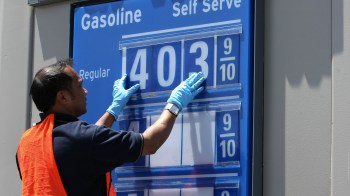
Kai Ryssdal: There are two ways to look at the inflation report that came out this morning. One is in the cold, analytical -- one might say, bloodless -- way that economists and analysts like to do it. What they call core inflation doesn't count food and energy, and it was up just a tenth of 1 percent last month. The other way is the way regular people live -- eating and driving -- like these folks.

Vanessa Robins: Everything is high, higher and highest.

Arthur Saginian: My wife does the shopping for that stuff, so I have no idea what the costs or anything else are.

Raul Banuellos: We haven't seen it yet, I think it's too early right now.

Tony Morillo: Anything that's kind of produced or manufactured has to be shipped over here, right? So oil prices are going up. It's obviously going to affect prices.

Melissa Farwell: The main thing that I've noticed an increase in that has hurt my budget the most has been gas.

That was Vanessa Robins in Washington, Arthur Saginian, Raul Banuellos, Tony Morillo, and Melissa Farwell here in Los Angeles.

The next voice you're going to hear is Marketplace's David Gura on why the government ignores the way we live.


David Gura: For one thing, if you look at energy prices and the cost of food, they bounce around a lot.

Gus Faucher is an economist with Moody's Analytics.

Gus Faucher: Gasoline prices can go up sharply in one month and then they can fall off in the next month, because of, you know, higher oil prices and global geopolitical concerns.

Lately, there's been turmoil in the Middle East. And bad weather can change food prices.

Michelle Girard is with RBS. She says that's why the Federal Reserve uses "core inflation" when it sets interest rates.

Michelle Girard: Policy makers can't just sort of say, 'OK, we need to respond to the big increase, and then when they reverse, we need to respond.' I mean, we'd have interest rates going up and down all over the place.

The Fed's powers are limited. If an earthquake or a revolution changes commodity prices, it can't do a whole lot, but Girard says Ben Bernanke and his colleagues don't live in a bubble. They know what a tank of gas costs, and what that means for the whole economy. Rising food and energy prices affect other things. If oil goes up, you could pay more for a train ticket or a new TV.

Nigel Gault, chief economist at IHS Global Insight, looks for that kind of spillover. He says prices for most other goods and services didn't go up that much, which suggests...

Nigel Gault: With consumers really being squeezed by these higher food and energy costs, they're spending power being reduced, that it's quite difficult to push through prices in other areas because consumers are going to resist.

And if they keep resisting, it could be because of the price of gas.

In Washington, I'm David Gura for Marketplace.

About the author

David Gura is a reporter for Marketplace, based in the Washington, D.C. bureau. Follow David on Twitter @davidgura
Mary Waterton's picture
Mary Waterton - Apr 16, 2011

The Fed has to deny that its money printing is causing inflation because that would necessitate raising interest rates and reining in credit as they said they would do at the first sign of inflation. But unwinding what they have done would cause the too-big-to-fail banks to fail because they still have a large volume of toxic assets on their books. In other words, the Fed wants to generate enough inflation to halt the slide in home prices and save their buddies on Wall Street, regardless of how much pain it causes on Main Street. But, in fact, it's even worse than that. The Fed is printing money so as to buy up US Treasuries to keep the US Government from collapsing. A fine mess we are in, wouldn't you say?

Gregg Henton's picture
Gregg Henton - Apr 16, 2011

Again, I don't really care if oil and food can be affected widely by political upheaval or a poor crop. Did the price go up? Yes or no. If it went up, then how much? This simple methodology needs to be the basis of all inflationary calculation. It may not be politically expedient, but my wallet doens't pay attention to political expediancy except at election time when I vote out the party that's using manipulated data to influence my vote. Figures lie and liars figure. At the end of the day, I'm thinking there's a group that wishing they had stuck with deflationary scenarios a while longer. Lower prices for everything, or high inflation that will kill the recovery as people begin cutting back on everything else in the market basket of goods used to guage consumer activities. Whoever thought that the economy was "overheating" and opted to allow inflationary pressures to run their course had other political motives, the least of which was protecting the very consumers that drive the US economy.

Jonathan Lovelace's picture
Jonathan Lovelace - Apr 15, 2011

Since we live in a somewhat free market, the Fed has no power to directly control price inflation, which is what these statistics measure. But it *does* control the single largest factor in price inflation: the size of the money supply. If the Fed creates currency inflation---as it's been doing in spades for months---prices are almost certain to rise too.

Bill B's picture
Bill B - Apr 15, 2011

The Bureau of Labor Statistics, in the U.S. Department of Labor, *does* publish inflation data that includes food and energy. The March CPI-U report is at http://www.bls.gov/news.release/cpi.nr0.htm and CPI-W is at http://www.bls.gov/news.release/cpi.t04.htm . Don't they send you press releases?

This story seems really strange; it's as though you're trying to get people angry at the Federal Reserve Bank (Fed). The Fed has to use core inflation because it sets monetary policy. But the U.S. Treasury uses CPI-U to set the TIPS rate (http://www.treasurydirect.gov/instit/annceresult/tipscpi/tipscpi_pr_cpi0...) and Social Security uses CPI-W to annually adjust benefits (http://www.ssa.gov/oact/STATS/cpiw.html).

Different applications require different indexes. A story reporting the various indexes, how they're moving and how they differ might not have the drama of a "frustrated people" story like this one, but it would be way more interesting and informative. This story was, at best, puzzling.

Sophie Allen's picture
Sophie Allen - Apr 15, 2011

But the fact that prices do go up and down is part of REALITY! It's like turning your watch back so you think you have more time. Ignoring this fact is silly. And this whole way of thinking about what is "real" needs to be re-examined, it end up being smoke and mirrors.

Peggy Martin's picture
Peggy Martin - Apr 15, 2011

I am poor, so I look at prices, closely, and my budget, after overhead (rent, insurance, co-pays, and utilities) has no extravagancies - like not even one Americano bought. No clothes - haven't been able to afford those since the downturn - when thriftstores jacked up their prices with the influx of middleclass shoppers. Just sundries and food - thats the extent of my budget - and these things have shot up dramatically. I no longer can even afford to wash my clothes at the laundromat - now it is the bathroom sink.

85% hamburger was over $7.00 a pound at Vons and Ralphs for two weeks, but I don't think that flew - now they are trying to sell 80% hamburger.
All this has left me on a diet of tuna - picked up a bunch of cans at 50 cents a piece - and chicken. And stuff I bake. Vegetables - love 'em - but a head of romaine is $2.99. I can get many more calories from chicken at that price.

It seems the very thing the gov. doesn't count towards their inlation rate calculations, are the very things that effect me and my cohorts right in the gut. And, of course, because there is "no inflation", for the fourth year running, the amount of my SSDI check will not increase.

It's all very depressing.

Frederick Theobald's picture
Frederick Theobald - Apr 15, 2011

Mr. Gura has produced a nice, timely piece. However, you folks at Marketplace so need to read my essay appearing at http://home.paonline.com/theobald/EXPECT.pdf