
12

Sioux Falls: The town credit built


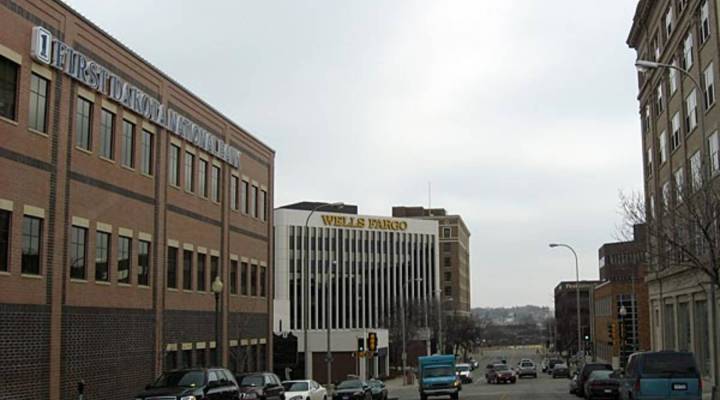
In downtown Sioux Falls, S.D., there are several banks, including First Dakota National Bank, left, and Wells Fargo.

- Stacey Vanek-Smith / Marketplace

Dacotah Bank in downtown Sioux Falls, S.D.

- Stacey Vanek-Smith / Marketplace

The ribbon-cutting for Citibank offices in Sioux Falls in 1981. From left: Gov. Bill Janklow, Citicorp CEO John Reed, Citibank President and CEO Dick McCrossen. The ribbon was decorated with credit cards.

- Photo courtesy of Citibank / Minnesota Public Radio

To view this content, Javascript must be enabled and Adobe Flash Player must be installed.

Get Adobe Flash player

The ribbon-cutting for Citibank offices in Sioux Falls in 1981. From left: Gov. Bill Janklow, Citicorp CEO John Reed, Citibank President and CEO Dick McCrossen. The ribbon was decorated with credit cards.

TEXT OF STORY

Kai Ryssdal: Next time you get a credit-card statement in the mail, take a minute and look at the address they want you to send your checks to. It'll probably be the same place a lot of the credit-card solicitations you get come from: beautiful downtown Sioux Falls, South Dakota. Sioux Falls is pretty much credit-card central. It's also one of the reasons your interest rates are so high. In the first of a two-part series, Marketplace's Stacey Vanek-Smith takes is to the town that credit built.


STACEY VANEK-SMITH: Drive around downtown Sioux Falls, and you'll see wide streets with brick sidewalks. Beautiful, turn-of-the-century architecture, some eclectic public art -- like a giant, wire cowboy boot -- and the Wells Fargo building, C&A, Bank of the West on my right, First National Bank on my left. And in my rear-view mirror, I can see First Bank and Trust. There are a lot of banks.

BILL JANKLOW: There never used to be, but there are a lot of banks now!

That's Bill Janklow. He's the former governor of South Dakota, and the man behind the bank boom. When he took office in the 70s, the country was in a recession and inflation was around 20 percent. But banks could only charge around 10 percent interest on loans and credit cards. That's because most states had strict usury laws that capped interest rates. With inflation higher than interest rates, banks were losing money every time they made a loan. Credit was drying up.

JANKLOW: I was trying to steer the ship of state through this incredible economic mess, and I got a phone call one day from Citibank directly. Citibank was absolutely bleeding to death. So were all the other banking centers.

Why was Citibank -- which is based in New York -- calling the governor of South Dakota? Because South Dakota had just passed a law that eliminated caps on interest rates. And the Supreme Court had just ruled that banks could charge interest based on where their credit-card operations were headquartered, even if the bank's main operations were somewhere else. Robert Manning is the author of "Credit Card Nation."

ROBERT MANNING: So, if you moved your headquarters to another state, you could export the interest rate of that state to any customers.

Citibank relocated its credit-card operations to South Dakota, where it could charge cardholders any interest rate it wanted to. Janklow still has a memento from the deal.

JANKLOW: What we're looking at now is a piece of ribbon, inter-dispersed on it are credit cards. And this was the groundbreaking on the first building for the credit-card operation with Citibank, which was a heck of a deal for my state.

And a heck of a deal for banks. Wells Fargo, HSBC, Target Card and dozens of others followed Citi to Sioux Falls and immediately jacked up the interest rates on their cards. Card applications went out by the millions and consumers, lured by easy money, embraced the credit-card culture.

CREDIT-CARD AD: If you need a card without going through credit checks, employment verifications or establishing a bank account...You should get one!...But I don't have a bank account and my credit, you know...It doesn't matter!

Plastic became the profit-center for big banks. Sioux Falls, where cows still outnumber people, became the back office for the booming credit-card industry. Jim Schmidt is a local county commissioner. He says before the bank boom, white-collar jobs were almost nonexistent in Sioux Falls. Now, roughly 20,000 people work in financial services. That's almost 15 percent of the population.

JIM SCHMIDT: And that employment opportunity spawned other businesses. And because of that you have incubating centers now that foster new, young businesses. The health-care industry has exploded. Our home builders are diversified.

But now, that growth may be threatened. Consumers are choking on debt and can't pay their credit-card bills. Credit Card Nation's Rob Manning says plastic is no longer a license to print money.

MANNING: This is the greatest crisis period in the history of the American credit-card industry. For the first time, banks are having trouble even selling their credit-card-backed securities, and the industry's talking about default rates of now over 8 percent.

The industry is also bracing for credit-card reform next year that will reign in interest rates and fees. And that could mean hard times ahead for the town that plastic built.

In Sioux Falls, South Dakota, I'm Stacey Vanek-Smith for Marketplace.

RYSSDAL: Stacey spent a couple of days in Sioux Falls, so we will too. Tomorrow: what the credit crisis did to the city credit built.

About the author

Stacey Vanek Smith is a senior reporter for Marketplace, where she covers banking, consumer finance, housing and advertising.

Pages

dan gallu's picture
dan gallu - Mar 24, 2011

True, the banks have never held a gun to anyone's head hen giving out credit cards, but the banks have used years of tricks to hook the consumers and ruin them for their own financial profit. At the same time, our senators, representitive, governors and other elected officials accected campaign contributions in return for the favorable laws that let them suck the blood from our bodies. Our elected officials have basically been in league with the devil (The banking industry).

thejman gee's picture
thejman gee - Feb 10, 2010

Why wouldn't credit card companies want to help individuals with bad credit by offering them low intrest rate.Simple these people will scam the system. Would you loan your money to you trust worthy family member yea, now how bout your not so trust worthy drug addict. Lets see good credit low rates bad credit bad rates. These companies are just making a few extra dollars by taking a risk on someone who might not pay them back.Would you?????????????????

da ve syverson's picture
da ve syverson - Jan 18, 2010

Haakon Maxwell:

"I wonder if the cavalier Janklow also keeps a memento from the day he killed Randolph Scott?"

Is that normal for where you are from? To keep a memento from the worst day of your life that ended an innocent man's life, your career and landed you in jail? If so, please stay there.

Back here in Sioux Falls, our Economy is down, but not nearly as bad as 99% of the rest of the Nation. The Banks have been a strong part of our Economy, but we have other industries that are doing as well. I'm not a Janklow fan, but you can't intelligently dispute the results and you can also bet that ANY Pol across the Nation would give his/her Left arm for the same impact in their district that the Banks have had here. Gov. Mickelson, who succeeded Janklow, also took the program and ran with it, as well as fought off the call for a State Income Tax. Gov. Mickelson died in a plane crash in 1993, does that inspire some neanderthal reaction of poetic justice from the likes of Mr. Maxwell also? If so, I'd invite him to seek couseling.

No one forces anyone to sign up for a Credit Card, let alone one with a high rate. People made choices and shame on them if they didn't read the terms and/or can't live with consecquences of such.

Sort of like how Mr. Maxwell made the unfortunate and idiotic choice to invoke the tragedy of Randy Scott, when in fact it has nothing to do with this story.

Walter Rutledge's picture
Walter Rutledge - Apr 25, 2009

An interesting side note, that when they change the rules, the opt-out note (back when there was a provision to opt-out) goes to an address clear across the country. Of course they then apply the change to your account anyway... But what are the details behind THAT aspect of jurisdiction shopping?

D Onanon's picture
D Onanon - Mar 27, 2009

We have South Dakota partly to thank for the overwhelming debt saddling the country's plastic addicts. This gratitude is not reserved for state's legislature; the populace puts and keeps those lawmakers in place. South Dakotans have been squeezing the rest of us for years, by allowing these games. Call me callous, but I have little sympathy for those who enabled (at best) the likes of Citibank to milk the rest of America. Where were they when the rest of the country was beginning to feel the hurt?

Don A's picture
Don A - Mar 26, 2009

To be sure, Sioux Falls has some historical relevance to the story, but the 1978 U.S. Supreme Court decision (Minneapolis v. First of Omaha Service Corp.), which ruled unanimously that under Section 85 of the U.S. National Bank Act, a bank located in one state (in that case, Nebraska) making a loan to a consumer in another state (in that case Minnesota) could charge interest rates allowed by the bank's home state. That ruling, in effect, enables the exportation of interest rates.

But South Dakota was one state that did not have usury caps, but it was NOT the only state ... Delaware was another, and a trip to Wilmington, DE reveals much the same situation, being home to credit card units for Bank of America, JPMorgan Chase, and countless others.

In fact, over the years, other states including Arizona and Nevada have also lured banks from the likes of HSBC and others, so today, South Dakota is no longer the magnet it once was.

David Newquist's picture
David Newquist - Mar 26, 2009

There is much more to the story regarding state government and its cozy relationship with the credit card banks. Through tax agreements and unclaimed property provisions the state received funds that it secreted away and would not disclose. The Governor's administration would not tell the state treasurer, who was a member of the other party, how much the funds were and where they were deposited. When agencies were urged to investigate these funds and their origins, Gov. Janklow got a law passed that made it a crime for any state official to reveal or comment upon investigation that involved a private business company. The state has other laws that permit closed records and it has no freedom of information laws. In other words, with the usury business came a financial police state. Those secret funds have never been revealed or explained, and even an open records law that passed this year does not provide for any responsible accounting for the funds or the governmental arrangements from which they originated.

Mark Mattington's picture
Mark Mattington - Mar 26, 2009

LOL Colleen, Im sure the author did not mean to offend.

My county has 8 times as many people as your village!

125,000 is a tiny town in my view.

RC Brooks's picture
RC Brooks - Mar 26, 2009

It was a shame these things were ever allowed to occur. Irresponsible government to say the least. While we all have individual responsibility, because of it's availability, many people use it in situations that present no other avenues. In effect, indenturing them to these companies at outrageous rates.

How can it be legal to be charged more in interest and charges than the original sum? Sometimes two or three times the amount? It is wrong on many ethical levels.

We all are blind from time to time, but to see the trouble these practices have caused for the people of this country and not to make some drastic changes would be a horrid failure of this democracy.

Haakon Maxwell's picture
Haakon Maxwell - Mar 26, 2009

It literally turned my stomach to hear Bill Janklow interviewed on Marketplace last night. I understand why Marketplace might think the convicted felon and former governor was worth being interviewed for the story, but he certainly wasn't necessary to it, and I'm disappointed that Marketplace decided to endorse the man's public voice by including him in the piece.

It was appalling--but not surprising--to hear that Mr. Janklow is actually proud to have dragged his state into bed with usurers. I wonder if the cavalier Janklow also keeps a memento from the day he killed Randolph Scott?

To hear it through Marketplace you'd think Bill Janklow is somehow worth listening to. He's not.

Pages







