17

The controversy over premium gas

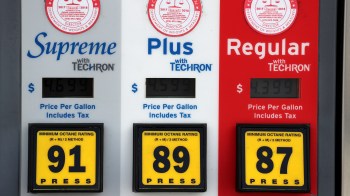
Some cars need the good stuff, others don't. Here, a gas station in Los Angeles, Calif., on March 2, 2012.

To view this content, Javascript must be enabled and Adobe Flash Player must be installed.

Get Adobe Flash player

Jeremy Hobson: Yesterday we told you the national average for a gallon of regular unleaded gasoline was $3.81. Well guess what? Now it's $3.82.

And as you may have heard, we spoke with a mechanic here in Los Angeles named Rebekah Fleischaker about some fuel efficiency tips. One of the things she said was that using premium gas would get you better mileage in the long run.

Well, many of you wrote to tell us you disagreed with that advice. So we sent Marketplace's Sarah Gardner out to do a little fact checking.


Sarah Gardner: Took me less than two minutes to find somebody filling up with premium. The first driver said her little BMW required premium gas, so she had to pay the $4.56 per gallon price tag. Same story from Dale Ingram, who pulled in minutes later in his 2002 Porsche.

Dale Ingram: So yeah, we’re at $69 for 15 gallons of gas.  It’s getting kind of crazy. I’m still kind of going, oh boy, am I really doing this?

But Consumer Reports’ Jeff Bartlett says if your owner’s manual doesn’t say your car requires premium, even if it recommends premium, don’t waste the 20 cents per gallon extra.

Jeff Bartlett: Premium gasoline has some theoretical benefits, but in the real world and in Consumer Reports testing, we haven’t seen that played out. 

Benefits like more horsepower, less wear on your engine or better mileage.

Bartlett: After all, manufacturers are spending millions of dollars to eke out just one or two more miles per gallon for their vehicles. If all they had to do was tell you to choose a different nozzle at the gas station, they would. 

But a lot of drivers in everyday cars still believe in the power of premium. The driver of a beat-up ’94 Chrysler minivan insisted to me her van shifts gears more easily because of it. But at today’s prices, she’s sticking with regular.

I’m Sarah Gardner for Marketplace.

About the author

Sarah Gardner is a reporter on the Marketplace sustainability desk covering sustainability news spots and features.

Pages

Robert Platt Bell's picture
Robert Platt Bell - Mar 15, 2012

I am not sure where you are getting this data from. Compression ratio on any automobile engine is determined by the rod length ratio, which is fixed by the crank throw, connecting rod length, and piston height. There is no such thing as a "variable compression ratio engine" for automotive use.

However, in the oil business, back in the day, they did make a test stand engine known as an octane engine, which was used to measure "engine octane". It had a movable cylinder block (relative to the crank throw centerline) and you could adjust the compression ratio while running on a test fuel, until knock occurred. And this ratio would be used to calculate "engine octane". Since those days (1960's) other techniques have come into play and octane engines are rarely used.

But this illustrates the main difference in octane ratings. Higher compression engines usually require higher octane gas to prevent knocking. Granted, almost all modern engines have a piezoelectric knock sensor to retard timing if knock is detected.

So, yes, you can run a high-compression engine that requires 91 octane gas on 87 octane. However, you will see a loss of power, as the knock sensor retards timing. I ran into this in Labrador last summer, when all they sold was 87 octane. Car ran poorly.

On the other hand, if you run an engine rated for 87 octant on 92 super-unleaded, the net effect is, well, bubkis. You are just spending more money and not getting more power or better gas mileage.

Variable valve timing has nothing to do with compression ratio. It merely optimized intake (VANOS) and exhaust (dual VANOS) timing for optimal output at a given rpm. It works well in extracting more horsepower from higher rpms out of smaller engines. BMW started using this in the 1990's and today most manufactures are now using it.

But changing valve timing does not change compression ratio. The crank throw, connecting rods and pistons maintain the same mechanical relationship to the engine block and head. Compression ratio is fixed. Period.

I am not sure where you are getting this information from about "variable compression." Such engines do not exist, outside of the lab.

And no, you don't get appreciably better mileage going to higher octane. And the subject personal measurements of one person are just empirical data.

Changing driving habits is the biggest way to save on gas, period. You can increase your gas mileage 20-50% by anticipating stops, not flooring it off the line, not riding the brakes, and slowing down and using cruise control on the highway.

im4udevco's picture
im4udevco - Mar 15, 2012

After listening to this past Tuesday's broadcast about using premium gas to improve efficiency, I somewhat disagree and that depends on your driving habits. If you solely do highway driving, yes using premium does improve efficiency. However, if you do stop/go and city driving like taxis, use "el cheapo" 87 octane. I have used premium to test this and I only got about 8 miles improvement on a 18.5 gallon tank at about 29 mpg doing stop/go/city driving. However, when I used premium, I got an extra 54 miles doing highway driving. If you do the math, are you really saving some cash? Maybe/maybe not. From an environmental standpoint, probably yes. Good for your engine? at least your engine feels high on oxygen, an extra 5% hp or so for a 140 hp engine and cleaner gasoline. How's that for premium?
On a side note about 12 years ago, I had a 88 Mazda 626 that used minimum 91 octane. I tried 87 octane and that was causing my car to run crappy. What I did was to advance the timing by extra 11 degrees to "fool" the engine in thinking that I was using 91 octane and used 87 octane since I was a student then. I am not sure you can easily do this for modern cars do to the electronics and reprogramming the PCM to shift the engine timing to achieve this.

lisamusic's picture
lisamusic - Mar 15, 2012

I use premium all the time ... in a small suv that does not "require" it. I started right after Hurricane Katrina hit MS and LA. Because power was out in many areas of Jackson MS, few gas stations could sell gas ... because they could not pump it out of the ground. There was plenty of gas, just no electricity. When I finally found a gas pump without people lined up ... I saw it was premium. I filled up anyway, being almost empty. Within the next day or so, having forgotten I put premium in my car, I noticed the car had more power ... it was accelerating much better. I was surprised, curious ... then remembered I had filled up with premium. It only costs me around $3 more per fill up ... which is worth it to me to get more power in my 4 cylinder! Plus, my car is 10 years old, so I figure premium gas may help it last longer ... and I need it to last as long as possible!

Capptainjjack's picture
Capptainjjack - Mar 15, 2012

Click and Clack have been asked this question many times over the years, and they generally agree with your comments. If I remember right, they say two things:

First, listen for "engine knock", and if you don't hear anything different from when you were using premium, then use regular. If you do, try to go up a notch, say to mid-level, and see if that helps.

Second, check your owner's manual. It almost never REQUIRES (more than just recommends) premium, but if it does, there usually is a reason

Robert Platt Bell's picture
Robert Platt Bell - Mar 15, 2012

You are likely never to hear knock in a modern automotive engine.

A knock sensor, which a sandwiched piezoelectric element, usually bolted to the engine block, listens for the sound of knocking. Before you can even hear it, it does.

This signal goes to the engine management computer which immediately retards timing to prevent knock, or pre-ignition.

The problem is, by retarding timing, you are also reducing the power output of the engine. So, if you have a high-octane engine and use low octane, the power output will suffer. Most might not notice this, except when accelerating or under heavy load, such as towing a trailer.

Will it hurt the engine? Perhaps. Manufacturers do not recommend lower octane gas unless nothing else is available.

But what about the opposite? Putting in higher octane gas doesn't make your car go any faster or get better mileage. There are a lot of esoteric volatiles put into higher octane gas (including ethanol) to increase octane and reduce detonation. It is not "watered down" as one poster suggests.

But the power output of the engine is pretty much fixed by the design of the engine - its displacement, compression ratio, fuel mixture (which today is pretty much at the stoichiometric ratio, thanks to fuel injection) and valve timing.

Putting in "more powerful fuel" isn't going to change anything, as the engine's ability to make power is really limited by its ability to pump air.

Note: Kock, or pre-ignition, is not the same as detonation. A car can knock all day long with little or no damage (most cars of the late 1970's did). But detonation - caused by a too-lean mixture, will blow a hole in a piston or throw a spark plug right out of the head, within a revolution or two. Ask anyone who raced with a Hemi back in the 1960's....

blaaapblaaap's picture
blaaapblaaap - Mar 15, 2012

Wow, very informative comments Ben_G, NCrum, and Robert Platt Bell - thank you!

I have a related question: I own a 2007 Chevy Silverado 1500 full size 4wd pickup truck (70k miles) that never really does any towing or heavy lifting. The owner's manual doesn't recommend high octane, but I have a nearby filling station that maintains one pump of NON-oxygenated, non-ethanol, premium octane (I think it's 91 octane). Would there be any benefits or any detriments of filling my truck up with that non-oxygenated fuel?

augustdeclemente's picture
augustdeclemente - Mar 15, 2012

As physicists/engineers we studied premium gas. It has less energy per unit volume than regular. Premium is "watered down" so to speak in order to reduce the pre-ignition inherent in high-compression (high-performance) engines. The power boost that the car gets from the higher compression is generally greater than the power loss that it gets from having to use premium gas. Unfortunately, many people only see the "premium gas" aspect of the design, not the high-compression aspect. So they think the additional power comes from the premium gas.

The consequence of this "watering down" is that the car needs to use a lot more premium gas in order to achieve its intended horsepower. So, it's unimaginable that you could get better gas mileage by using it. In fact, I'd expect the reverse to be true.

This may be a good question for Click and Clack

Pages