


Jensen Huang is back as Nvidia chief — and center of the stock market
After 11 days, and a stock market meltdown, Huang has been reinstated as head of the chipmaker. But what does it mean for one person to be the center of the stock market?
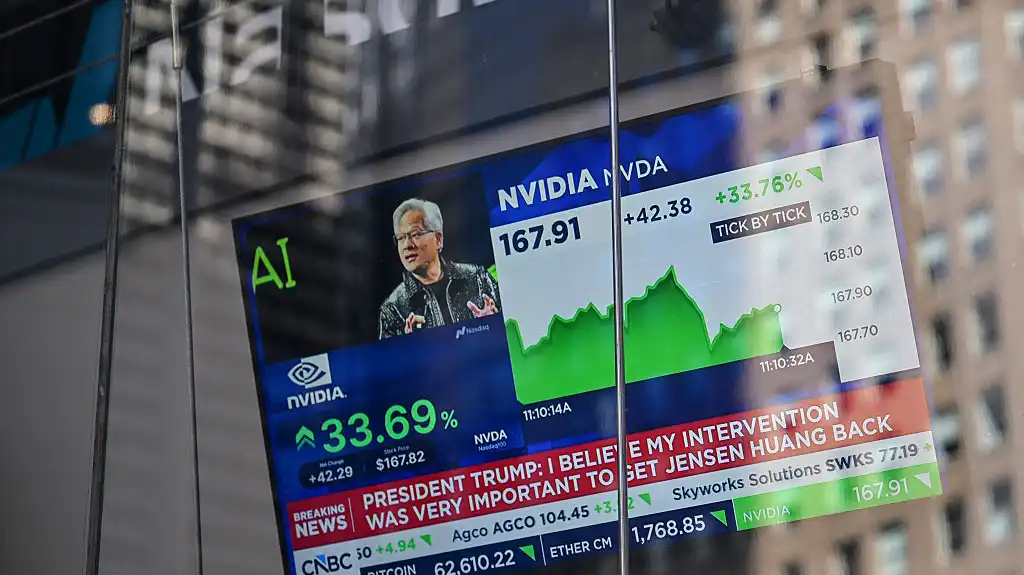
Jensen Huang was reinstated as CEO of Nvidia on Monday, just two week after he was ousted following multiple extramarital affairs — including one with an alleged Chinese intelligence asset.
The news roiled the stock market. Nvidia stock tumbled 40% between initial reports of the Chinese spy plot in late October and last Friday. Last week, the Nasdaq and Dow saw their worst weekly decline in over six years.
The Trump administration pressed Nvidia’s board to reinstate Huang, assuring them that the White House did not believe Huang posed a national security risk.
Those efforts were successful. His reinstatement as CEO triggered a market rally; the Nasdaq closed Monday up 6.5%.
To understand why an individual executive is so critical to a company’s public image — and why the federal government got involved — “Marketplace” host Amy Scott spoke to “Marketplace Tech” host Meghan McCarty Carino, who has been following the Nvidia turmoil closely.
The following is an edited transcript of their conversation.
Amy Scott: So 11 days. This has to be some kind of record for a CEO-ouster-then-return. How surprised should we be?
Meghan McCarty Carino: It apparently is a record for a public company, but listeners may be familiar with the fast turnaround of Sam Altman being fired from OpenAI a couple of years ago — also around Thanksgiving, strangely — that was only a five-day turnaround that Sam Altman was was brought back to OpenAI.
Amy Scott: Oh wow!
McCarty Carino: But so I think you know these kinds of things happen in in Silicon Valley from time to time. It's it's shocking, but maybe not surprising. Just last week during the earnings report, the Nvidia board was very unequivocal that Jensen is not coming back. But there has been sort of a mounting drumbeat calling for his return. More than 200,000 people signed this “Stand with Jensen” letter to the board. Nvidia employees, tech leaders, investors, all kinds of people, and of course, we were sort of starting to see signals from some parts of the Trump administration, including the president, that this was the preferred outcome.
Scott: Yeah, and the president is taking some credit for this. What was the board's rationale for bringing him back after saying just last week, no way?
McCarty Carino: Well, the board did say that it had received input from high levels of the U.S. government that made it confident that Jensen Huang was not a national security threat. I think clearly we're seeing the message from the markets that Jensen is very, very valuable to the company and the economy, worth, I guess, nearly a trillion dollars. But when it comes down to sort of the the arguments that have been made for restoring him to leadership, I think specifically you hear arguments about his relationships, his personal deals, his unrelenting approach to leadership and, kind of, the grandness of his vision, particularly around AI, his ability to motivate and inspire the staff. I think a lot of the loudest voices in tech making some of those arguments may often have a bit of a financial stake in some of the decisions that Jensen Huang was making and the AI economy that Nvidia is sort of holding up with its investments. We know that under Jensen Huang, Nvidia had kind of entangled itself in this web of AI investments and financing. It's likely that they would have pulled back from some of that.
Scott: Well, based on the market response today — and last week, frankly, when it looked like he wasn't coming back — what does it say that one man has so much impact on stocks?
McCarty Carino: Yeah, I mean, I think in sort of the plainest terms, it paints the picture of an economy that is not the most stable, or resilient, or balanced. Whether we're talking about one man, or this one company, or this one industry as being essentially too big to fail, I don't know if that's a sign of great underlying health in the economy. And I would point out that , yes, we saw this sell-off in the wake of Jensen's departure, and we saw this massive bounce back today. But, things were already trending down. Nvidia, you know, even before this whole Jensen scandal, had dropped about 20%. And the questions that investors had in the lead up to this have not been answered today. You know, questions about kind of the fundamentals of the AI economy in an environment where money is getting more expensive. You know, politics are changing. Those questions are all unresolved still.
Scott: Real quick before we let you go, how does this not leave a giant shadow over the future of this company and its governance going forward?
McCarty Carino: Yeah, I mean, I don't think you can draw many conclusions from this other than that. Basically, the board and governance of the company is irrelevant in the face of a CEO this powerful. When it comes to the shadow, I think that's maybe going to be another thing. I think there are a lot of, you know, politicians that are eager to to look into some of the outstanding national security issues. There's going to be constant scrutiny of the company's relationship with China going forward. So I don't think that part is over.
Related Topics


Latest Episodes
View All Shows 2 minutes ago26:04
 7 hours ago6:51
 12 hours ago10:07
 5 days ago30:25
 21 days ago29:48
 5 months ago24:33