17

The controversy over premium gas

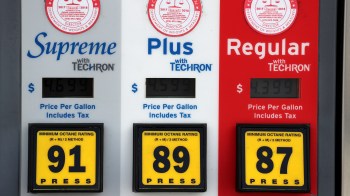
Some cars need the good stuff, others don't. Here, a gas station in Los Angeles, Calif., on March 2, 2012.

To view this content, Javascript must be enabled and Adobe Flash Player must be installed.

Get Adobe Flash player

Jeremy Hobson: Yesterday we told you the national average for a gallon of regular unleaded gasoline was $3.81. Well guess what? Now it's $3.82.

And as you may have heard, we spoke with a mechanic here in Los Angeles named Rebekah Fleischaker about some fuel efficiency tips. One of the things she said was that using premium gas would get you better mileage in the long run.

Well, many of you wrote to tell us you disagreed with that advice. So we sent Marketplace's Sarah Gardner out to do a little fact checking.


Sarah Gardner: Took me less than two minutes to find somebody filling up with premium. The first driver said her little BMW required premium gas, so she had to pay the $4.56 per gallon price tag. Same story from Dale Ingram, who pulled in minutes later in his 2002 Porsche.

Dale Ingram: So yeah, we’re at $69 for 15 gallons of gas.  It’s getting kind of crazy. I’m still kind of going, oh boy, am I really doing this?

But Consumer Reports’ Jeff Bartlett says if your owner’s manual doesn’t say your car requires premium, even if it recommends premium, don’t waste the 20 cents per gallon extra.

Jeff Bartlett: Premium gasoline has some theoretical benefits, but in the real world and in Consumer Reports testing, we haven’t seen that played out. 

Benefits like more horsepower, less wear on your engine or better mileage.

Bartlett: After all, manufacturers are spending millions of dollars to eke out just one or two more miles per gallon for their vehicles. If all they had to do was tell you to choose a different nozzle at the gas station, they would. 

But a lot of drivers in everyday cars still believe in the power of premium. The driver of a beat-up ’94 Chrysler minivan insisted to me her van shifts gears more easily because of it. But at today’s prices, she’s sticking with regular.

I’m Sarah Gardner for Marketplace.

About the author

Sarah Gardner is a reporter on the Marketplace sustainability desk covering sustainability news spots and features.

Pages

blaaapblaaap's picture
blaaapblaaap - Mar 20, 2012

What about non-oxygenated premium (91 octane) gasoline? Where does it fit into this equation? Does it provide any benefits for modern, non-high performance vehicles?

dsheib's picture
dsheib - Mar 17, 2012

There's an excellent Car and Driver article on this subject at http://www.caranddriver.com/features/regular-or-premium where they actually dyno tested various cars and trucks.

dfreier's picture
dfreier - Mar 16, 2012

New car engines are now sporting higher compression ratios above 10:1.
Especially small cars with Direct injection and/or turbo-charging.
Not much help when trying to save money on commuting , but if these new cars
were to be FFVs, and able to use E85 or some higher blend of ethanol, a new level of
mpg performance may be available than traditional engines . And if the price of
e85 starts coming down below 3.00/gal, even better yet..

ararla's picture
ararla - Mar 16, 2012

I don't quite understand all the science behind the burning of the gas, but I do know my 1998 Infiniti NEEDS premium. When gas prices started to rise I purchased regular instead of my usual premium. I had to put an extra $25 in that week to make it to the weekend. Regular gas burned more quickly and I did not deviate from my normal driving patterns.

marc0p0l0's picture
marc0p0l0 - Mar 15, 2012

Winter or Summer maters: I've noticed my car does much better on the Winter Blend than the Summer Blend of gasoline in Texas....

Ben_G's picture
Ben_G - Mar 15, 2012

As someone with a minor in chemistry, I can answer this. Performance differences with gas octane have to do with 3 things:

1. Engine Design
2. Engine Load
3. Engine Age/Maintenence

The one common thread between those is compression. Engines can be designed with different compression, higher engine load can cause higher compression, and older engines with carbon deposits can have higher compression.

Higher compression = more likely knocking ("detonation") with lower octane. Knocking causes incomplete combustion, loss of power and mileage, and engine damage. So the higher octane will burn more completely and provide more power and lower emissions and better gas mileage than a detonating engine with lower octane fuel.

Engine load is often overlooked. Sometimes an overloaded car with a small engine (that's maybe also facing a lot of steep hills) will see a noticeable performance increase with higher octane. It's kind of counter-intuitive for people to think that a fully-loaded 3-cylinder GEO will see more benefit from high octane than a 6-cylinder Camry, but that may very well be the case, since that GEO is running at close to 100% load at high highway speeds, while the Camry may be only at 33% load. It all depends on the driving conditions.

What's more is that your car's computer often adjusts things to reduce knocking in a way that reduces power. If you're suffering power loss in this way, then higher octane will restore the power loss, but whether your gas mileage improves in that case is dubious.

Hope that helps.

NCrum's picture
NCrum - Mar 15, 2012

Premium gas has zero practical mpg advantages. It never has - it never will. There is no more energy in premium gas than regular. In fact - in blended fuels like E85 which have an AKI octane rating around 96 - they have considerably less energy per unit volume than gasoline and will result in significantly lower fuel economy.

However - they CAN provide higher power output by enabling the engine to run at higher compression ratios. This can be achieved to some degree in modern high compression naturally aspirated engines (like the above mentioned Porsche & BMW) through variable valve timing and intelligent ignition/fuel delivery and it can be achieved to a much greater extent in forced induction (turbo/supercharged) engines which have much more control over combustion pressure.

This higher efficiency / high pressure thermodynamic cycle can in theory yield better overall mechanical efficiency vs. an engine that cannot utilize the higher pressure cycle. A gasoline engine designed to run in this pressure range really does require high octane fuel or it will result in early detonation of the fuel/air charge in the cylinder. Modern engines can sense this detonation and retard timing (and intake pressure in FI engines) to protect your engine from damage should you fill up 1 tank accidentally (or in an emergency) with lower grade, but doing it consistently is a bad idea.

A good modern engine not designed to utilize high octane fuel though might only gain minuscule power output from sensing no knock and allowing the engine timing to advance all the way forward. An older or lower performing engine might not sense the difference at all and may actually run worse on the slower burning premium fuel. At best, the power gain vs. added fuel cost will not be justifiable in terms of economy, but if you absolutely want to have that last 1-5 hp out of your engine - go for it - it's your money.

Robert Platt Bell's picture
Robert Platt Bell - Mar 15, 2012

You are correct, but are confusing knocking (pre-ignition) with detonation. They are NOT the same thing.

Detonation is caused by a too-lean fuel mixture, a near-impossibility in today's cars, where the air/fuel mixture is fairly tightly controlled to the stochiometric ratio of 14:67 to 1, thanks to fuel injection (and please, shout down anyone who tries to tell you than "carburetors were better!")

If a car exhibits detonation, it usually blows out a piston within a revolution or two.

As the name implies, detonation occurs when the fuel/air mixture literally explodes in the cylinder. In a normally running engine, this mixture does not explode, but rather burns in an even and orderly flame front which propagates through the cylinder. There is no "bang" but rather an internal combustion. Hence the name.

Knocking or pre-ignition is, as the latter name implies, an early combustion of the engine which occurs when the compression ratio is too high for the fuel involved. The fuel ignites before the spark, which can cause a number of problems, including very poor performance.

Retarding timing reduces or eliminates knocking, and modern engines do this automatically. So you rarely hear "knock" anymore, you just lose power.

It is a common thing - people throw around the terms detonation and knocking interchangeably. But they are not the same thing.

NCrum's picture
NCrum - Mar 15, 2012

Kind of splitting hairs aren't you? In my experience knocking is synonymous with detonation. Pre-ignition is something else entirely. I've heard people use detonation to alternately describe pre-ignition though. Obviously that wasn't what I was referring to, although excessive intake pressure and/or lower than expected octane can cause pre-ignition too. If you you think it's impossible, you obviously haven't owned very many turbocharged vehicles.

artificer's picture
artificer - Mar 15, 2012

Everyone is assuming that the compression ratio in modern engines is set by the manufacturer, and that will control how much octane your fuel needs. This was true on older engines. Anything with a turbo can have higher compression ratios, so can use higher octane for more power or better mpg's. Engines with variable valve timing can also change their compression ratios to match the fuel. Higher compression ratios tend to give better mpg. With meticulous record keeping, I have seen a VW Passat get several mpg better with premium gas. Does the extra mpg offset the extra cost? You have to run your own numbers. $4/gal gas, 30mpg will cost you $0.13/mile. 2mpg better mileage will save you $0.26/gal... and that tends to pay for the premium gas. If your engine does not have advanced compression controls or a turbo, then you will probably not see a difference. Since mileage is such a big deal now, if your engine is relatively new, it probably has these features, and it would make sense to use premium.

Pages