
3

NYC private hospitals to get big bill for ambulances


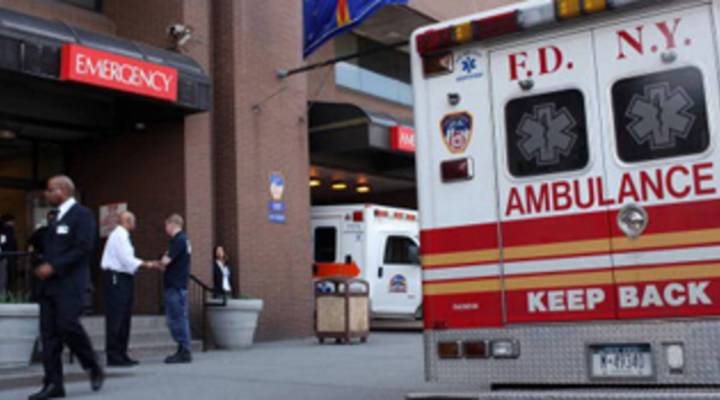
An ambulance is parked in front of St. Vincent's Hospital on April 7, 2010 in New York City. On Tuesday the board of St. Vincent Catholic Medical Centers voted to close the hospital following its unsuccessful search to find a way out of its estimated $700 million of debt. The Westside hospital, which has served Manhattan for 160 years, may retain some of its services like an urgent care facility.

To view this content, Javascript must be enabled and Adobe Flash Player must be installed.

Get Adobe Flash player

TEXT OF STORY

Tess Vigeland: State and local governments are trying just about anything these days to get their budgets out of hock. Arizona is cutting back on funding for medical transplants. Cities are inviting corporations to slap their names on everything from subway stops to playgrounds.

The latest sign of desperation? New York City wants private hospitals to pay up to $1 million a year to have their ambulances respond to 911 calls. New York's bravest don't have enough ambulances, so 25 city hospitals help pick up the slack. Needless to say, this move is opening some fresh wounds.

Marketplace's Stacey Vanek Smith reports.


Stacey Vanek Smith: It's a sound you hear a lot if you live in New York.

Sirens

To many private hospitals, that now sounds like a bill for $1 million, or more.

Terry Lynam: We anticipate this would cost us about $1.5 million.

Terry Lynam is with Northshore LIJ health systems, which operates several New York hospitals and dozens of ambulances. Under the new plan, when a 911 call gets passed to one of its ambulances, Northshore would have to pay.

Lynam: Our hope is that there will be efforts made to reduce this burden.

Some hospitals are threatening to stop taking 911 calls. Dr. Lewis Marshall chairs emergency medicine at Brookdale Medical Center. He says the new fees would cost his Brooklyn hospital nearly $300,000 a year. Marshall says if hospitals like his opt out, residents will suffer.

Lewis Marshall: It would reduce the availability of ambulances. I think that the waiting times for ambulances would go up.

The city says that private hospitals benefits by being part of the 911 network and should share in the cost. More and more cities are charging fees for emergency services, as they scramble to plug holes in their budgets. Chris Hoene is the director of research at the National League of Cities.

Hoene: The emergency services budgets tend to be a part of larger public safety budgets and those are often times the single largest category of expenditures in city governments.

Hoene says many cities have started charging residents for 911 calls -- at times, hundreds of dollars for a ride to the hospital.

In New York, I'm Stacey Vanek Smith for Marketplace.

About the author

Stacey Vanek Smith is a senior reporter for Marketplace, where she covers banking, consumer finance, housing and advertising.
Scot Phelps's picture
Scot Phelps - Jan 13, 2011

Please keep in mind that the term "private" does not equal "for profit". All hospitals in New York City that have an emergency department, public and private, are non-profit. HHC hospitals, commonly referred to as "city" or "public" hospitals, are actually run by New York State as a public benefit corporation. The remainder are federal (the VA Hospitals in Brooklyn, Manhattan, and the Bronx), state (SUNY Downstate) or independent non-profit organizations.

Most hospitals have a 100 year tradition of emergency ambulances. The HHC hospitals had their ambulances go from direct supervision by the hospitals to central supervision in the 1970s, then to management by the Fire Department about 10 years ago (at the time they were still technically owned by the hospital system because Medicare paid more for that and special state permission was needed).

The crux of the matter is that NYC has BARELY ENOUGH ambulances for daily needs- no extras when a 9/11 or a snowstorm happen. To make matters worse, the closure of over a dozen hospitals in the past 15 years means that a lot of ambulances were lost (Cabrini-3, St Vincents-3, St Clares-3, Mary Immaculate-4 (?), St Marys-2, St John's 2, etc).

Ask you local Councilperson EXACTLY how many ambulances you community has at any given time. I'll bet they can't get you a straight answer.

Scot Phelps

Ryan McMahon's picture
Ryan McMahon - Dec 14, 2010

I am an EMT for a NYC private hospital, I would just like to say if the City charges these private hospitals up to a million dollar fee for volunterily putting ambulaces into the system to service the communities they are in, who is going to pay for all of this since private hospitals cover 40% of the 911 system now. Not a dime of your tax dollar goes to private hospital ambulances, but your taxes do pay for FDNY ambulaces and how much will taxes go up when they have to so called "pick up the slack" of 40% they currently do not cover. They also are not staffing the ambulances tours they have 100% currently, so how does anyone think for a second they will just step right in and cover all of these tours if the City is making million dollar budget cuts, lets get real. The City is draining itself. Some of these private hospitals have there own telemetry Doctors and do not use FDNY for telemetry. So will the City be charging the City hospals for ambulances since every City owned hospital has an FDNY ambulance base called a station or battalion? Hospitals will pull their ambulances out of the system because they won't be able to afford this fee, which means more City ambulances which means hire taxes to pay for all of this which really mean job security for FDNY at your expence. WELCOME TO NYC!

Angel Acevedo's picture
Angel Acevedo - Dec 9, 2010

Nyc charges 600+ to be transported by a ambulace and has for years NYC ALSO has one of the busiest ems systems in the country Who is over worked and under paid emt and medics







