

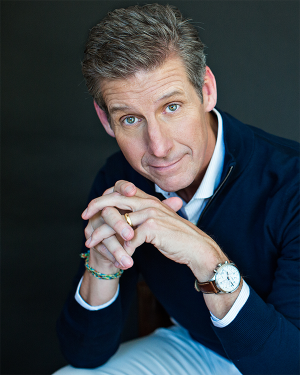
EXECUTIVE SNAPSHOT
WHO: Sprint CEO Dan Hesse
EDUCATION: Holds masters degrees from the Massachusetts Institute of Technology (science) and Cornell University (business) and an undergraduate degree from Notre Dame.
NOTABLE: Named “Most Influential Person in Mobile Technology” by LAPTOP Magazine.
Kai Ryssdal: What do you do if you’re a distant third in one of the most dynamic parts of the technology industry? That’s the question Sprint has been wrestling with since it merged with Nextel back in 2005. You could say that deal turned out to be one giant dropped call after another. The new company struggled with network problems and customer service complaints. It lost millions of customers and billions of dollars.
So two-and-a-half years ago, a guy who used to run AT&T Wireless was hired to turn things around.
Today on “Conversations from the Corner Office,” Sprint CEO Dan Hesse. He’s the face of the company, quite literally. You have probably seen him in the company’s television ads.
When we talked in New York on Monday, I asked him how he’s going to get all those lost customers, and their lost dollars, back.
Dan Hesse: Well there’s a number of things that play into a customer’s decision of either staying or leaving. Number one is who has the device or phone that I really want. Part of it also, increasingly, is the family. I might love my Sprint phone, but there’s one person in the family that just maybe has to have the iPhone, and so the whole family goes over — if I may use that as an example. What I’m hoping is that one person in the family has to have an Evo.
Ryssdal: About this whiz-bang new phone you guys have, this is now supposed to be the only 4-G phone in the world, the Evo by HTC. Kind of seems like you’re betting on this one to bring back those iPhone users and everybody who got away.
Hesse: Well, we hope so, and it is important to be on the leading edge. And we think that 4-G, anybody who wants mobile video…
Ryssdal: You have one right here. Let’s pull it up, we’ll do a little show-and-tell.
Hesse: Boy, this thing does so much, I don’t know where to start.
Ryssdal: Well, pick one. When you pick this thing up and play with it, what do you do?
Hesse: I typically do e-mail. So I go there, and there’s my e-mail. I go out of that, I go to my messages, which are my text messages.
Ryssdal: And it’s a nice crisp screen, and it’s big and fancy and all that.
Hesse: I hit this button, I go to my tons of applications. And they have so many. My favorite probably is Google Goggles.
Ryssdal: I don’t know what Google Goggles is.
Hesse: Take a picture of anything, like a wine label, and it’ll automatically come back with all the search results.
Ryssdal: So what all this tells me — I mean, you’re hauling around these two really nice new smartphones — it tells me that here’s a guy who runs a major wireless network company. In a lot of ways, it’s all about the toys, it’s all about the gizmos on the other end.

Hesse: It’s getting more and more that way each year. And it’s actually one of the challenges for the industry, because these are heavily subsidized. The average user doesn’t know that these are $500 and $600 phones. They think that they’re $100 and $200 phones. And that’s why they say, “Why do I have to sign a two-year contract?” Well, it’s because you are making a down payment. You’re not really buying a phone, you’re making a down payment on the phone.
Ryssdal: So if Steve Jobs came to you tomorrow and said, “Dan when our contract with AT&T expires in a couple of years, we would like you to have the iPhone contract.” How long would it take you to jump on that deal?
Hesse: Well, I would want to see what the deal was.
Ryssdal: Oh gosh, come on!
Hesse: Of course it’s a great device, and I would be very interested. But everything has a cost and a price.
Ryssdal: Seems that everybody in this country over the age of 11.5 has a cell phone, and there’s not so much room to grow in the actual cell phone part of the mobile phone market. How do you guys grow then, I mean where is the growth opportunity for you if you can’t get more cell phones into people’s hands?
Hesse: Penetration in the Unites States right now is 91 percent, which is high, and it’s a very good question: How do you grow? First, if you just look at the phone piece of the business, the pre-paid market is growing very rapidly. That’s people who don’t have a phone. Part of it is because if your credit score isn’t high enough, we won’t sell you a phone unless you go pre-paid, because basically we are a bank when you come in and sign a two-year contract.
Ryssdal: You’re financing that phone.
Hesse: We’re financing the phone. Then there’s what I call the inanimate objects that will start to carry wireless chips. What we call “machine-to-machine,” meters, vending machines, you can go right down the list. Your cars will have wireless chips, where they’re monitored all the time. And that’ll give us revenue on our network. So there’ll be many more devices that are connected to the wireless network than there are people. So, the concept of penetration is how many people have a cell phone won’t be as important, because penetration could be 300 percent, 400 percent in terms of the number of devices that are connected to the mobile network, more than just what we would call a “phone,” although they’re hardly a phone anymore.
Ryssdal: No, I know. When you guys have your Monday morning ops meetings, when you get together…
Hesse: Monday afternoon.
Ryssdal: Monday afternoon, not morning? All right, you’re not a morning guy. How frequently do the phrases AT&T or Verizon come up? Do you think actively about the leaders in the field?
Hesse: Oh absolutely. All the time. And T-Mobile would be the other third major competitor. There’s three big national competitors and we benchmark ourselves and compare ourselves and compare rate plans and devices against those three all the time.
Ryssdal: All right, well given that then, since the gap between you and the industry leaders is so large, is catching up something you are thinking about or are you trying to keep the pace?
Hesse: Well, I just look at having a good successful, viable, growing company that does well for our shareholders. So is Apple one of the biggest cell phone makers in the world? No. Number one in computers? No, but I think their shareholders have done pretty darn well. You don’t have to be a RIM, you know, Blackberry. They’re not one of the big monster guys. They’re not one of the top three, but they’re a very profitable growing company.
So people ask me, “Boy Sprint, boy you’re only $36 billion in revenues, do you think you are big enough to make it?” I think so. I think we are number 57 in the Fortune 500 list. We’re roughly half the size of Verizon and AT&T. Do I think it’s likely in the near future that we are going to catch them in size? No. But if I can keep improving our financial performance, we’ll have satisfied shareholders and employees.
Ryssdal: Dan Hesse from Sprint. Thanks so much for your time.
Hesse: Thank you, Kai. It’s been a pleasure.
Read the full interview with Sprint CEO Dan Hesse.
Stories You Might Like


There’s a lot happening in the world. Through it all, Marketplace is here for you.
You rely on Marketplace to break down the world’s events and tell you how it affects you in a fact-based, approachable way. We rely on your financial support to keep making that possible.
Your donation today powers the independent journalism that you rely on. For just $5/month, you can help sustain Marketplace so we can keep reporting on the things that matter to you.









