


This is how much more you're paying for candy this year
Since the pandemic, some candy has nearly doubled in price when you break down the cost per ounce.

You're not imagining it: Candy prices are not only going up, but you might be getting fewer chocolates in your bag, leaving you to deal with both inflation and shrinkflation.
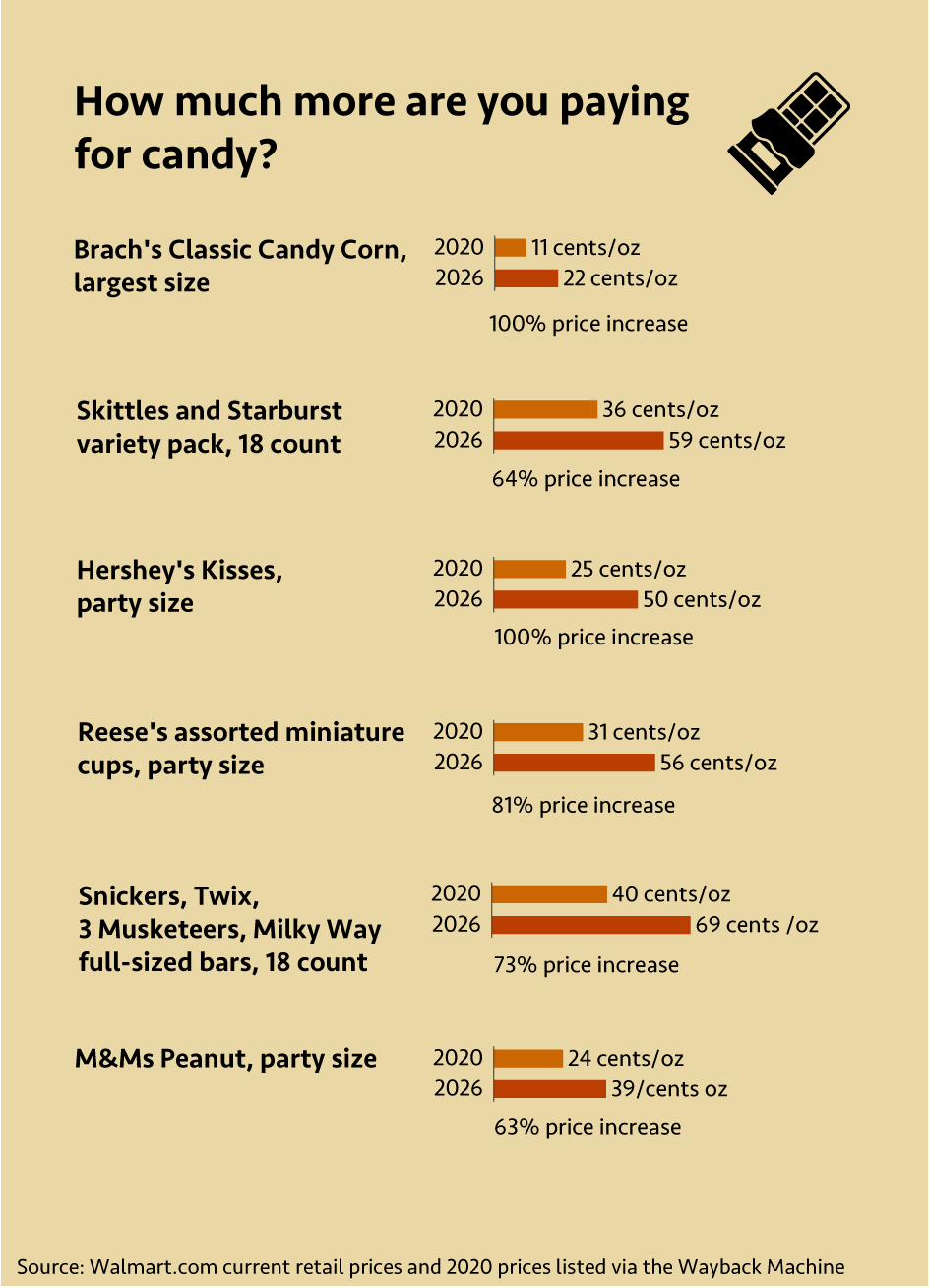
Overall, the price of candy and chewing gum has risen by more than 47% since 2020, according to the Bureau of Labor Statistics' Consumer Price Index. Marketplace looked at price changes for popular chocolates and candy between 2020 and 2026 using the Wayback Machine, finding that some products rose even more, with prices increasing between 60% and 100%.
A party-size bag of peanut M&Ms weighing 38 ounces retailed for $8.98 at Walmart back in 2020. In 2026, the price rose more than 65%, jumping to $14.84.
In recent years, candymakers have faced rising sugar and cocoa costs, leading to pricier Skittles and Snickers bars.
To mitigate costs, some companies have decided to skimp on the chocolate by opting for gimmicky flavors like pumpkin spice latte cream and peanut butter-berry. Or they've reduced the size of their packaging so that they can maintain the same price while offering you more, a process known as shrinkflation. In some cases, the packaging is getting smaller and prices are still going up.
A bag of party-size Hershey's Kisses weighed 35.8 ounces in 2020 and retailed for $8.98 at Walmart. Now, the party size weighs 30 ounces and costs $14.92. That's a 66% price increase. But if you look at the cost per ounce, the price actually doubled, rising from 25 cents an ounce to 50 cents an ounce. The largest bag of Brach's Classic Candy Corn shrunk from 44 ounces in 2020 to 34 ounces in 2026. But the price per ounce doubled from 11 cents to 22 cents.
Here's a look at some candy price changes over the past several years.
Click here to read more about our methodology.
Prices were calculated by dividing cost per total weight. Total weights are as follows. M&Ms peanut party size: 38 ounces in 2020 and 2026. Snickers, Twix, 3 Musketeers and Milky Way full-size candy bars, 18 count: 33.31 ounces in 2020 and 2026. Reese's party-size assorted miniature cups: 32.1 ounces in 2020 and 26.6 ounces in 2026. Hershey's Kisses, party size: 35.8 ounces in 2020 and 30 ounces in 2026. Skittles and Starburst full-size, 18-count variety mix: 37.05 ounces in 2020 and 2026. Brach's Classic Candy Corn, largest bag available: 44 ounces in 2020 and 34 ounces in 2026.
Chocolate candy manufacturers faced an unusually severe "cocoa shock" in 2024 that continues to have ripple effects, said Alexis Villacis, an assistant professor of agricultural economics at Ohio State University.
West Africa, which produces about 70% of the world's cocoa, faced crop disease and simultaneously experienced heavy flooding and dry weather. Those fluctuating conditions were largely connected to El Niño and exacerbated an already-growing cocoa bean deficit.
New York-traded cocoa futures hit $12,000 a ton in late 2024, a massive leap from 2020, when prices ranged between $2,000 and $3,000.
Prices have fallen from their record highs and futures are now trading around $5,400 a ton. Manufacturers will store inventory months in advance, so even though cocoa prices have declined, shoppers have yet to reap the benefits because candy makers are still using cocoa they purchased in 2025, Villacis said.
Cocoa production in Ghana has been forecasted to fall next season due to unfavorable weather partners and disease. Those expectations likely keep candymakers from reducing prices, Villacis said.
Sugar has also faced supply constraints. India and Thailand, which are major producers, saw drier weather due to El Niño's weather patterns, leading to less sugar production between 2023 and 2024. Brazil, the largest sugar exporter, has faced shipping challenges, and Mexico, another exporter, has experienced droughts in recent years.
Sugar futures also rose this year as people anticipated El Niño disrupting sugar production again, said John Saldanha, a global supply chain management professor at West Virginia University. In September, sugar prices climbed 6.1%, marking the third consecutive monthly increase.
Other costs have gone up, including fertilizer and diesel fuel (which increases transportation costs), Saldanha said. The Iran war has also inadvertently led to sugar constraints, since the Arabian Peninsula exports the sweetener.
"Closing off the Strait of Hormuz has shut off basically 5% of the world's supply of refined sugar," Saldanha said.
Costs are going up everywhere, and your favorite treats are no exception. But that won't prevent trick or treaters from getting candy when they arrive on doorsteps.
Candy is still the most popular Halloween purchase, according to an annual Halloween survey from the National Retail Federation. Ninety-six percent of consumers plan to buy treats, amounting to $4.1 billion in spending.


Latest Episodes
View All Shows 6 hours ago7:49
 12 hours ago21:12
 12 hours ago5:12
 a day ago25:20
 2 days ago27:55
 4 months ago24:33