


Social media, YouTube, and the “golden age” of meteorology
A growing number of meteorologists are taking a non-traditional path, making a name and a living, doing the weather online.
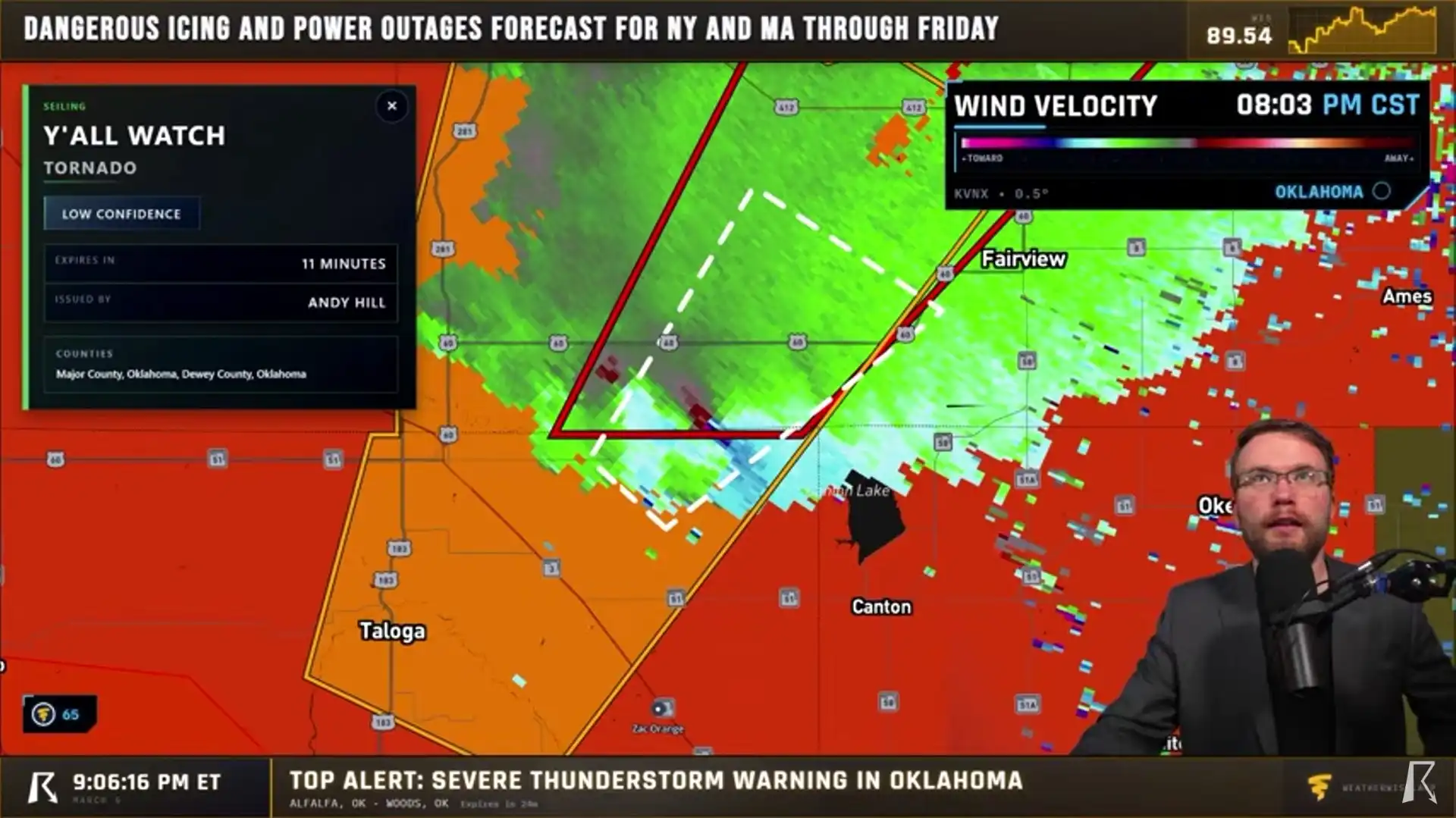
Around noon on the second to last Sunday in February, as a massive snowstorm was getting going along the East Coast, Ryan Hall went live on YouTube. He stayed live, updating the forecast and checking in with storm chasers, officials and viewers, for a solid 10 hours before signing off for the night. The next morning he was back before 7 a.m., for another full day of live coverage of what he called the “full-dumpage snowicane.”
Hall runs one of the most popular weather accounts on social media and YouTube, where he has more than 3 million subscribers. It started as a hobby early in the pandemic.
“I didn't think it was going to turn into anything, and here we are, about five years after that,” he said with a laugh, “we took off insanely.”
Hall has been into meteorology since he was a kid, and thought he’d get a degree in it and go the TV weatherman route. When he got a job at a local television station in college, though, he realized it wasn’t for him.
“I did not like the TV world at all,” he said. “I didn't like the fact that I had to shave my beard and look a certain way, and people were telling me I needed to fix my accent a little bit, even though I was in Eastern Kentucky on that TV station.”
He also didn’t like the constraints of television news, and how little time meteorologists actually got on air to talk about the weather. So he quit — both the job and school — and did other things for a while before starting his YouTube channel.
“One of our first streams for severe weather was the Mayfield, Kentucky, tornado, which is one of the deadliest and worst tornadoes the United States has seen in a very long time,” Hall said. “We were live for that while a lot of other networks weren't, because it was like in the middle of the night, and we helped a lot of people that night.”
It was after that, in 2021, that his channel, Ryan Hall Y’all, exploded and he started doing it full time. These days, he said it generates millions of dollars a year, through ads, sponsorships and merch, and employs about 30 people, both full time and contract.
“I say I took a non-traditional path into meteorology,” Hall said. “And I think it's opened up a door to where this is a real career path now for people who want to get into doing the weather not on TV.”
A growing number of degreed meteorologists and self-taught weather enthusiasts are taking that non-traditional path, trying to make a name, and a living, doing the weather on social media. Hall is an outlier — few accounts are as big or bring in as much money as his. But with audiences increasingly turning to social platforms rather than television news for forecasts and weather coverage, many are having success.
“I always say we're in the Golden Age of meteorology,” said Steven DiMartino, a meteorologist based in New Jersey. “Because so much data is at your fingertips, and so much opportunities are at your fingertips.”
DiMartino started posting forecasts online for New York, New Jersey and Pennsylvania back in 2007, “when YouTube was, like, cat videos and Twitter had, like, five people on it.”
He recently became one of the first people to earn a Digital Meteorologist Certification, which the American Meteorological Society developed in the last couple of years to help identify forecasters and accounts on social media that offer accurate weather information.
DiMartino has always had other jobs, in addition to running NY, NJ, PA Weather, but today he has tens of thousands of followers on social media and is at a point where he could do it full time.
“It's kind of like a 20-year overnight success type thing,” he said. “I always tell young meteorologists, look, build this, but also have other income to supplement while you're building it.”

“It takes time,” DiMartino said, “because what you're doing is you have to build trust.”
Trust is key in a world where anyone can post a forecast on the internet, and where getting accurate information can be life-saving in the case of extreme weather.
“Social media is kind of a choose your own adventure during weather events,” said Matt Lanza, one of the meteorologists behind the popular Space City Weather account in Houston, and The Eyewall, which has a national focus. (Lanza also still has a full time job, as a forecaster for the energy industry.)
For anyone who likes to get their weather on social media but is wondering how to tell legitimate accounts from the not-so-legit, he suggests looking to see if the person running it has a degree in meteorology or a digital meteorology certification from AMS; if they don’t, look at their track record.
“If every weather event to them ends up being the biggest, the worst, the most extreme, all the writing is in all caps with lots of exclamation points, they're probably just trying to hook you,” Lanza said. To get you to engage so they can monetize their account.
At Space City Weather, Lanza said he and his co-founder, Eric Berger, try to do the opposite. “Most of the time we want to be kind of boring, but when this stuff gets a little crazy, you're going to notice us really ramp things up.”

That’s intentional, so people will really pay attention when it matters, he said, like during Hurricane Harvey, which devastated Houston in 2017. After that storm, many wrote in to Space City Weather to thank them.
“One in particular struck me was someone saying,’ I trust you guys, I read you guys every day, when you started writing the way you did ahead of the storm, I took just possessions, stuff that they had on the ground floor of their house, and moved up to the second floor,’” Lanza said. “And the bottom part of their house flooded, all their possessions were fine that they had moved, and they just wanted to thank us for that. And that just really resonated with me because that's the goal, right? The goal is not, it's not to — it is to get that engagement, it is to get ways to monetize it, but that's not the ultimate goal.”
The ultimate goal, for him, is to get people good information so they can protect their stuff, and themselves, from extreme weather.

Latest Episodes
View All Shows 2 days ago25:17
 3 days ago6:21
 3 days ago12:25
 4 days ago27:11
 6 days ago12:18
 4 months ago24:33