A version of this story first aired on Blue Ridge Public Radio.
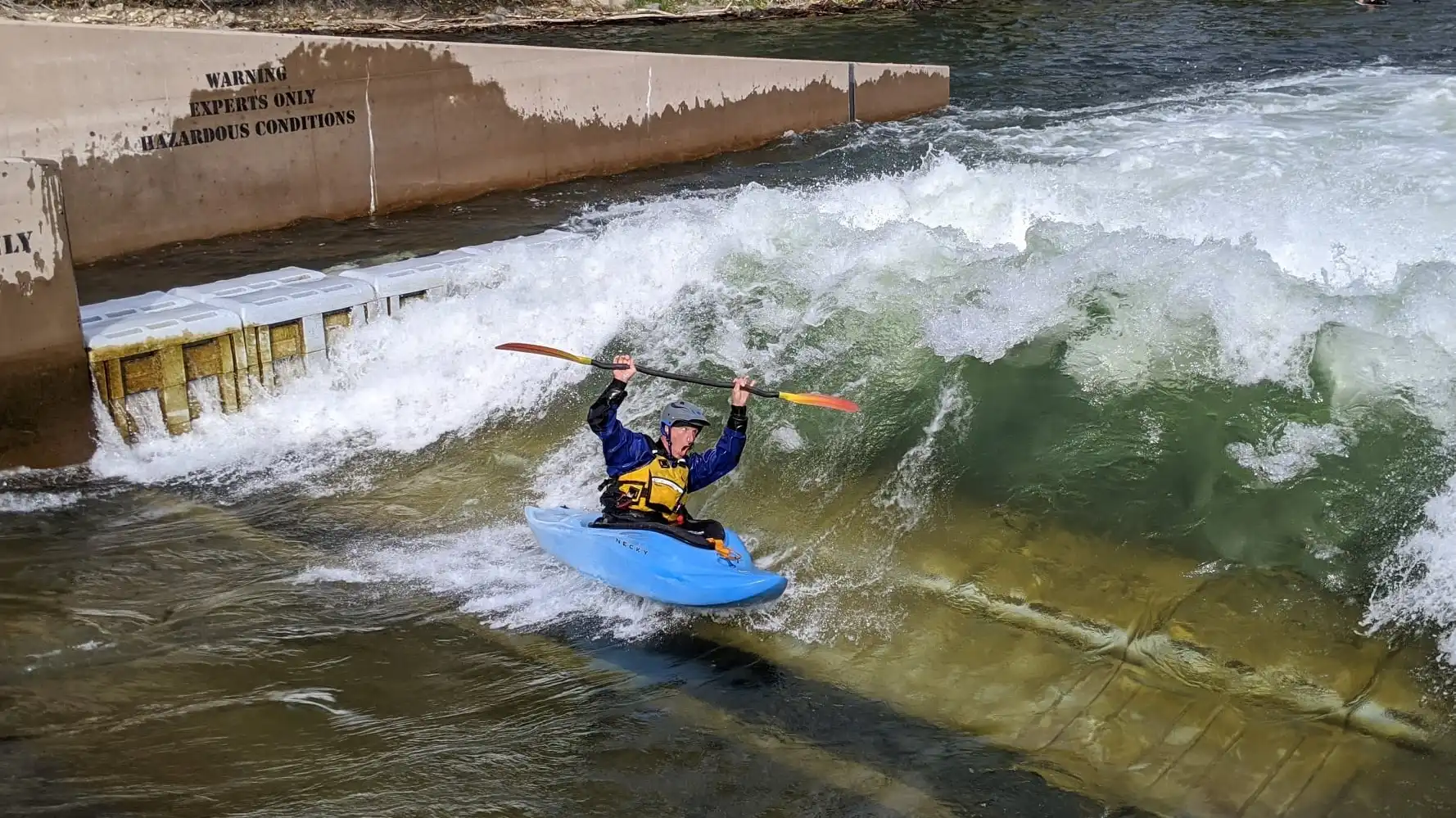
Boise, Idaho is hundreds of miles away from the ocean. And yet, the landlocked city is a hot spot for surfers. During the warm months, they flock to the Boise River with shortboards and boogie boards, along with the fleets of free style kayakers who come to practice tricks, flips and spins.
Underneath the surface, inflatable air bladders and hydraulic panels shape the water’s pressure and flow. And there are several wave technicians that the City of Boise has hired, who monitor the shape, volume and overall “surfability” of the community’s two artificial whitewater waves.
Since the first wave was installed more than a decade ago, the project has cost the city more than $15 million. The cost is worth it to Sara Arkle, the city’s director of parks and recreation, who said the development has transformed the riverfront.
“I've lived in Boise almost 20 years and before that whitewater park went into the river, the area was completely different,” she said. “It was unrecognizable.”
Before the wave, Arkle said the Boise River was flanked with a gravel pit and lots of empty lots. “You look at it today and it is thriving with businesses, residential development, restaurants, and a beautiful park.” Not to mention, the town’s “stoke” has skyrocketed, Arkle said.
“I mean we went from not only a whitewater kayaking mecca in Idaho to now a surfing destination,” she added.
That “stoke” is spreading across the country, especially for places with an existing outdoor recreation scene and a healthy river. There are more than 70 artificial waves installed nationwide, and even more coming down the pipeline. One of the newest ones is getting installed in Woodfin, North Carolina, a former factory town where plants used to churn out textiles and furniture.
This winter, excavators, cranes and dump trucks line the shore of the French Broad River, which cuts right through the small town of 8,000. And there’s a massive cofferdam installed in the middle of the river, temporarily sealing the work site from the river water. This is the process for installing a stationary ledge at the base of the riverbed, which by next summer, should serve as the structure for a world-class surfing wave.
“We're talking about the river equivalent of the perfect surfing wave. Like Waimea Bay in Hawaii comes to Woodfin, North Carolina,” explained Marc Hunt, a local organizer and kayaker who is championing the project.
Hunt, along with other project members, traveled all the way to a premier hydraulics lab in Prague to test the design, ensuring it has the perfect combination of slope and height. If all goes according to plan, the new wave will attract international freestyle competitions, like the International Canoe Federation World Cup.
And with all those visitors, the hope is new restaurants, cafes and gear shops will follow, Hunt said.
Outdoor economist Mark Buckley said projects like these can be a great way to revitalize a former industrial zone or sleepy part of town.
“When they're successful, they become such an iconic focal point for a community,” Buckley said.
There’s just one caveat: the wave needs to be built correctly. In Dallas, Texas, that was not the case and the city ended up paying $2 million to dismantle its wave that was too scary for even die-hard kayakers.
Even if the wave is built properly, the community should set aside plenty of cash for maintenance, Buckley added. For instance, Bend, Oregon, where Buckley lives, needs to make about $12 million in repairs to its ten-year old wave on the Deschutes River.
“There's a lot of management costs, there's a lot of upkeep costs, there's a lot of initial construction costs, but it is probably one of the single best investments in the Bend area ever when you think about the return on the investment.”
In Bend alone, more than a hundred thousand people visit the whitewater park every year. In total, the park adds about $26 million annually to the economy.




 2 hours ago25:16
 9 hours ago5:54
 14 hours ago8:19
 5 days ago27:11
 7 days ago12:18
 4 months ago24:33