


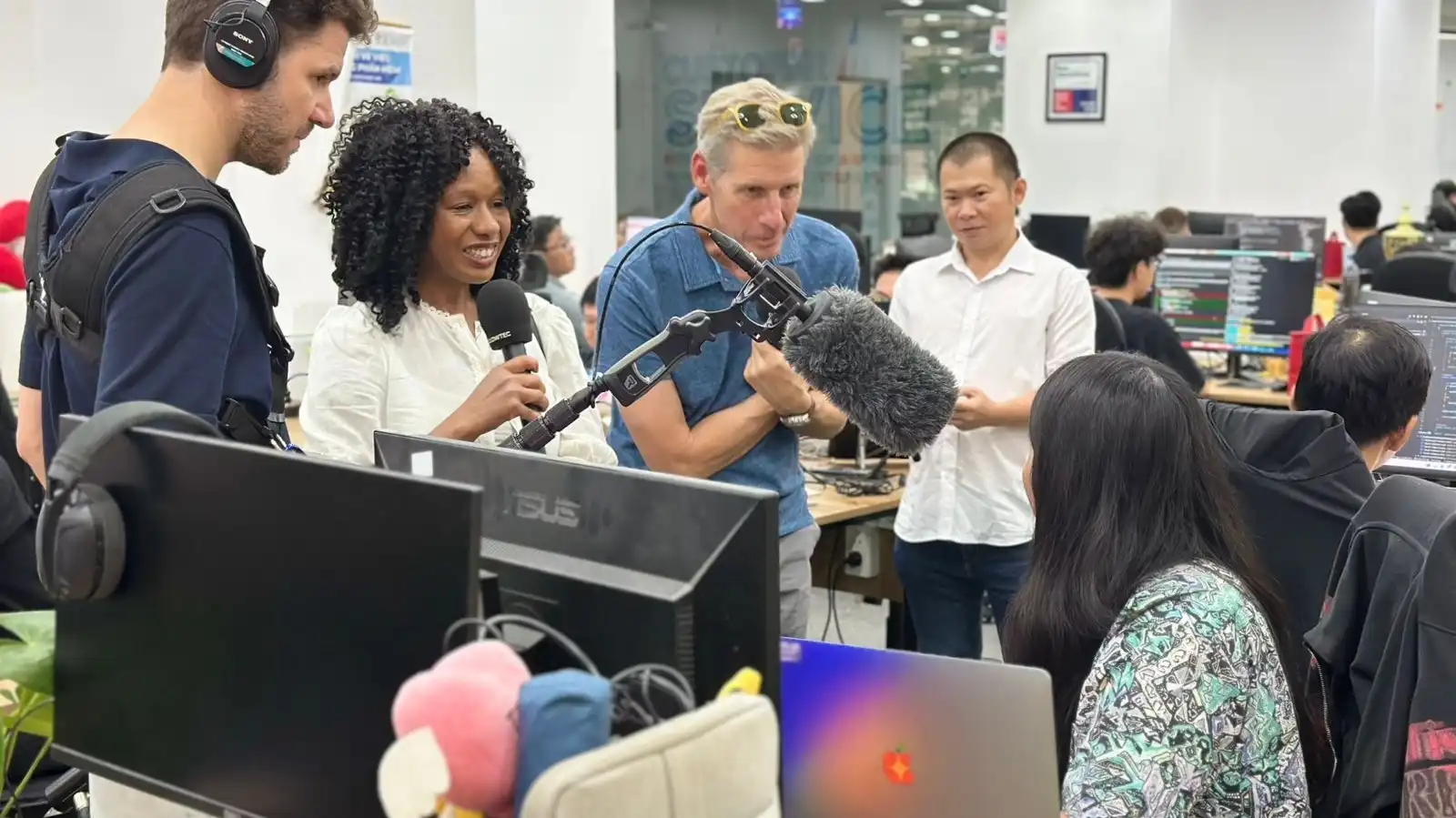
Behind America's consumer goods, Vietnamese factories like this one
American consumption helps drive the global economy. The workers powering it are halfway across the world.

In a warehouse in Southern California, Bill Webster Jr. and his son, Bill Webster III, showed “Marketplace” host Kai Ryssdal their company’s signature product — a stretchy piece of fabric that attaches to garage doors for decoration.
“You can have Merry Christmas, Happy Halloween, put American flags up, whatever you want on your garage door,” the elder Webster said. “It’s like a big pair of Lululemon yoga pants. The Websters started their company, Garage Celebrations, five years ago, and have grown it to more than $1 million in annual revenue.
But like many American companies selling products primarily to American consumers, Garage Celebrations relies on workers in Vietnam.
“Would you be where you are without Vietnamese manufacturing?” asked Ryssdal. “No, I don’t think we would have been able to start,” said Webster III.
As Ryssdal and ADP Chief Economist Nela Richardson have been exploring in our series “The Age of Work,” Vietnam’s labor force is in a demographic golden age. In the wake of the Vietnam War, there was a baby boom, which means there’s a huge cohort of people there right in their prime working years. Right now, there are two working-age people for every one dependent.
The country’s young, well-educated workforce has attracted foreign investment and helped entrepreneurs like the Websters turn their ideas into companies. But to truly understand that relationship, we need to look at both sides of the Pacific.
At Saigon Printer in Ho Chi Minh City, skilled workers make products for American consumers
“This is Bill’s product,” said Sunny Lau, owner of Saigon Printing, the company that manufactures Garage Celebration’s door covers in Ho Chi Minh City, Vietnam.
Lau is originally from Singapore, but his career in textiles — including more than a decade working for Ralph Lauren — has taken him all over the world. “Thailand, Bangladesh, Sri Lanka, Myanmar, you name it,” he said.

In 2018, a German company he was working for sent him to a factory in Vietnam. “I came at the right time,” he said. “In 2018, Vietnam was receiving a lot of business orders.”
That year was a turning point for Vietnamese manufacturers. Tariffs imposed by the first Trump administration sent many brands seeking alternatives to Chinese manufacturing. “Vietnam is the best choice compared to the rest of Southeast Asia,” said Lau. “The majority of the people here, the workforce, are in their 30s, up and down. And then it's a developing country, so the infrastructure is slow, but it's growing.”
Crucially, Vietnam is also geographically near China, which supplies much of the raw material used by manufacturers elsewhere. As trade tensions with China escalated, Vietnam has become an increasingly important source for U.S. importers.
Five years ago, Lau decided to start his own business in Vietnam. He specializes in “sublimation printing,” which is a technique for printing patterns onto fabrics by heating ink to high temperatures. The work is technical, requiring expensive machinery and well-trained workers.

Lau said he hired Chinese technicians to help him establish his factory in Vietnam, but believes a localized workforce is better for the long-term sustainability of his company. “Once the foundation is there, I have [Vietnamese workers] who are senior, who already got the skill set, we continue to localize,” said Lau. “That is the way I run the company.”
One of Lau’s Vietnamese employees, Lưu Thị Huỳnh Trang, started working for him around three years ago and has since become one of his right-hand people.
She’s 28 years old. It was her first job out of university, where she studied both English and Chinese. She uses those language skills to communicate with her customers in the U.S., Australia, and Europe, as well as the Chinese suppliers Saigon Printer works with.

The products that Saigon Printer makes get shipped all over the world. Trang showed Ryssdal and Richardson a pair of kids’ swimsuits sold at Target. She and a colleague explained that the fabric for that swimwear is printed by them at this factory, sewn together by workers in Korea, and then shipped to the United States.
Trang visited a Target while on a business trip to the U.S, where she purchased the swimsuits off the rack. “We see a lot of products print[ed] by us,” she said. “And we are so proud.”
To hear more, use the play button at the top of the page.


Latest Episodes
View All Shows 2 days ago25:17
 2 days ago6:24
 3 days ago16:16
 4 days ago28:46
 6 days ago30:57
 4 months ago24:33