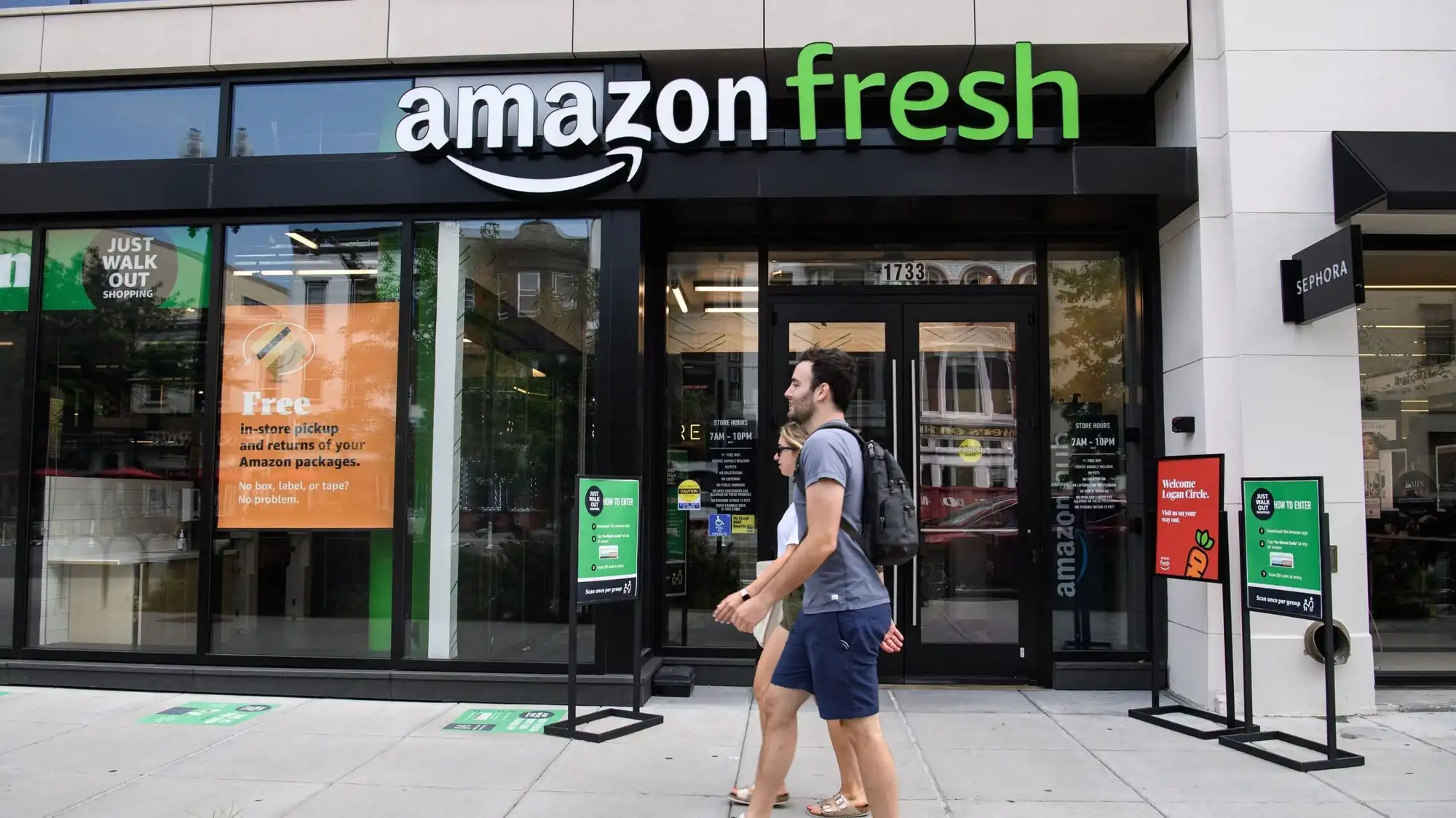
Fresh off its announcement to lay off 16,000 corporate workers, Amazon has closed up shop on Amazon Fresh and Amazon Go brick-and-mortar stores.
But Amazon isn’t getting out of the grocery business. Instead, the company says it will focus on opening 100 more Whole Foods locations and expanding its grocery delivery service.
So what went wrong with Amazon’s foray into physical stores?
“Marketplace Morning Report” host David Brancaccio spoke with Neil Saunders, managing director and retail analyst at GlobalData Retail, on Amazon’s change in focus. The following is an edited transcript of their conversation.
David Brancaccio: All right, Amazon Fresh, Amazon Go. What happened to these guys, do you think?
Neil Saunders: What they really found with both concepts over time is that they just weren't strong enough to pull customers away from where they were shopping already, and they weren't generating the volumes from the stores — they therefore didn't make economic sense. They've tried, and they've decided, actually, it's better to cut our losses and invest in where we know we can make an impact in grocery.
Brancaccio: Yeah, and it's not like some people as an alternative are going completely outside the Amazon fold. I mean, if you need an emergency jug of Tide detergent and a loaf of sourdough, you can get that actually delivered without going over to the nearby store.
Saunders: Well, that's the thing you have to look at, where Amazon is strong, and what Amazon does well, and it really is, mostly in the online space. They're super convenient, they're super reliable, they're super fast, increasingly, when delivering things, and that's actually the arena where they can win. When it comes to running physical grocery stores, the country is already pretty saturated.
Brancaccio: Neil, do you ever try one of these stores set up with ”just walk out” technology?
Saunders: I did try them. I've been in quite a few, but to be honest, since I was only buying a few things, the differentiation of just being able to walk out wasn't really that strong, because, honestly, self scanning some things or putting them through a register doesn't really take that much longer in a traditional store.
Brancaccio: I went to one in an airport, and I found it disorienting. I mean, there are these two human employees there to answer my questions. I said, “Really, I could just walk out right now?” Yes. Where, there? I felt it was a bit weird. And then I was unnerved that, like, what if, because I picked up a candy bar but didn't actually walk out with it? You know, would it register that kind of stuff?
Saunders: And that was one of the problems with Amazon Go you never quite knew how much you were spending, and sometimes the technology was a bit glitchy. I mean, sometimes you wouldn't get a receipt for hours and hours until you'd left the shop, and sometimes it never even materialized. So, it was all kind of a bit of a mystery, and I think that made a lot of consumers very uncomfortable.
Brancaccio: Also supermarkets, grocery, it's a tough market. Always has been. I mean, this fierce competition and profit margins, you know, I'm told, are generally pretty slim.
Saunders: The grocery market is very, very low margin. It's very focused on price, and it's also very saturated and crowded. And if you want to come up with a new concept and you want to pull people over to your stores, to your brand, you have to do something that's really compelling. But the question with Amazon physical stores was, what is that point of differentiation? What's the reason I should come here, over the supermarket I already go to, and honestly, they never really answered that question convincingly.




 2 hours ago25:16
 10 hours ago5:54
 14 hours ago8:19
 5 days ago27:11
 7 days ago12:18
 4 months ago24:33