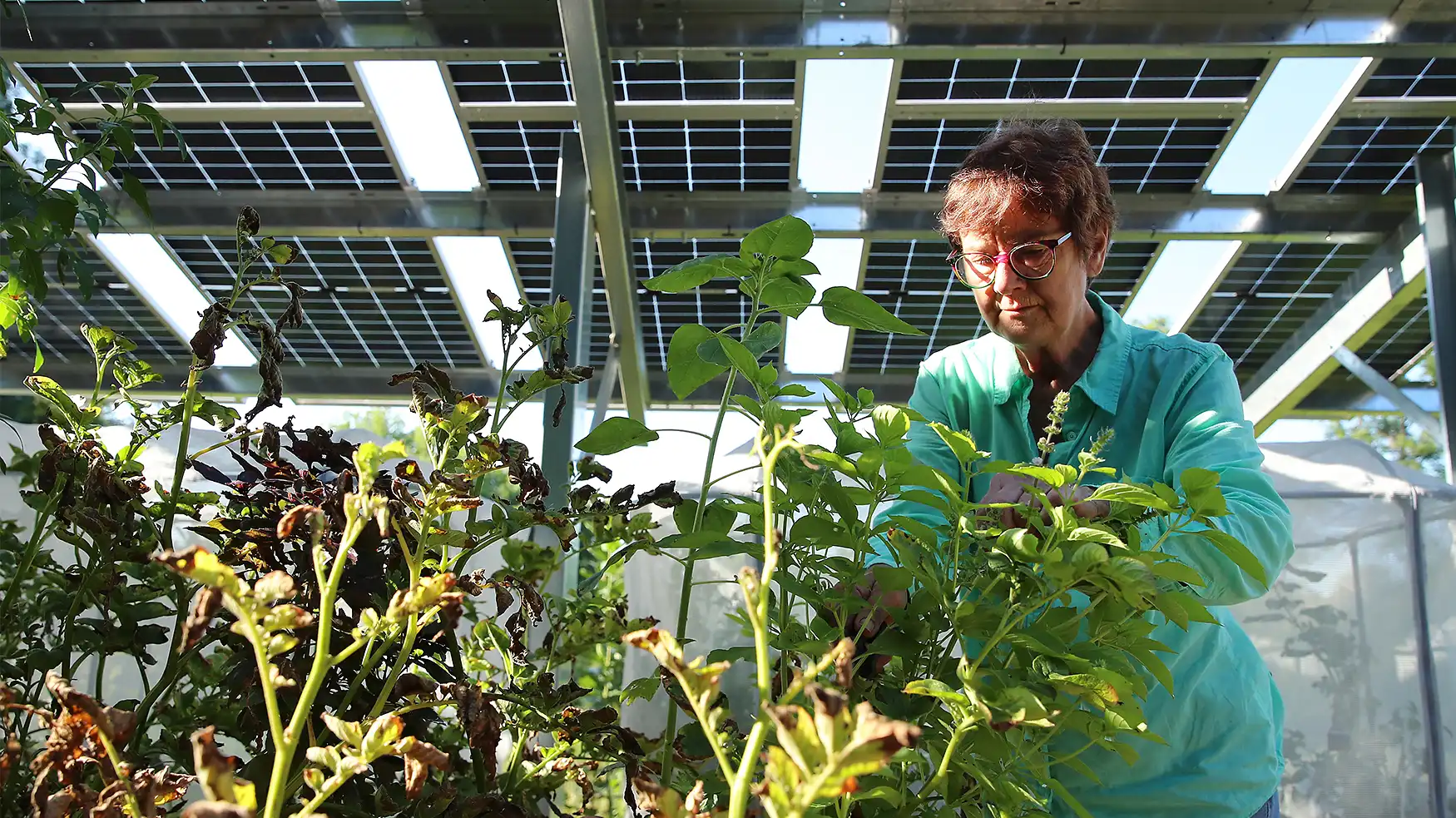
Linda Hezel gets up early to clip herbs, vegetables and produce from the plants on her farm north of Kansas City.
“I'm trying peppers which you normally think would be only in full sun,” Hezel said.
Hezel’s peppers are shaded by 18 solar panels hoisted more than 8 feet off the ground. The bounty of produce and herbs that eventually ends up on dinner plates in Kansas City are grown on Hezel’s farm in the approximately 40 feet of space underneath a solar array.
“There's no blossom on it yet, but the plants look healthy,” she said.
Farming is a notoriously difficult occupation. Now, climate change means farmers are facing increasingly severe weather such as heat waves which can have negative consequences for human health and crop viability.
Enter a process for producing food and energy at the same time. It’s called agrivoltaics and farmers are experimenting with the novel agriculture method across the Midwest.
Hezel has been farming for three decades, and this is her first season using agrivoltaics. The solar panels power her home and also provide shade, which is crucial for many crops in Missouri.
“I have observed over the 30 years here, the heating of this landscape is making it more difficult for some plants to thrive and even survive,” Hezel said.
Hezel has a small farm and a small-scale solar array, but agrivolatic installations are becoming more and more common. From 2020 to 2024 the number of agrivoltaic sites in the U.S more than doubled, to cover some 62,000 acres — because there’s lots of land out there underneath larger solar projects.
“Every time I see land space, I'm like, food!” said KaZoua Berry, farm director at Minnesota-based nonprofit The Food Group. The organization offers training for new organic farmers.
Berry said one huge challenge for farmers is finding affordable, consistent access to land to grow produce. Competition for agricultural land near metropolitan markets is accelerating.
“Whenever they rent land, they are just subjected to the annual lease,” she said of new farmers. “They can't plant perennials. I mean, they could, but it will cost them a lot of money and then they can't take it with them.”
So, Berry is constantly hustling to find any little plot of available land for the farmers she works with.
“My kids make fun of me because they're like, ‘Mommy's probably just thinking about how many tomatoes or how many watermelons can we grow?’ And I'm like, yes, you know me so well,” she said.
The Food Group is partnering with a Minnesota-based energy developer called U.S. Solar to pilot long-term farming leases for more than an acre of land underneath and around solar panels.
The company gets free land maintenance and the project's farmers get an essentially free space to grow their crops.
Peter Schmitt is U.S. Solar’s director of project development and said the company has experimented with other types of agrivoltaics like planting pollinator habitat or providing pasture for flocks of sheep.
He said working with farmers on agrivoltaics projects is a good deal for his company because something has to happen to that land.
“Whether it's pollinators, whether it's grazing, whether it's crop production … we're not going to leave it fallow,” he said.
Schmitt said agrivoltaics could be one answer for agricultural communities that wonder whether solar arrays are a good fit in general.
“As solar becomes more common in agricultural communities that doesn't necessarily mean welcome in every community,” Schmitt said. “They might have folks that are saying, ‘Hey, we don't want to see farmland taken out of production.’ Well, our response could be: neither do we.”
For some small-scale farmers in the Midwest at least, it’s working.
KaZoua Berry says the farmers she works with in Minnesota are now able to grow lettuce or herbs in the middle of the summer, thanks to the shade.




 an hour ago25:16
 8 hours ago5:54
 13 hours ago8:19
 5 days ago27:11
 7 days ago12:18
 4 months ago24:33