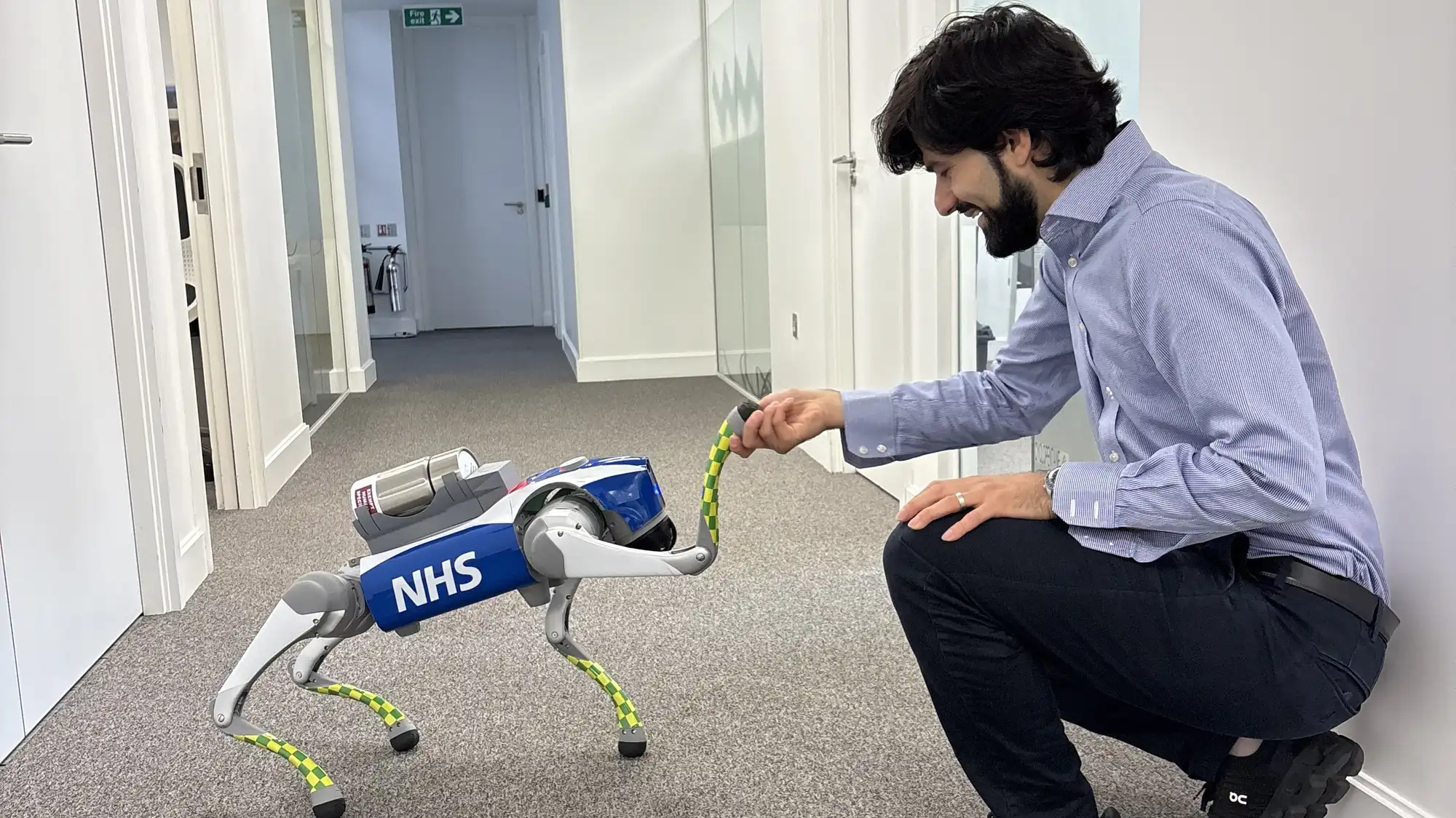
Hammad Jeilani, co-founder of the healthcare logistics company Apian, with a “robot dog” named Clive.
Maria Hollenhorst/Marketplace
As part of our ongoing series “The Age of Work” about how demographic shifts are shaking up the global economy, “Marketplace” host Kai Ryssdal and ADP chief economist Nela Richardson visit London, England. The U.K. has a higher percentage of people over 65 than the United States, and thus holds insights into our economic future.
In an office building in the London borough of Southwark, “Marketplace” host Kai Ryssdal and ADP Chief Economist Nela Richardson watched a blue and silver robot with the letters N-H-S on the side walk down a hallway.
“I’m sorry, this freaks me out,” said Ryssdal as the robot turned back towards him. “Oh don’t make it sit up like that!”
“It just blew you a kiss,” said Hammad Jeilani, co-founder and medical director of a company called Apian. “You can see a world in which this robot dog will go and deliver a sample and then it will go to the patients, say hello, and let the children play with it.”
Jeilani and his fellow co-founders describe Apian as a “health care logistics company.” They hope to use automation to help make health care more efficient. The company is currently partnered with the United Kingdom’s National Health Service to use drones to deliver blood samples in central London.
Given that the number of people 85 years and older in the U.K. is expected to double over the next couple of decades at the same time that fewer prime-aged workers are entering the labor force, Jeilani said automation is essential to meeting increased health care demands.
Click the audio player above to hear Jeilani’s conversation with Ryssdal and Richardson about how improved health care logistics could help mitigate that problem.




 2 hours ago7:25
 7 hours ago30:58
 7 hours ago8:04
 18 hours ago25:18
 5 days ago28:46
 4 months ago24:33