


How one college is planning to reopen campus in the fall, amid COVID-19
Beloit College’s pandemic response includes overhauling the academic calendar.
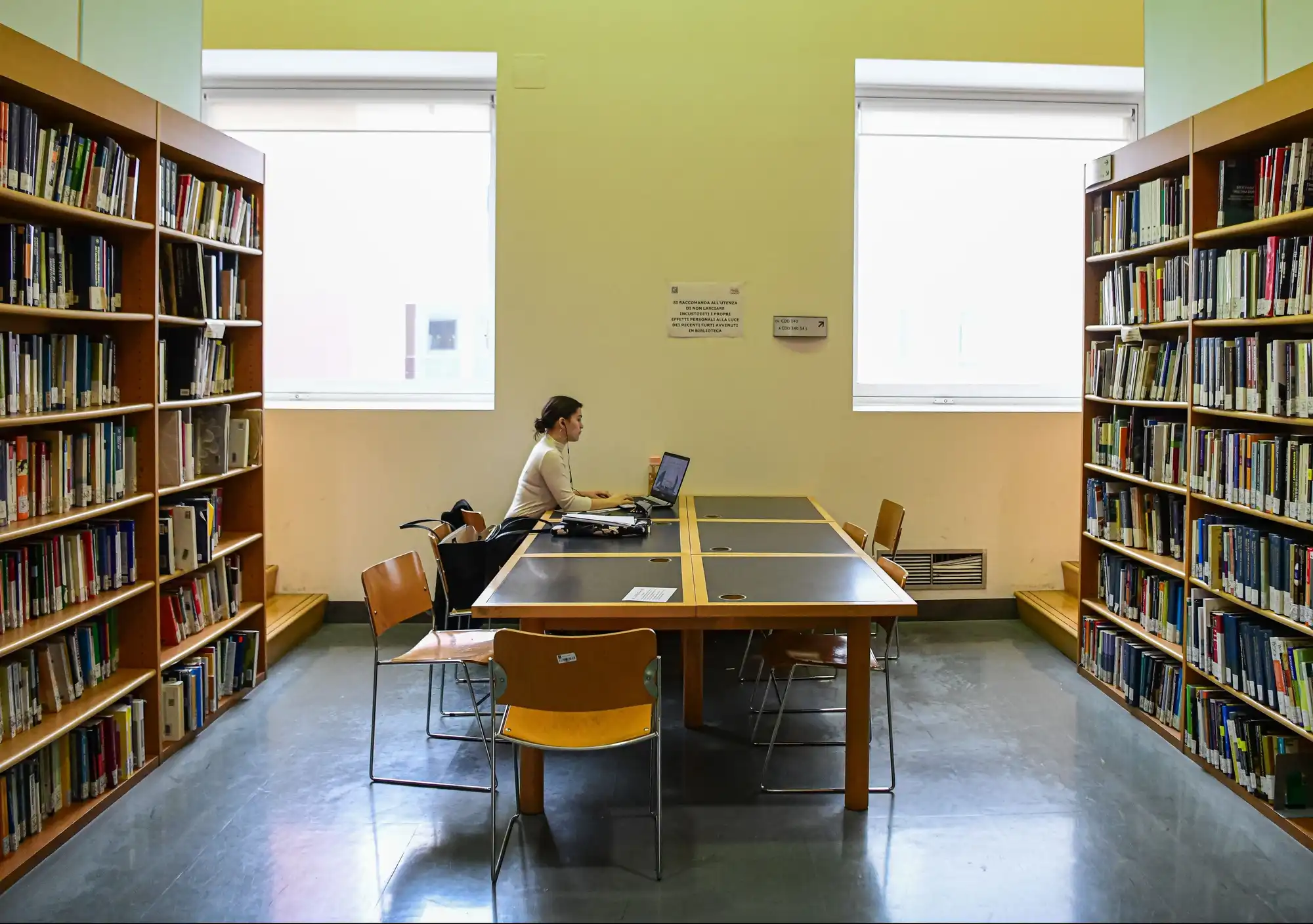
Fall is still a big question mark for a lot of colleges and universities, whose administrators are weighing the risks of reopening their campuses in the midst of the coronavirus pandemic against the serious financial challenges that online classes present — from the money already lost, to refunded room and board costs, to the threat of students withdrawing enrollment (and tuition dollars) if virtual instruction continues.
At the end of May, two-thirds of colleges and universities surveyed by The Chronicle of Higher Education said they would attempt to welcome students back to campus in the fall. Others, including the California State University system, have decided to keep classes mostly online.
Still others are trying to find a middle ground. One of those institutions is Beloit College, a small liberal arts college in Beloit, Wisconsin. Administrators hope to reopen its campus in the fall, but they know that pandemic developments could force them to switch to online classes at any point.
To give educators flexibility in the event that they need to make the switch mid-semester, the college is overhauling its 2020-2021 academic calendar, splitting the ordinary four-month semester into two seven-and-a-half week modules. Beloit students, instead of taking four courses for the duration of the semester, will enroll in two courses during each module.
Eric Boynton, the provost and dean of the college, said the plan has garnered widespread buy-in from faculty.
He also noted that colleges like Beloit are uniquely positioned to make these kinds of sweeping changes to their educational models in the face of COVID-19.
“This is a moment that is a challenge for small liberal arts and tuition-dependent institutions. There’s also a way in which these kinds of institutions really shine,” Boynton told “Marketplace Morning Report” host David Brancaccio.
“If an institution responds to the challenges in these agile, nimble ways, you can expect as a student and a parent that that’s the kind of education you’re going to get. You’re going to get the kind of preparation for the ever-evolving complexities of the world, of which COVID is the recent flavor.”
Brancaccio spoke to Boynton about how he’s planning to reopen campus in the fall. The following is an edited transcript of the interview.
David Brancaccio: Tell me about this hinge, this pivot point that you’re building into the semester to come.
Eric Boynton: Instead of teaching a 15- or 16-week semester in which a student takes four courses, which is a normal load, we would split the semester up into two modules, and students would take two full courses, each in a seven and a half week “Mod.” And so there’s a hinge in the semester, and that hinge is this way to maximize flexibility. If we needed to move away from campus, there would be a place, a pivot point in the semester where it’d be natural to move off campus. Or, if we had to start out online, it’s also a place in which only two courses would be affected.
Brancaccio: What are you doing about classroom size, seating, labs — even dorms?
Boynton: We’re going to be on campus in clever ways. We will have nearly enough capacity to give people single rooms, for instance. We’ll have classroom spaces in which no more than 10 students will be gathered at a time. This is one of the benefits of a small liberal arts institution where you have a rather large campus for a small number of students. And so we’re able to deal with density in ways that larger state campuses just can’t deal with.
Brancaccio: And as a small liberal arts place, you will be tuition dependent. I mean, the big research universities have other revenue streams. What are you hearing from students about if they would come this fall or if they won’t, depending on whether it’s distance learning or if it’s on campus?
Boynton: Well, depending on when you take the polls, you’ll get different kinds of responses. I’m betting that it’s going to be some kind of hybrid educational model, in which we’re on campus with most of our students, but not all of our students. There’ll be certain students that can’t return to campus, like there’ll be certain faculty that should not teach on campus, those who are at risk.
I have to say that this is a moment that is a challenge for small liberal arts and tuition-dependent institutions. There’s also a way in which these kinds of institutions really shine, really demonstrate the ability to be agile and nimble. And, you know what? If an institution responds to the challenges in these agile, nimble ways, you can expect as a student and a parent, that that’s the kind of education you’re going to get. You’re going to get the kind of preparation for the ever-evolving complexities of the world, of which COVID is the recent flavor.
Related Topics
Collections:
Tagged as:


Latest Episodes
View All Shows 11 hours ago25:22
 19 hours ago7:09
 a day ago30:57
 a day ago12:45
 6 days ago28:44
 4 months ago24:33