


“You’re out right away”: Lettuce sells fast at farmers' markets amid cyclospora outbreak
With lettuce sales down nationwide, more people are looking to buy local. That can be a mixed bag for farmers.
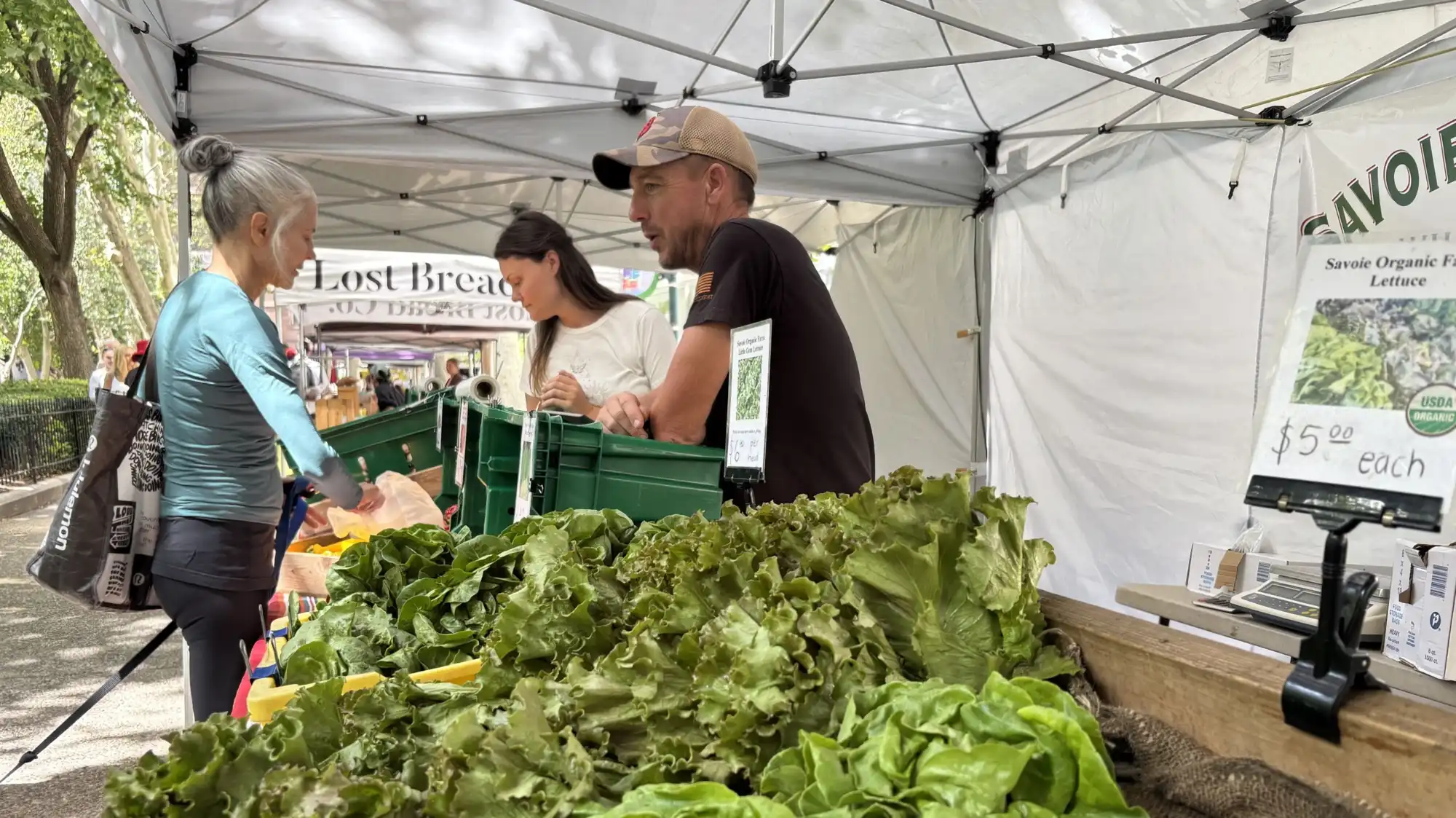
On Tuesdays from May to December, you can find Barry Savoie in Rittenhouse Square in Philadelphia, selling tomatoes, eggplant, peppers, broccoli, and all sorts of lettuce. Lettuce is his specialty.
“I always say lettuce is what pays my mortgage,” Savoie said.

Savoie runs Savoie Organic Farm with his business partner, Carol Di Meo, in Williamstown, New Jersey, about 40 minutes outside Philadelphia.
“We have a specific soil,” he said. "It's got a high mineral content, and it comes through in a flavor of greens. So, it makes great kale and great lettuces and great escaroles and frisées and stuff like that, just really flavorful.”
Those greens are extra popular lately thanks in part to the ongoing cyclospora outbreak. Savoie has heard about it a lot from customers and has seen it in his sales. A lettuce harvest that would’ve normally lasted him two-and-a-half weeks is now selling out in five days.
“You have this huge surge of new customers coming to you, and … you're out right away,” he said.
Nationwide, sales of pre-packaged salads are down about 35% since the cyclospora outbreak began, lettuce sales are down more than 15%, and all produce sales are down nearly 10%, according to recent data from NielsenIQ. At the same time, interest in farmers markets is up.
Anna Squitieri of South Philly recently started buying all her produce at farmers markets. She works across the street from Rittenhouse, and has long popped over to the Tuesday market, in the past, primarily for bread. Lately, she’s been buying her vegetables there, too.
“Now, I don't buy any produce at the supermarket,” Squiteri said. “Only because I won't buy anything in a bag, which I used to buy all the time. Which, it's convenient for me, but now, I don't want to die.”
Because of the long-lasting cyclospora outbreak, and recent headlines about other foodborne illnesses, including salmonella in eggs and jalapenos, she just feels safer right now buying locally-grown produce.
As manager of the Rittenhouse Farmers Market, Jeanette Stroeber is hearing that a lot these days.
“Customers are asking more about where their food's coming from, and they want to get to know the farmers and know how everything works,” Stroeber said.
It’s hard to know for sure how many new people are coming to the market and actually buying produce because of all the recent outbreaks and recalls, she said.

“But talking to my farmers, they're saying that they're hearing more questions about it, which makes me think they're not our typical customers,” she said.
For Savoie, the spike in sales is a mixed bag.
“Everyone thinks it's all great because I'm selling out of lettuce,” he said. “But it doesn't mean I'm doing more business.”
For one, he’s always sold his lettuce in the past, it’s just selling faster now. And lettuce is not something he can just go make more of when there’s a sudden increase in demand.
“An average head of lettuce spends about four weeks in a tray in the greenhouse, then gets transplanted and takes about five to six weeks, depending on the variety, outside to produce,” Savoie said. “Well, I can't go back in time. They don't make DeLoreans and flux capacitors anymore.”

So there have been a bunch of markets this summer where Savoie just didn’t have any lettuce to sell, which can cost him customers.
“When you don't have it, if you go one week, it's okay,” he said. “If you go two weeks in a row … a lot of them move on.”
For the last couple of weeks, Greg Scott has been on the lookout for lettuce.
“It wasn't here last week, and I'm glad that it's here this week,” Scott said on a recent Tuesday at the Rittenhouse Farmers Market.
Like Squiteri, he works near the square, and often pops over to the farmers market, just to peruse, see what looks good.
This time, though — for the first time — he was specifically on the hunt for lettuce. Which he found at Savoie’s stand.
Scott has always liked the idea of buying local but hasn’t always done it, mostly because of convenience. Lately, though, he has been making more of a point of it because of cyclospora and other recent recalls.
He’d like to think he’ll keep doing it long-term, but, “when there's not a situation like this,” he said, “I think it's harder to maintain that level of awareness and presence to stay local and go out of your way to do that.”


Latest Episodes
View All Shows 9 hours ago25:22
 17 hours ago6:20
 a day ago9:48
 2 days ago12:18
 7 days ago39:00
 4 months ago24:33