Marketplace®
Every story is an economic story

David Brancaccio

"Future Effects" Senior Correspondent

David Brancaccio is Marketplace’s “future effects” senior correspondent. In this role, David aims to explore how short-term thinking can impact our personal finances, innovation, government policy, and more.

David worked as the host and senior editor of “Marketplace Morning Report” from 2013 to 2026, where he focused on the regulation of financial markets, the role of technology in labor markets, the history of innovation, digital privacy, sustainability, social enterprises, and financial vulnerability in older adults. David freelanced for Marketplace in 1989 before becoming the program’s European correspondent based in London in 1990.

David hosted the evening program from 1993-2003, then anchored the award-winning public television news program “Now” on PBS after a period co-hosting with journalist Bill Moyers. David has co-produced and appeared in several documentaries, including “Fixing the Future,” about alternative approaches to the economy, and “On Thin Ice,” about climate change and water security, with mountaineer Conrad Anker. David is the author of “Squandering Aimlessly,” a book about personal values and money. He enjoys moderating public policy discussions, including at the Aspen Ideas Festival, Chicago Ideas Week, and the Camden Conference in Maine.

David is from Waterville, Maine, and has degrees from Wesleyan and Stanford universities. Honors include the Peabody, Alfred I. duPont-Columbia University, Emmy, and Walter Cronkite awards. He is married to Mary Brancaccio, a poet and educator. They have three offspring, all adults. He likes making beer and building (and launching) pretty big rockets. Among his heroes are Edward R. Murrow and Wolfman Jack.

Latest from David Brancaccio

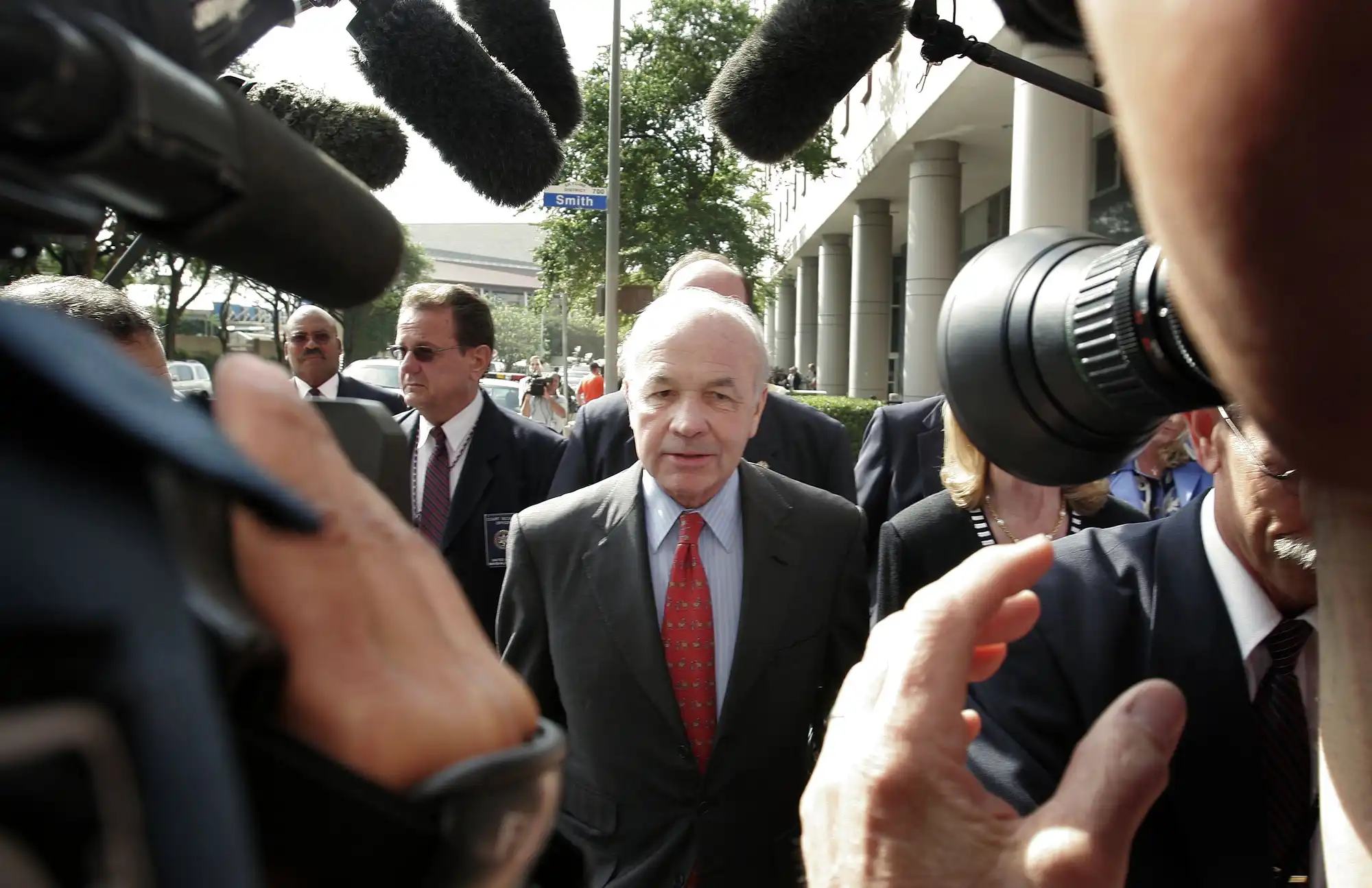
  • HOUSTON - APRIL 26:  Former Enron chairman Kenneth Lay (C) leaves the Bob Casey U.S. Courthouse after the day's proceedings in his fraud and conspiracy trial, April 26, 2006, in Houston, Texas. Lay faced cross examination by the prosecution during his third day on the stand.  (Photo by Dave Einsel/Getty Images)

    Also today: There’s more to discuss regarding the Fed, and the upcoming holiday shopping season does not seem to mean good cheer for FedEx and other companies dealing with the national labor shortage.

    Read MoreDownload
  • May 26 2017, Abu Dhabi - UAE. Inntake of Boeing 777 Jet Engine blades with inner cowling.
    Rathke/Getty

    From the BBC World Service: American aerospace giant Boeing has announced that it will build its first factory outside the U.S. in Australia. It will produce unmanned military drones and is expected to create 3,500 jobs by 2028. India is second in the world for coal consumption, but it has set ambitious renewable energy targets. Is it ready to wean itself off of coal?

    Read MoreDownload
  • Former Enron CEO and Chairman Kenneth Lay is sworn in before the Senate Committee on Commerce, Science and Transportation in 2002.
    Stephen Jaffe/AFP/Getty Images

    Very little, according to Bethany McLean, the first financial reporter to ask questions about Enron’s accounting practices.

    Read MoreDownload
  • There are high expectations for second-quarter earnings results that will be released by companies this week.
    Johannes Eisele/AFP via Getty Images

    Also today: The BBC reports on China’s pledge to stop building new coal-fired power plants abroad. The Department of Justice has taken issue with what it sees as an alliance between JetBlue and American Airlines. And, we take a look at the economic dynamics behind China’s shopping malls.

    Read MoreDownload
  • The Fed can't make grants. That's Congress' job. "These are lending powers, not spending powers," Fed Chair Jerome Powell said Wednesday.
    Brendan Smialowski/AFP via Getty Images

    Also today: We explore how the anti-abortion law in Texas could have an effect on recruiting in the tech industry. We also examine how some hospital systems still face overwhelming odds in the fight against COVID-19.

    Read MoreDownload
  • The silhouette of a coal-fired power station at sunset in Pocerady, Czech Republic.
    Kamil Petran/Getty

    From the BBC World Service: China has announced at the United Nations that it will stop building coal plants overseas. Chinese property group Evergrande says it has agreed to a deal with domestic bondholders, who are due payments of around $36 million. Ahead of the U.N. climate summit in Glasgow, Justin Rowlatt is traveling around the U.K. taking stock of its green potential. Today, he’s looking at how composting could be one key to a renewable economy.

    Read MoreDownload
  • Small businesses have been required to pivot during the pandemic in order to survive. The BackTo.Biz program helps small business owners do just that.
    LeoPatrizi via Getty Images

    David Brancaccio speaks with Efrem Fesaha and Jasmine Star about the new BackTo.Biz program funded by Howard Schultz.

    Read MoreDownload
  • What’s a vice chair of supervision? At the Fed, it’s kind of a big deal.
    Alex Wong/Getty Image

    Also today: Christopher Low joins us to discuss the markets. The president’s easing of international travel restrictions has some businesses hopeful for an upswing in visitors.

    Read MoreDownload
  • The Federal Reserve building in Washington, DC.
    DANIEL SLIM/AFP via Getty Images

    Also today: A global group issued a warning today about countries that withdraw support for their economies too soon. We also check in with a business owner who benefited from a program that helps businesses rebuild and adapt from the damage of the pandemic.

    Read MoreDownload
  • An airport staff checks a carton box of Covishield vaccine developed by Pune based Serum Institute of India (SII) at the Mumbai airport on February 24, 2021, as part of the Covax scheme, which aims to procure and distribute inoculations fairly among all nations. (Photo by INDRANIL MUKHERJEE / AFP) (Photo by INDRANIL MUKHERJEE/AFP via Getty Images)
    Indranil Mukherjee / AFP via Getty Images

    From the BBC World Service: India is the world’s biggest vaccine manufacturer, and the country’s health minister has announced it can resume coronavirus shot exports from next month. And we hear about the factors likely to influence the future of Africa’s tariff free deal for access to U.S. markets, the African Growth and Opportunity Act.

    Read MoreDownload