NASA will launch a mission to Jupiter’s moon Europa later this year to see if the salt water ocean beneath its icy layers can support life.
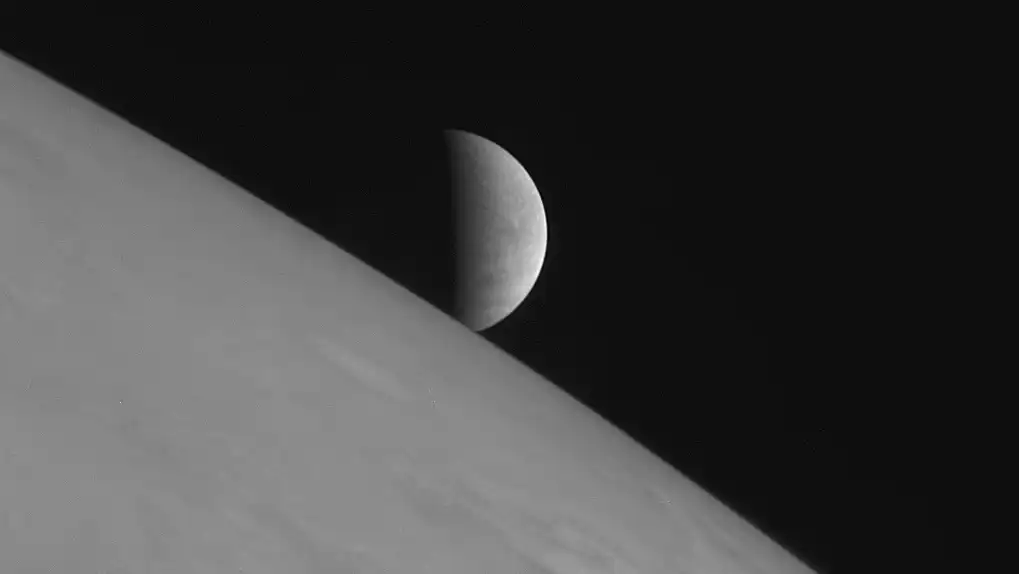
This October, NASA will launch the Europa Clipper spacecraft, beginning a deep space mission to one of Jupiter’s moons, Europa, to determine if it’s capable of supporting life.
Marketplace’s Lily Jamali recently visited NASA’s Jet Propulsion Laboratory in Pasadena, California, where the Clipper was built, to learn more about the mission and see the spacecraft before it’s shipped off to Cape Canaveral, Florida, later this month.
In order to make its scheduled 1.8 billion-mile voyage to Europa, the spacecraft comes equipped with massive solar power arrays, heavy radiation shielding and a thin metal plate that will carry, among other things, visual representations of the word “water” in 140 languages.
Why water? Because NASA is confident there’s a salt water ocean underneath Europa’s icy surface that could support life, thanks to scans conducted by the Galileo spacecraft in the 1990s.
“The best evidence for this liquid water ocean being there came from this magnetic signal that’s created when this conductive layer of saltwater that’s under Europa’s surface moves through the magnetic field created by Jupiter,” said Cynthia Phillips, project staff scientist and planetary geologist at JPL.
Marketplace’s Lily Jamali spoke with Phillips and mission scientist Kate Craft with the Johns Hopkins Applied Physics Laboratory about why NASA is looking for these conditions for life on Europa.
Click the player above to hear the at interview, and watch footage from our recent trip to JPL below.


 Apple
Apple Spotify
 Amazon
 RSS
RSS