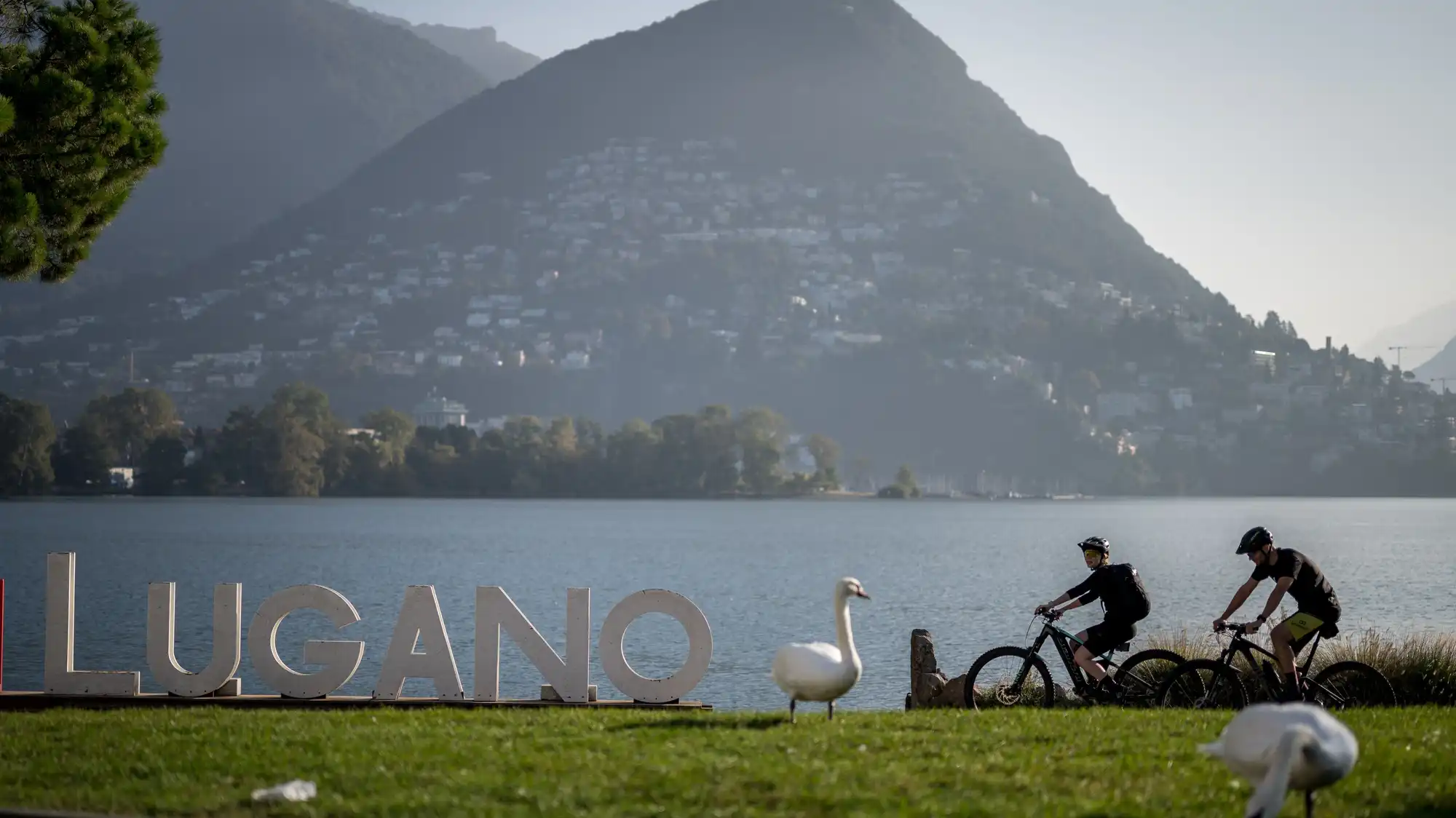
In the Swiss lakeside town of Lugano, residents can pay for meals, shopping and even taxes with bitcoin, as part of local government's push to lure more cryptocurrency companies to the area.
This story was produced by our colleagues at the BBC.
In a McDonald’s by the lake in the centre of Lugano, Switzerland, a customer orders coffee, asking if he can pay with bitcoin.
The salesperson says yes, then holds up what looks like a credit card payment terminal but is in fact a special crypto one, distributed free to businesses by the town council. The customer pays contactless from the bitcoin wallet on his telephone, to the tune of 0.00008629 bitcoin.
Bitcoin, this purely digital currency that uses encryption to control, manage and issue units as opposed to fiat money issued by a central banks or governments, is something people often buy as an investment, betting that its value going up.
But how many even think about using it to buy actual things like a diamond ring or a pizza? Well, in Lugano it’s different.
“I want to talk about an experiment I did this July. I have a problem with my bank. I had to live in bitcoin-only for 11 days,” said Mir Liponi, director of the Plan B hub, a meeting place for people who work in the bitcoin sector.
While there are some things you can’t purchase with bitcoin in the city, such as public transportation, you can pay your bills, buy your groceries or even pay your taxes, according to Liponi.
But not everyone in Lugano is keen on crypto. At a local park stands a square block of metal, upon which stood a statue of Satoshi Nakamoto, the mysterious person who brought bitcoin into being in 2009. Playing on the mystery, the statue - made of slats of metal - is transparent when you look at it from the front.
And it is now completely invisible because this summer some equally anonymous individual or individuals unscrewed it, broke it into bits and threw it in the lake.
“It's interesting because not that many things get vandalized around here, people are usually fairly well-behaved,” said Lucia, a local resident. “I'm from the University of Lugano and there's a club to promote bitcoin and everything. I personally don't use any cryptocurrencies, so I don't feel like it impacts me at all.”
Still, Lucia remains skeptical of cryptocurrencies in general.
“I do find it surprising that institutions such as my university would promote it so much,” she added. “I think it's associated to crime, to the dark web and speculation. A lot of people lose their money because they invest in it and then it crashes.”
The mayor of Lugano, Michele Foletti, isn’t concerned that Lugano will become something of a magnet of crime and mafia activity.
“Mafia people are more interested to use fiat for money laundering, the risk for Switzerland is this, with the Swiss franc, not with the bitcoin,” Foletti said. “Because when they sell drugs or something like this, they receive fiat money, not bitcoin. Because the most anonymous is the cash. You can use fiat money to do something good or something bad. The same with bitcoin.”
Lugano is, though, a bitcoin magnet, with almost 110 crypto-sector companies moving or starting up here.


 Apple
 Spotify
 Amazon
 RSS