Marketplace®
Every story is an economic story

David Brancaccio

"Future Effects" Senior Correspondent

David Brancaccio is Marketplace’s “future effects” senior correspondent. In this role, David aims to explore how short-term thinking can impact our personal finances, innovation, government policy, and more.

David worked as the host and senior editor of “Marketplace Morning Report” from 2013 to 2026, where he focused on the regulation of financial markets, the role of technology in labor markets, the history of innovation, digital privacy, sustainability, social enterprises, and financial vulnerability in older adults. David freelanced for Marketplace in 1989 before becoming the program’s European correspondent based in London in 1990.

David hosted the evening program from 1993-2003, then anchored the award-winning public television news program “Now” on PBS after a period co-hosting with journalist Bill Moyers. David has co-produced and appeared in several documentaries, including “Fixing the Future,” about alternative approaches to the economy, and “On Thin Ice,” about climate change and water security, with mountaineer Conrad Anker. David is the author of “Squandering Aimlessly,” a book about personal values and money. He enjoys moderating public policy discussions, including at the Aspen Ideas Festival, Chicago Ideas Week, and the Camden Conference in Maine.

David is from Waterville, Maine, and has degrees from Wesleyan and Stanford universities. Honors include the Peabody, Alfred I. duPont-Columbia University, Emmy, and Walter Cronkite awards. He is married to Mary Brancaccio, a poet and educator. They have three offspring, all adults. He likes making beer and building (and launching) pretty big rockets. Among his heroes are Edward R. Murrow and Wolfman Jack.

Latest from David Brancaccio

  • A natural gas line runs through the country side on March 11, 2015 outside Donetsk, Ukraine.
    Andrew Burton/Getty Images

    Unpacking Europe’s reliance on Russian energy — and the risks that now carries.

    Read MoreDownload
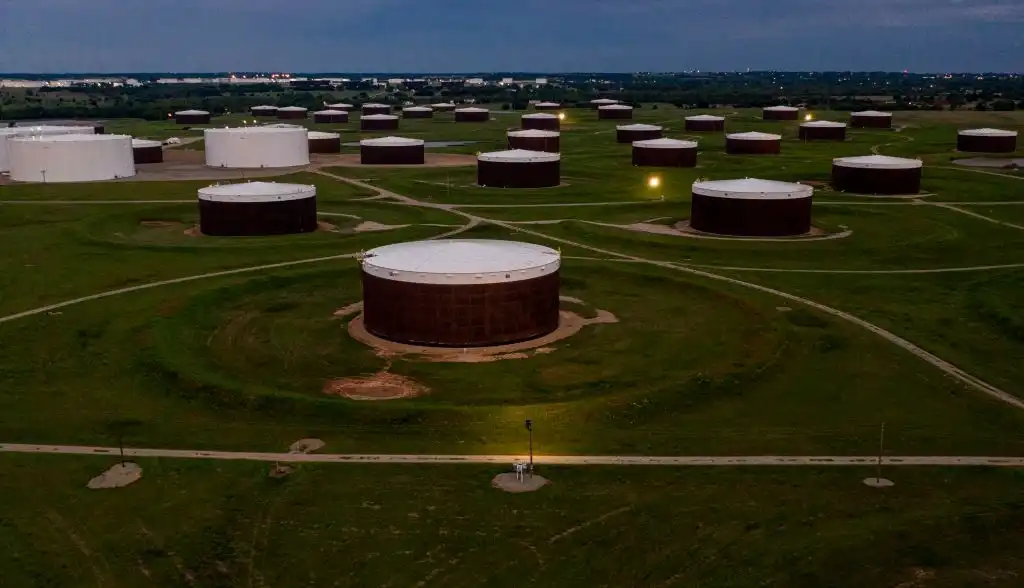
  • An aerial view of a crude oil storage facility is seen on May 5, 2020 in Cushing, Oklahoma. Rising demand for crude oil along with rising gas prices has led to an "energy shock" as the world attempts to transition to clean energy.
    Photo by JOHANNES EISELE/AFP via Getty Images

    Oil prices continue to climb this morning. Global benchmark Brent crude is at $116 a barrel, which is a near 20% increase just this week. The price may go higher as the United States imposes the first export controls connected to Russia’s energy sector. We discuss rate hikes coming in March and preview upcoming jobs numbers with Diane Swonk. Philadelphia Fed president Patrick Harker talks about the Russia-Ukraine conflict and its potential impact on what the Fed could do with interest rates.

    Read MoreDownload
  • Help wanted sign in front of a store front.

    Employers lowered the educational requirements for certain jobs during the pandemic, according to a new report from the Federal Reserve Bank of Philadelphia — potentially signaling new opportunities for workers without a bachelor’s degree. We spoke to Patrick Harker, the Philadelphia Fed’s president, about what the research can tell us about the economy. He also talked about whether Russia’s invasion of Ukraine and the resulting economic fallout could alter the Fed’s approach about raising interest rates in March. The war in Ukraine has led to high wheat prices, which impact certain parts of the world more than others. Fed chair Jerome Powell testifies today.

    Read MoreDownload
  • A harvester works in a wheat field in the Russian village of Nur-Shari.
    Oleg Nikishin/Getty Images

    From the BBC World Service: A number of commodity prices have seen sharp price increases over the past week, as has the impact of Western sanctions and reluctance to do business with Russia. As the conflict continues, what will it take to cool price swings? Plus: As Ukrainian refugees continue to flee to neighboring EU nations, interior ministers meet to discuss a plan to grant temporary protection.

    Read MoreDownload
  • "I could be supportive of a 50 basis point rise in the future — but not at this meeting," said Patrick Harker.

    “I could be supportive of a 50 basis point rise in the future — but not at this meeting,” said Patrick Harker.

    Read MoreDownload
  • As younger, higher earners stay in the rental market longer, it can limit their chances to build wealth and price out lower-income people.
    Justin Sullivan via Getty Images

    A new report from ProPublica dives into the role of private equity in the multifamily rental market. It reveals the growing proportion of private equity-owned apartment buildings as well as how tenants are being affected by changes in ownership. We spoke with ProPublica’s Heather Vogell, the reporter behind the investigation. Susan Schmidt offers insight into today’s market activity.

    Read MoreDownload
  • President Joe Biden delivers his 2022 state of the union address to Congress. This year, president is likely to talk progress on inflation and other economic matters.
    Sarahbeth Maney-Pool/Getty Images

    President Biden used Tuesday night’s State of the Union address to urge global unity against Russia’s invasion of Ukraine, but he also pushed forth pieces of his domestic agenda, specifically ways to control inflation. He called fighting inflation his top priority. We know how the invasion of Ukraine is disrupting the crude oil industry, but it’s also causing chaos in the industry of edible oils as well. Ukraine is leaning on its familiarity with cryptocurrency to gather funding for aid.

    Read MoreDownload
  • MCKITTRICK, CALIFORNIA - NOVEMBER 03:  Pumpjacks operate in the Belridge oil field on November 03, 2021 near McKittrick, California. The Biden administration pledged to cut methane emissions from oil and gas production yesterday. In California, 35,000 oil and gas wells sit idle, many of which are unplugged and could leak methane gas. Scientists estimate that one-third of human-induced global warming is caused by methane. (Photo by Mario Tama/Getty Images)

    From the BBC World Service: Brent crude oil rose above $112 a barrel for the first time since 2014, and European natural gas prices hit a fresh record as Russia’s invasion of Ukraine continues. Plus, a look at whether cryptocurrency exchanges can be held legally responsible if users use digital currencies to flout sanctions against Russia. 

    Read MoreDownload
  • China's CIPS interbank payments system is seen as a possible avenue for Russia after it was cut off from the more widely used SWIFT system.
    ISAAC LAWRENCE/AFP via Getty Images

    China’s system is known as the Cross-Border Interbank Payments System, or CIPS for short.

    Read MoreDownload
  •  (Photo by Feng Li/Getty Images)

    That’s the concern of the United States and its European allies after cutting off Russia from the SWIFT banking system. China features an interbank system known as CIPS that could, in theory, provide Russia the avenues necessary to keep its financial wheels moving. Helping us explain CIPS is Marketplace’s China correspondent Jennifer Pak. David Kelly offers up some insight into today’s market activity as oil surpasses $100 a barrel. We also look into the pathways that humanitarian aid for Ukraine can take.

    Read MoreDownload