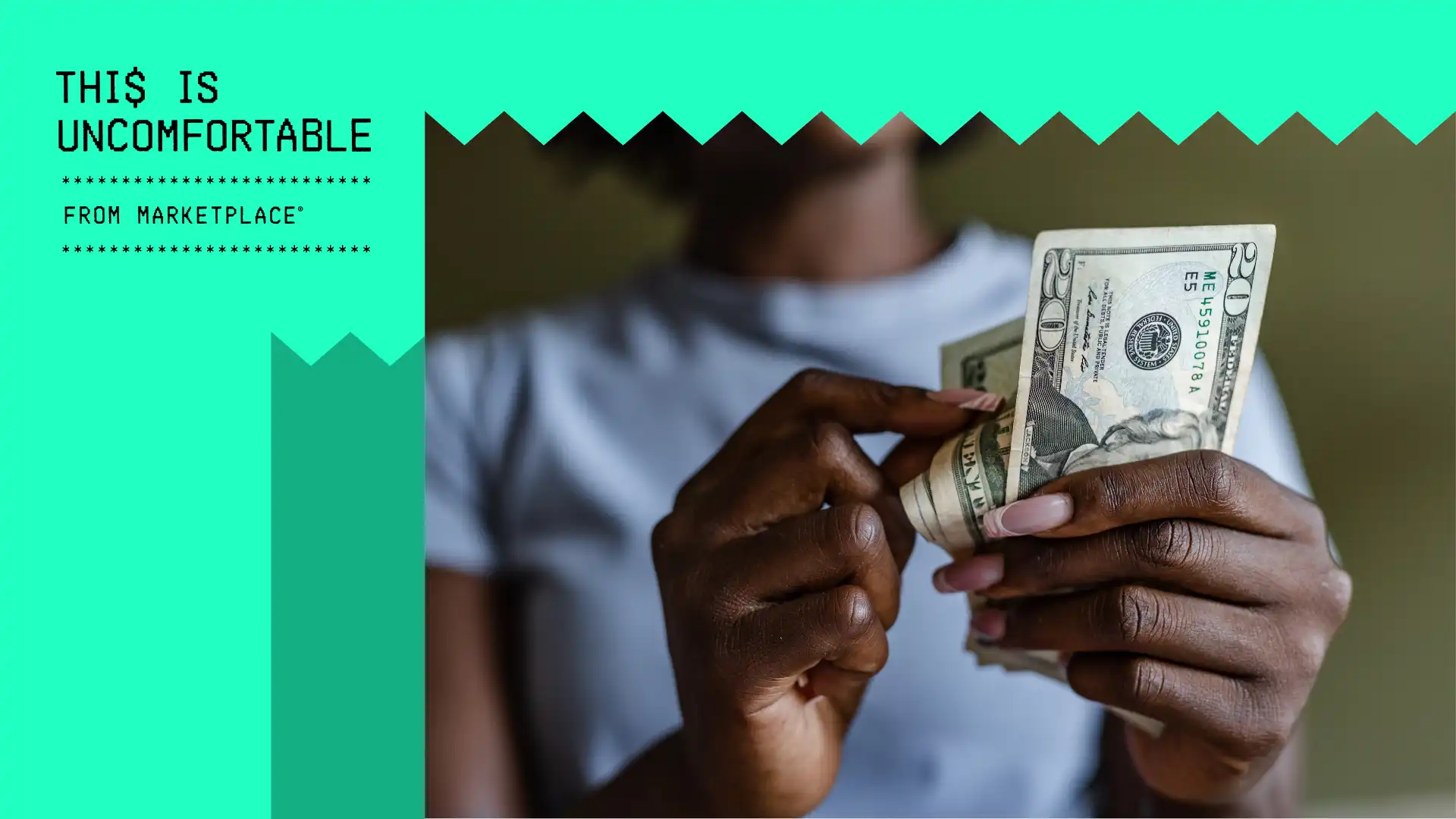
What does it mean to have “enough money?” Is that an ever-moving goalpost, or can we actually pinpoint a dollar amount for optimal happiness? And what’s the psychology that underlies this money anxiety?
Reema talks with listener Miriam Tinburg, who tackled this question in a very practical way when she quit her job to become a content creator. Then Reema digs into the research with Wharton professor Wendy De La Rosa, who helps us understand why this is more of a psychological question than a math problem. And things get more complicated when we hear from Jo Nemeth, an Australian woman who lives “without money.”
A few takeaways:
The “hedonic treadmill” is the idea that no matter how much we have (whether that’s money, pleasure, or anything other good thing) we still feel the need for more. Our brains are really good at adjusting to the “new normal” and then looking ahead for the next target.
Objective vs. subjective wealth: Your objective net worth is a simple equation of all your assets minus all your debts. But that’s not the only way to measure wealth. De La Rosa explains, “Our subjective wealth is all about, how do you feel about your objective wealth? Do you feel like you have enough money? Do you feel like you lack money? Do you feel like you have enough resources? And it's all subjective.”
Your feelings impact your financial behaviors more than your actual wealth. “In our lab we've shown that over and above your objective financial situation, how you feel is more indicative and predictive of your financial behaviors than where you are,” says De La Rosa. They’ve found that those who have been made to feel less wealthy not only spend less but also save less, too, regardless of the amount of money they have!
If you liked this episode, share it with a friend. And if you want to tell us what you thought about the episode or anything else, email us at uncomfortable@marketplace.org or fill out the form below.
This Is Uncomfortable January 15, 2026 Transcript
Note: Marketplace podcasts are meant to be heard, with emphasis, tone and audio elements a transcript can’t capture. Transcripts are generated using a combination of automated software and human transcribers, and may contain errors. Please check the corresponding audio before quoting.
Reema Khrais: Hey everyone, it’s me Reema Khrais. So for the last six years or so, I’ve been asking people to share some of the most intimate details of their financial lives. I was in my late 20s when I started doing this podcast…and I really wanted to understand why our relationship with money can feel so complicated and heavy. And since then, the show has taken me into all sorts of places. We’ve told stories about financial infidelity and the ways money can quietly erode a relationship.
Jordan Rosenfeld: I knew in that moment, I could not keep this secret any longer and live with myself. And so I said, well, I have debt that I haven't told you about.
Khrais: We’ve looked at how something as basic as your teeth can shape your job prospects.
Ryanne Jones: I have this emotional attachment to good teeth. And the thought of not having them again, kind of, it scares me actually because it would be reverting to that past Ryann who is young and not doing really well in life
Khrais: And I’ve even talked with family members of people involved in extremist groups, trying to understand how money and power get tangled up together.
Dakota Adams: The worst things got, the more he hoarded. I knew it wasn't normal to be tripping over piles of survival gear when we couldn't afford to take anyone to the dentist for years on end.
Khrais: And along the way, my life has changed. I’ve gotten married. I’ve moved cities. And the world feels different too. Things cost more. The margin for error feels thinner. And there’s just a lot of uncertainty in the air. I’ve been wanting to build a stronger community to feel a little less alone with our money, and so to really do that, I’m very excited to say that This Is Uncomfortable is going weekly – more episodes, more opportunities for us to connect and learn from each other.
I’m really looking forward to this new chapter and I want you all to be a part of it! I want to know: What sorts of things are keeping you up at night? What’s on your mind? What are your money wins? Or the part of your finances - or the economy - that don’t quite make sense. You can always call us and leave us a voice message at 347-RING-TIU.
Something that’s been on my mind lately is just how precarious the economy feels, even when the numbers don't always reflect that. So many people are struggling to cover the basics. And even if your finances technically work on paper, the ground beneath you doesn’t always feel solid. You're bracing for your next rent increase, or for your healthcare insurance to get more expensive, or for one medical problem to upend your finances…
I’m someone who tends to feel anxious that everything could tip over at any moment - even when I was a kid…that’s where my brain went. I remember being like 8 years old…and always asking my dad the same question: I needed to know how much money he made. I felt panicked. Like if I didn’t know, something bad might happen. My dad was a nurse anesthetist and I couldn’t understand how his salary alone was enough for a family of five. He never told me, but I think I just wanted to grab onto a number - onto something. And I still do this sometimes, like I’ll catch myself thinking - maybe if I make this much…then I can finally stop worrying… Maybe that will be enough.
Nico: Enough? I think, I mean it's, it's a tricky one.
Richard: I could make, uh, somewhere over a hundred grand, that'd be good.
Claude: Half a million dollars.
Nico: I base it off of my anxiety: am I able to feel like there's a safe number in my bank account?
Yitzy: Enough would be 400,000 a year.
Daryl: Shoot enough, it's like, my wife not to be working as much.
Claude: Having enough is really feeling like, for our retirement years, we will not have to depend on our kids.
Ernie: I’d say $1,000,000. That’s enough for a couple.
Khrais: I’m Reema Khrais and welcome to This is Uncomfortable. We’re introducing some new things on the show, including what we call This Week’s Question, where I pose a question about our relationship with money, you know the kind we quietly ask to ourselves, and just sit with it for a bit. Lately, I’ve noticed how often people around me are asking some version of this question: How much money is enough? What’s enough to feel comfortable or to stop feeling anxious?
It’s a squishy question, and I don’t think there’s some magical number, but I am curious how people think of it and what it says about us. So this week, I’m talking with a lot of folks with very different ideas on what “enough” means, including one woman who decided that, for her, the answer was…no money at all.
Those voices you heard at the top are listeners who called in and people we talked to on the streets of New York…Nico, Richard, Claude, Yitzy (Itzy), Darryl and Ernie… I talked with another listener, Miriam Tinburg, who told me she spent years chasing higher numbers....for a long time, she dreamed of making 100-thousand dollars.
Miriam Tinburg: I was convinced when I hit that milestone, um, I'm going to feel like I've made it. I'm gonna feel wealthy, I'm gonna feel proud of myself. I'm gonna feel like, finally I have a quote grownup job.
Khrais: She’d been working in marketing and in tech, living in Los Angeles - and eventually, she got there. Even reached 115k.
Tinburg: You know, I cried. It was like a very big deal. It was a product manager. I was managing a team of engineers. I felt like for the first time I was able to spread my wings, and then, I kid you not within a couple pay cycles, it, it already started, the luster had started to fade, like so fast, and I could not believe it because you know, 30K is a marked difference in your paychecks. You are feeling that!
Khrais: Yeah. That's huge.
Khrais: I think this happens a lot -- attaching a feeling to an arbitrary number and assuming when we get there, the feeling will arrive too.
Social scientists call the “hedonic treadmill.” You know, how quickly our minds adapt to a new normal and slide back to baseline. Like one expert told me that people tend to think they’ll be happier with 10 or 20% more, but when they actually get it, the boost is usually smaller and shorter-lived than they expect. Basically, what happened to Miriam.
Tinburg: My whole thing had always been, get more money with every new job. It was always fight, fight, fight. There was always some like chase that I was on.
Khrais: Right, right.
Tinburg: But then suddenly when I hit 100k, I really had to sit with: wait, what am I supposed to ask for next? Is it 115? Is it a 135, 150, 200? I suddenly was sort of…
Khrais: What's my next number? Yeah.
Tinburg: … confused about what the milestone was, and that's when the beginning of me sort of realizing, wait, I think this is all a bit of a farce that I've been made to believe was like the thing I was supposed to be working towards.
Khrais: Even though more money gave Miriam more stability, it didn’t give her the sense of arrival she was expecting. Instead, her work was draining her. She realized she was spending most of her energy just trying to survive the workday.
Around the same time, she’d started experimenting posting on TikTok and was getting some real traction, like even a couple brand deals. She started to imagine a version of her life that didn’t include a 9-5 or that perfect upward trajectory.
After months of doing the math and talking herself in and out of it, she quit her job. It was scary, but with her debt paid off, a partner to split rent with, no dependents and a small cushion, she decided the risk was worth taking.
Tinburg: I think I had around $17,000 in my, like, lifetime emergency savings, and I said, I'm willing to spend $10,000 from that. So I had calculated, like that gives me like a six-month runway or whatever.
Khrais: She quit her job about two years ago. Since then, her income has been much more variable. She made $85k one year, and about $60-thousand the next…so, far less than she used to make. But the tradeoff has changed how she thinks of “enough”
Tinburg: So for me, the calculus has totally changed. I value time and autonomy over everything. I mean, it's actually almost become too binary in my head, um, between time or money. Now, I'm not saving for retirement. I have not put anything into my Roth IRA this year.
Khrais: Okay.
Tinburg: Um. And I told myself that is a sacrifice that I personally am willing to make. But that's not a sustainable situation, which is why I know I need more. I need to be, you know, planning for the future. I also haven't really been contributing to my savings account, like I'm just breaking even, um, which in itself is a miracle.
Khrais: But for right now, you're saying it's enough for me because I value time over money in this period of my life?
Tinburg: Exactly. But like even saying the word “enough” is such a radical thing. It has transformed my life to even just ask that question. The idea that there could be a ceiling.
Khrais: Yeah. Because for a long time that's not how your brain worked. You were like, there's no ceiling!
Tinburg: Exactly. And so for me it's the feeling of, whoa, I could just aim to settle and slow. And that feels so deeply radical. And so I… I want more people to ask just that simple question of what is enough. If you can sit with it. I mean, and if you, it's even more radical, if you have no idea what enough is. Like that is very hard to sit with because what has been the whole point of what you've been working for?
Khrais: Yeah, I mean that's why I wanna do this episode because it's something that I've thought about quite a bit. And once I actually sit down and have to think about it more concretely, like, oh, what's my actual number? I can feel the anxiety spiking in my body because yeah, for so long, like you, it's just been a treadmill.
Tinburg: Yeah, and it's hard because, on the one hand, you could realize, oh my God, I do not have enough for what I want to achieve. I, that might mean I have to get a new job. I have to do whatever. I have to switch apartments. But the other side is realizing you have more than enough. And you have to sit with the fact that you are, in many cases, hating your life at your job and have more than enough. And I'm not suggesting that everyone quit their job, but it's about like making different decisions: Might you take a longer vacation and actually use all your PTO? Might you not aim for it to be a people manager because you actually don't need the money and that would cause you more stress like, right? So it's the two sides, which I think that is even more powerful in some ways. 'cause a lot, most of us think we don't have enough, whether we do or not.
Khrais: So for Miriam “enough” stopped being about hitting some magic income - and became about how much risk she was willing to live with in exchange for autonomy
I was curious what the research says about this question – how much is enough – and it turns out experts have tried to pin a number to it, at least as it relates to happiness. For years, they thought your emotional well-being kind of leveled off once your basic needs were covered. At one point, like 15 years ago, that number was 75-thousand dollars.
People have kept arguing over the exact figure, but newer research suggests that there might not actually be a ceiling. There are some exceptions, but on average, the research shows that the more money people have, the happier they tend to be, which feels kind of sobering that there isn’t a clear finish line.
But it also makes sense. Like how many of us have thought a raise would solve our financial problems just to have the rent or insurance premiums or grocery prices go up unexpectedly. Unless you’re ultra wealthy, there’s always going to be so many factors out of your control. Which makes it hard to think about “enough” even being possible.
Khrais: When you hear this question…how much is enough…what’s the first thing that comes to mind?
Wendy De La Rosa: What are your fears? What are you so afraid of?
Khrais: Wendy De La Rosa is an assistant professor at Wharton. I wanted her take because she studies how money feels, and she thinks that’s what this question is really about.
De La Rosa: So much of what we spend the last decades studying is how people feel about their money, which can be fundamentally different from their objective financial situation. Like our feelings are really stemming from our perceived difference between our expectations and reality. I should be at a better place than where I am, or I should be earning more than what I am earning now, or I shouldn't have this much debt. We are social creatures by nature, and so we are engaging in social comparisons all the time.
Khrais: I find myself feeling like that depending on the social circles that I'm around. Like if I'm around people who are making a lot of money, I suddenly feel like I don't have enough. And if I'm around another group of friends, I feel like I'm okay. It is interesting how subjective it can feel, based off of your environment – and not even your environment, but the assumptions you're making about your environment.
De La Rosa: Yeah, so much of what we see are essentially the asset side of the balance sheet.
Khrais: Right.
De La Rosa: We see whether or not someone's a homeowner, we don't see their mortgage.
Khrais: We don't know if their family's helping them out.
De La Rosa: Right. We don't know if they're second, third generation family wealth or if they're generation zero. Like we see whether or not someone has a nice car. We don't see the interest rate and the auto loan on that. And so we know that systematically people tend to de-emphasize the liability side of someone else's balance sheet when making judgements about other people.
Khrais: Our imaginations wanna fill the gaps, and usually we try to fill it in ways that make us feel bad. At least maybe that's how my brain works.
De La Rosa: I'm like, Hmm, we should chat about that, Reema.
Khrais: Let's dig more into that. What's going on there?
De La Rosa: That’s true. I think uniquely though, in the American context, there's something else that's driving our feelings, which is we have made so much of our self-worth be our financial worth. You can take that to the founding of the country in that we have these Protestant values. If I'm financially prosperous, then I am a good person and all of my work and my individual work is leading to my financial wellbeing, which we know is not true, but we internalize that. It quickly turns into, man, my net worth is my self-worth.
Khrais: Mm-hmm.
De La Rosa: And that's a really painful place to be, which is why I think people have a really hard time figuring out what's enough. Because what they might be thinking about is: what am I worth?
Khrais: Have you ever felt like that?
De La Rosa: Oh, yeah.
Khrais: You're like, yeah, definitely.
De La Rosa: Oh, yeah.
Khrais: Yeah.
De La Rosa: I come from an immigrant family. I and my mom immigrated from the Dominican Republic. We lived in the Bronx. And we always talked about our lack of money. I knew from a very early age that I was going to do whatever I could to get my family out of the financial situation that they were in. Like I was just so focused on thinking through the world from an ROI perspective.
Khrais: Yeah.
De La Rosa: And I remember when I started my first job right outta college, I was feeling on top of the world because I finally landed a job where I was earning three times what my mom was earning.
Khrais: Oh wow. What was the job?
De La Rosa: I was a private equity investor at Goldman.
Khrais: Oh that’s a big job!
De La Rosa: I really was trying to maximize my, my earning potential. Uh, I was doing everything I could to do that. And I signed up to mint.com. I put in all of my financial situation, and my net worth was negative because all I had…
Khrais: Hmm.
De La Rosa: …were all of these student loans and I just went into a spiral, like I couldn't believe that I had worked so hard for so long, and still I was not even worth a penny right in the eyes of the, you know, American capitalistic system.
Khrais: Sure.
De La Rosa: And it took a long time to disassociate for myself that my self worth has nothing to do with my financial worth.
Khrais: Well, so, okay. If we tie this feeling of not having enough with things like our sense of self worth, how does that affect the way that we make financial decisions?
De La Rosa: In our lab we've shown that over and above your objective financial situation, how you feel is more indicative and predictive of your financial behaviors than where you are.
Khrais: Oh, that's interesting.
De La Rosa: Yeah, we've done a couple of experiments showing that we give people the same amount of money, but we manipulate their subjective wealth, right? So their feelings about how they feel, and then we measure their likelihood of spending, how much they spend or likelihood of saving. And what we find is that unsurprisingly, right? When you feel a little bit more financially constrained, you spend less. Now, what's interesting about that is you would then immediately assume that you would also save more. But that's not the case.
Khrais: Sure, okay.
De La Rosa: When I feel like I don't have enough resources, I not only spend less, I save less. Because how can I afford to save if I feel like I don't have any money right now?
Khrais: Yeah. You don't do much with your money.
De La Rosa: You just don't do anything. You become paralyzed. Like, of course, I'm not gonna save for my retirement, of course, I'm not gonna save into a college savings account. Of course, I'm not even gonna move money away from my checking account when I feel like I don't have enough right now to cover what I think are my basic needs.
Khrais: That's interesting.
De La Rosa: The decision making frame and the decision making framework of people's minds just becomes like an ostrich, right? I am in a bad situation. I don't wanna think about anything. I just want to hoard.
Khrais: I want to cut in here because this point shifted something for me. What Wendy’s saying is that how we feel about our money predicts what we do with it more than the actual number. So feeling like you don’t have “enough” – even if you objectively do – can lead you to make worse financial decisions.
I’ve felt like before, like I can remember specific moments when I’ve told myself that I’ll start investing once I make more money, and then just kept putting it off. It feels ironic that the feeling I was trying to fix – the anxiety of not having enough was actually the thing keeping me stuck.
Okay, now back to Wharton professor Wendy De La Rosa.
De La Rosa: We often tend to think about financial decision making as hard numbers…
Khrais: Yeah.
De La Rosa: ..on a spreadsheet. And it's not like there's nothing more emotional than how we feel about our money and how we make financial decisions.
Khrais: Yeah. And this is like, a lot of this conversation assumes that you have the basic needs met, right?
De La Rosa: Reema, I think that's such a great point. Uh, I, like I think I have a personal convulsion that happens inside of me when people say, like, “Money doesn't make you happy.”
Khrais: Yeah, yeah,
De La Rosa: I'm like, oh, you've never been poor. And you know. actually my life right now is objectively better than what my life was like 20 years ago. It's, it's nice. It's nice to…
Khrais: Yeah. It’s nice to have more.
De La Rosa: Yeah. So it was clear when I was younger that we didn't have enough, the answer was clear no.
Khrais: Yeah. Yeah.
De La Rosa: And how much is enough? I think that was a question where, man, we just, if we can have our own apartment, that would be amazing, right? Like there were clear, tangible ways in which we can answer that question, that were about meeting people's basic needs. Now I remember, like after I started working, I had paid off my student student loans and for the first time I could ask myself the question: How do I wanna contribute to society or what brings me joy? I think we have to be really realistic for a lot of people. Like asking yourself that question, “what brings me joy” is a luxury.
Khrais: Yep.
De La Rosa: I think there's all of these like podcasts and YouTube videos saying like, follow your passion, follow your dreams without wrapping it up into the reality that for a lot of people there is no safety net. You are your family’s safety net, and that's a really difficult place to be. So for me, I'll be really honest, I only started to reframe that question of “how much is enough” once I had the luxury of not – of living above the, of being able to, right? Of living along a, above, like a, a self-sustaining line.
Khrais: One of my takeaways from Wendy is that when we ask “how much is enough” we’re often responding to fear…and questions about our own worth. But what happens if you take money out of the equation entirely? That’s after the break.
[BREAK]
Khrais: Welcome back to This Is Uncomfortable. I ended up talking with a lot of people for this episode, how they thought of “enough” for a comfortable life and right away I noticed some patterns. Like a lot of you all said it really comes down to feeling like you have options.
Matt: Hi this is Matt from Tucson Arizona. And I think what kind of came to me while I was on parental leave which is like the financial security that I could work because I wanted to work, not because I had to work.
Vijay: Hello I’m Vijay Chinta. I would love to leave a little something behind for my children and spend time with my mom who lives in a different country and unable to travel. To me having enough means having the time and the means to be there for those moments while I still can.
Khrais: Some of you all said that “enough” shows up in the smaller things, like when you’re standing in a grocery aisle and don’t need to do the math in your head.
Julia: Hello, my name is Julia and I'm 32 years old. I don't currently have much job security, and the pay is okay, which is about 15-thousand a year, but I personally think it's enough for me because I define it enough as being able to buy milk whenever I want without checking my finances first. When I was financially struggling, I couldn't justify buying most liquids when tap water is free.
Khrais: Julia says if she does lose her job, she’d move back into her van – a lifestyle she says she doesn’t mind.
Julia: In short, I have the flexibility to change my lifestyle to make most of my income be enough. The caveat, though, is that I will need to stay in very good health
Khrais: A lot of you all pointed that out…that the cost of healthcare changes the entire equation.
Amy: My name is Amy and I live beneath my means and save up as much as I can. But five years ago I was diagnosed with cancer. The medical costs in the first year alone reached about 800,000. Now I had insurance, so that's okay, right? But my out-of-pocket costs were still about $30,000. So until we can reach a point where there is some kind of safety net so that people aren't afraid they're gonna lose absolutely everything, no, there's no such thing as enough.
Khrais: What Amy is getting at is that it feels like so much of the risk…the really catastrophic stuff falls on us as individuals.
Another listener, Sinda, made the point that it didn’t always feel like this. A lot of that shock used to be absorbed by the systems around us.
Sinda: I'm from southeastern Michigan, which was once the land of unions and pensions, and this is just not how it was. My grandfather had an eighth grade education and worked at a machine shop, but he was able to retire comfortably with a pension, and my mom was a unionized public school teacher with a pension. None of these people had anywhere near the amount of wealth I'm trying to save just to have enough.
Khrais: I heard from a lot of y’all, because you contacted our hotline, which you can do too! You can call us and leave us a voice message anytime at 347-RING-TIU.
Listening to those messages, I could hear a lot of the vulnerability, this fear that without a real safety net, “enough” is always temporary. I definitely feel like that. Which is why I was surprised when I heard this next story, someone who told me that she’s built a life that doesn’t depend on money for security.
Jo Nemeth: I am Jo Nemeth. I have been living in Australia. I've been living without money by choice for about 10 and a half years now.
Khrais: Jo’s life is extreme. She lives without money…which I know sounds strange to say… something that’s only possible because of where she lives and the fact that she leans on the people around her. She’s very upfront about her unique situation.
I called her up not because I think she’s a blueprint for how to live, but because, well first of all, I was just really curious, but also I wanted to know what “enough” can look like when money is no longer the thing you're chasing.
She made the big decision back in 2014.
Nemeth: And at the time I had been feeling so sad and, and guilty and horrible about the state of the world and the fact that I was complicit in this giant economic system that was damaging people and places around the world.
Khrais: Money felt like the stand-in for the harms of capitalism as she saw it. And at the time, she was reading about this guy named Mark Boyle who’d lived in the UK without money for several years.
Nemeth: I was absolutely gobsmacked. As soon as I read that, I knew that that was the answer for me. I had to try this thing, so I went away and did some research and I was exhilarated. I was so excited.
Khrais: Can you just paint me a picture of what your life was like before you decided to quit your job and close your bank account?
Nemeth: My life before I decided to do this experiment was a fairly regular middle class life in Australia here. I was working in a great job 20 hours a week, really well paid, um, as a community development worker for a local NGO.
Khrais: How much were you making?
Nemeth: The hourly rate was good back then. Um, but because it was 20 hours a week, the annual salary was only barely enough to make ends meet. I was living in a rural old timber farmhouse, and the rent even 10 years ago was quite a lot and I was, um, barely able to pay all of the bills. So I was stressed.
Khrais: And at the time, were you living by yourself? Did you have a family?
Nemeth: No, at the time I was living with my partner and my daughter. And my daughter was just finishing high school, so I decided to do this experiment once she had finished high school and she was set up safely in her own, you know, life.
Khrais: How are the people in your life reacting and how would you sell it to them? Were you like, I just wanna give up money, and…
Nemeth: Yeah,
Khrais: How did they respond?
Nemeth: Yeah. I knew that it would not go down well with my partner. And I knew that it meant that we would have to break up because he was looking to do the opposite. He was thinking of moving back to Sydney and back into his kind of high powered moneymaking lifestyle that he had come from. I had hoped that he might be able to come part of the way, but yeah, no, when, when I did talk to him about it, he was not very interested.
Khrais: Alright, so you decided that you wanna live a life without money. What's the first thing that you do?
Nemeth: Well, the first thing that I did was I made a list of the things that I would need, actually need, not want, but need. And it was very short. It was surprisingly short. We all know…
Khrais: What was on that list?
Nemeth: Yeah. Uh, what was on the list? Accommodation, food, water, pens and paper, cooking equipment, clothes, toiletries.
Khrais: So you were gonna figure out a way to acquire all those things without money?
Nemeth: Exactly. So I, I had some friends who lived down the road who had a big farm, three young children, busy careers. I knew that they had their hands full, and I thought I would, I… so I decided to ask them if I could come and live on their farm and help them out.
Khrais: How did they respond?
Nemeth: When I first, when I first started talking to people about this, I was really nervous because…
Khrais: Oh, I'm sure.
Nemeth: It was such a strange thing to, to be talking about. And, um, but they were immediately receptive and we started to make plans for me to move there and help them out in their market garden.
Khrais: So you figured out rent, you were staying at your friend's place. How were you checking the other things off of your list?
Nemeth: Yeah, so I was really nervous about not having enough food to eat. So I had, before I gave up the last of my money, I had bought some, you know…
Khrais: Wait, sorry. You gave up your money?
Nemeth: Uh, well, I just, I only had a little bit left.
Khrais: Okay.
Nemeth: Um, so I closed my bank account, is a better way of saying it. My last $12 I spent on New Year's Eve food, because I was trying to start on New Year's Day in 2015.
Khrais: Ooh, okay.
Nemeth: And then put the last few coins in a donation tin, and it was very freeing. It was such a nice feeling. Um, I just, I guess so, so food, yeah, I was nervous…
Khrais: Oh yeah. Going back to food.
Nemeth: So I had bought some, um, lentils and rolled oats and rice and things like that. But I knew what I wanted to do was I wanted to live out of my friend's market garden. I was gonna be working in their garden and I wanted to live on what I could produce there. I also had some chickens. Or we call 'em chooks here in Australia. I had some chooks so I had access to some eggs and we live in an area where pecan nuts and macadamia nuts grew readily. So I had kind of thought about all these things and knew that I would be okay for food.
Khrais: Yeah, but before I ask my next question are those birds i hear in the background?
Nemeth: I can't believe you can hear the birds. I don't even notice them at the moment. They're not even the loud ones right now. Oh, there was a storm bird. That was a storm bird that was just calling.
Khrais: It sounds beautiful. Okay, so going back to your lifestyle…it sounds like generally speaking, you're being resourceful, but you're also relying a lot on your community.
Nemeth: Yeah, and so a lot of critics will say, I have, I've got a few critics out there, and they'll say, well, you're just bludging. I dunno if that's an Australian word? You are just using other people.
Khrais: Yeah.
Nemeth: And you know, in a way that's true. I'm reliant on other people and I'm reliant on my community. And at first I felt really bad about that, but I realized over time that we're all reliant on other people. When we live with money, we still have underlying that economy, this gift economy that works in the background where we share and we give just naturally, mostly to friends and family. And what happens is the more you gift and the more you share, you build strong connections and you build a community around you. And so that's what's happened for me in the last 10 years. I've got these really strong connections. And I can give eggs to people, and eggs are really expensive apparently. Um, and I can make sauerkraut and I can make, you know, fermented kefir. Mostly a lot of it with waste products that I collect and I can give that to people. So there's all sorts of ways that we give.
Khrais: Yeah. How would you compare your life back then and your overall wellness to how things are today?
Nemeth: My life now is easier, um, than it was before when I was living with money. I don't wanna go back to living with money. That actually really scares me because living with money is really hard. Um…
Khrais: Oh, that's so interesting that you feel like it's harder than the kind of life you're living right now.
Nemeth: Yeah, totally. Um, you know, and…
Khrais: Because it seems difficult what you're doing.
Nemeth: Yeah, this lifestyle really suits me. I wouldn't suit other people and other people would find it much harder. And it does really help that I already had a good social, a good network of people around me 'cause you really need that. If you were a grumpy person who didn't like people and didn't, didn't like doing the kinds of household management jobs that I fill my days with, then this would be a terrible life.
Khrais: But also it doesn't seem feasible to have this way of life without that kind of social currency and support.
Nemeth: That’s right. Yeah. You couldn't do it. You, you really do need other people around you, and money gives us that false sense of independence that's not really real. We’re still dependent on others, but it creates a distance between others and the people who meet our needs, when we have money.
Khrais: So is this the plan indefinitely? Like is this no longer an experiment for you?
Nemeth: Yeah, I would really like to keep doing this forever. Um, but I think that what's gonna let me down is my teeth, you know, my health, my health is generally good, but I have issues with my teeth. And in Australia, I'm very lucky again to be living in this country that I live in where we have some free- some free dental care and some free healthcare.
Khrais: That's huge, by the way.
Nemeth: Yeah, I know. I know.
Khrais: The fact that y'all have free healthcare. Wow, I think this life would be infinitely harder, uh, here in America.
Nemeth: That's right. Yes. Yeah, exactly.
Khrais: And if you do wind up needing a lot of money, do you imagine that you'll get that from your community as well?
Nemeth: No. If I, if I need money, I'm gonna have to go and earn it. If it was an ongoing need for money, then I would go and get a job, you know? And then that, with that would come all of these questions like, then do I… I need to pay for rent then, and I need to pay for my, um, you know, different things that I'm not currently paying for with money.
Khrais: Oh, why would you feel like that?
Nemeth: I don't know, having money I think changes the dynamic. It changes the relationship with those around me in a way.
Khrais: You know, the driving question of this episode is how much is enough? How do you answer that question?
Nemeth: Yeah well, once you have your basic needs met of food and water and housing, um, you need people and yeah. And that's, that's enough, really, if you have those things. The best thing about living this way is that my, my actions meet my values. Whereas before I had all these values about, you know, no not doing any harm and trying to live, you know, with fewer impacts, but my world didn’t allow it because i was stuck in this treadmill, in this rat race. It's been such a great experiment in the last 10 years, just to see how caring and giving and loving people are. You know?
Khrais: When I was talking with Jo, I could hear two competing voices in my head.
Part of me genuinely found her life inspiring… the clarity, the way she talks about needing less. And then another part was like, okay, this only works because other people are still inside the system, which she acknowledges.
But I do think there’s value in looking at an extreme case. No matter how carefully we plan, there’s only so much we can control, right? Your rent can go up. You can lose your health insurance. A wildfire or a flood can wipe out everything. Unless you have millions, there’s always going to be some vulnerability.
But I think Jo is basically saying money isn’t the only thing that buffers those risks. Another form of wealth is community, which is something we do have more control over.
That anxiety we feel chasing the next raise is real. But maybe it is just as important that we get to know our neighbors and build relationships – and to invest in the kinds of connections that can hold us when money can’t.
That’s all for this week. But let me know, after listening to this episode, how do you think of this question? Did any of the stories bring up anything for you? Also - going back to that last point - let me know if you’ve ever relied on your community or friends to get you through a tough financial time.
You can give us a call at 347-RING-TIU. That’s 347-746-4848. or you can send us an email uncomfortable@marketplace.org. We love hearing from you.
And you can find us on social media, @ThisIsUncomfortablePod on Instagram and TikTok.
This episode was co-produced by our Senior Producer, Zoë Saunders, and me, Reema Khrais, with help from CC Lucas. Our producer is Alice Wilder. Audio engineering by Drew Jostad. Bridget Bodnar is Marketplace’s Director of Podcasts. Marketplace’s Chief Content Officer is Joanne Griffith. Neal Scarbrough is Vice President and general manager of Marketplace.


 Apple
Apple Spotify
 Amazon
 RSS
RSS