We’re checking in on the James Webb Space Telescope’s first year.
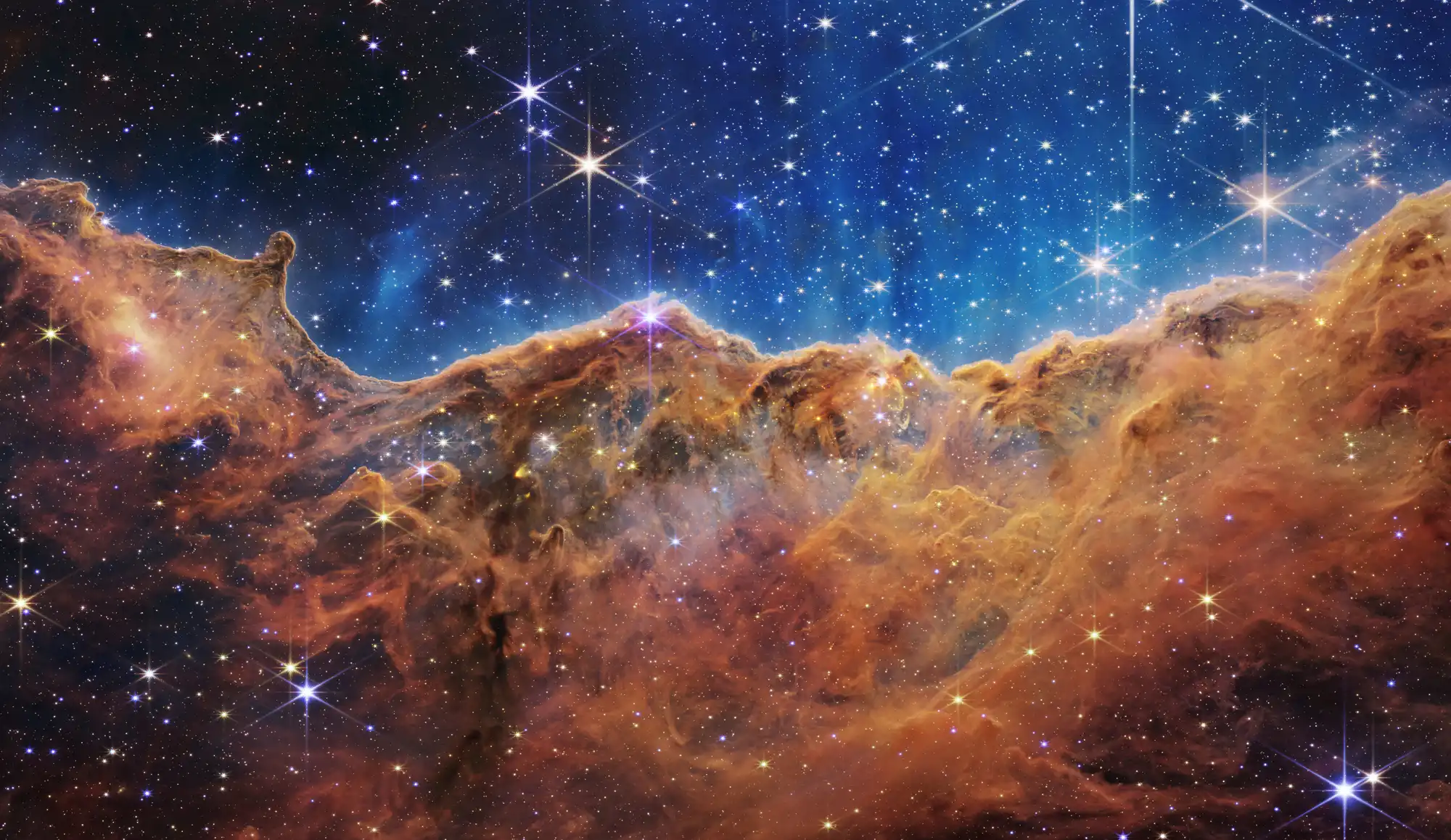
NASA recently celebrated one orbit around the sun since the James Webb Space Telescope became operational.
This powerhouse piece of technology is expected to cost NASA around $10 billion over a span of 24 years. But Caitlin Casey, professor of astronomy at the University of Texas at Austin and leader of one of the biggest JWST projects, says that so far the investment is well worth it.
“I like to put it in perspective. The JWST cost something like $10 billion. That’s what the United States spends on potato chips in a year or so,” Casey said.
On the show today, Casey shares some of the exciting discoveries her team has made in the first year of the JWST’s mission and fills us in on the buzz over gravitational waves. Plus, why learning about the seemingly incomprehensible cosmos can keep us grounded.
Later, we’ll discuss dueling op-eds that arrive at the same conclusion: Immigration is good for the economy. And, UPS appears to have averted a major strike by agreeing to a contract with its unionized workers.
Then, a follow-up on high injury rates in women’s soccer and a beer cocktail recipe for Kimberly. Plus, a tortoise with the hiccups inspires this week’s answer to the Make Me Smart question.
Here’s everything we talked about today:
“12 amazing James Webb Space Telescope discoveries across the universe” from Space
“Webb telescope discovers oldest galaxies ever observed” from Phys
“New 3D Visualization Highlights 5,000 Galaxies Revealed by Webb” from NASA
“The James Webb Space Telescope is out of this world” from “Make Me Smart”
“America’s Choice: Immigration or Bust” from The Wall Street Journal
“Opinion | The left needs to win, not duck, the immigration debate” from The Washington Post
“UPS Reaches Tentative Deal With Teamsters to Head Off Strike” from The New York Times
“IMF raises global growth forecast despite China’s recovery ‘losing steam'” from CNBC
“Nike is coming out with a soccer cleat specifically for women” from NPR
“Boots and balls made for men an injury risk to women footballers” from BBC News
We want to hear your answer to the Make Me Smart question. You can reach us at makemesmart@marketplace.org or leave us a voicemail at 508-U-B-SMART.
Make Me Smart July 25, 2023 Transcript
Note: Marketplace podcasts are meant to be heard, with emphasis, tone and audio elements a transcript can’t capture. Transcripts are generated using a combination of automated software and human transcribers, and may contain errors. Please check the corresponding audio before quoting it.
Kimberly Adams
Awesome, I think we are good to go. Let’s go. Hello, I’m Kimberly Adams. Welcome back to Make Me Smart, where none of us is as smart as all of us. It is July 25.
Kai Ryssdal
I’m Kai Ryssdal. Thanks for joining us on this Tuesday, Tuesday shows are of course, one topic, the topic du jour is space. Because it’s cool. And Kimberly and I like to talk about it. And so we’re gonna and we’re gonna talk space, most specifically the James Webb Space Telescope.
Kimberly Adams
Which you may have heard when we talked about it incessantly last year when it was just getting up in space. But since then, as predicted, it’s helped astronomers break totally new ground in our understanding of the universe and how it’s worked, how it works, raised tons of new questions. But we’re going to learn all about that and more, plus some mind boggling discoveries, like gravitational wave background. But back to make us smart about this is Caitlin Casey. She’s a professor of Astronomy at the University of Texas at Austin and a leader of one of the biggest projects on the JWST as we the cool kids call it. Don’t steal my joy. Dr. Casey, welcome back to the program.
Caitlin Casey
Thanks so much for having me. It’s great to be here.
Kimberly Adams
So how does it feel to be celebrating one year of working on the James Webb, I know you were working out long before. But how does it feel to celebrate a year with the James Webb Space Telescope, it’s JWST.
Caitlin Casey
It’s awesome. It’s been a phenomenal year, we’re just so excited to have such an amazing telescope up in space. It’s been transformational in terms of what we’ve been able to look at in the cosmos, how far we’re able to look, how faint we’re able to look. So it’s really been a whole new world for astronomy in general. And so we’re just super excited to see what comes in the next several years from this awesome, awesome telescope.
Kai Ryssdal
What is your project? Layman’s terms, please?
Caitlin Casey
Yeah, we’re, it’s a great question, we are trying to build the largest deep field that has ever been taken. So your listeners may be familiar with the Hubble Deep Field image. It’s one of the most iconic astronomical images ever taken by the Hubble Space Telescope, which is the predecessor for JWST. And Hubble Deep Field is this image that you know, represents just a speck on the night sky if you’re holding your arm out and holding a pin. And in that, you know, in your hand, it is the area of sky that is covered just by the head of a pin. It’s an incredibly tiny area. And in it, it contains thousands like tens of thousands of galaxies that stretch all the way back to the beginning of the universe. So what we’re trying to do with JWST is take similarly deep images of space, finding the most distant galaxies, but we’re doing it over a big area of sky. That’s approximately the size of three full moons. So you can imagine the size of the full moon. It’s not about, it’s not a speck on the sky, right? So we’re patching together, just an enormous deep field that is about 200 times larger than the Hubble Ultra Deep Field.
Kimberly Adams
So how’s that going?
Caitlin Casey
It’s a lot of work. Let me tell you that. It’s going really, really well. We’re not done with it yet, though. So the project is actually so big that they couldn’t even fit it into the first year in its entirety. So half of it is spilling over and we’re not going to get the other half of the deep field until the end of this year, or right around New Years. It turns out JWST is very, very difficult to schedule, you know, lots lots of different things to consider. It has to, you know, point at sun shield at the, at the sun, so the instruments stay cool. And you know, where you can look in the sky at any given time is pretty restricted. And when you’re trying to build a really, really big deep field, you have to take all of that into consideration.
Kai Ryssdal
Alright, so I’m gonna get a little dorky here. Actually, one of the big things about this telescope at Kimberly and I fixed on last year when we were talking about it was where it is and why it has to be there? So could you explain just picking up off your thing about the sun shield and all that jazz? Could you explain number one, what a Lagrange Point is? And why this thing has to be all the way out there?
Caitlin Casey
Yeah, that’s a great question. So yeah, JWST is located at a spot called L2. It’s a little grunge point, it’s, you can think of it like a stable point in the solar system. It’s kind of like a gravitational special place between the Earth and the Sun. It’s actually further out from Earth than you know, it’s pointed kind of in the opposite direction of the sun. So it’s always further out in the solar system than the Earth, it’s about a million miles. So it’s, you know, about five times the distance of the moon. So it’s pretty far out there. And JWST is set up to orbit this special spot, it basically minimizes how much fuel you need to spend and you know, keeping it in a stable position to keep it around this gravitational well, but we keep it far away from Earth, so that it actually can stay really, really cool. The Hubble Space Telescope orbits Earth, but Hubble is not able to see the same type of light that JWST can see. And and that’s in part due, in part because the Earth radiates a lot of energy. And so we want to keep JWST as far away from from that energy as possible.
Kimberly Adams
It’s radiating quite a bit of heat at the moment, um.
Caitlin Casey
Yeah it is. Hot everywhere.
Kimberly Adams
Yes, it is. We’ve just seen these astonishing images. And I’m seeing images, not photographs, because I recognize that they’re not images coming out of JWST. Have you been surprised by anything that you’ve seen or that you found in the data?
Caitlin Casey
Yeah, totally. I think astronomers, the world over have been surprised by all of the discoveries in the last year, but in particular, I think the thing that’s most interesting, that we’ve been, you know, thinking a lot about, is the discovery of really enormous galaxies that have been found in the universe’s infancy. So if I can back up just a little bit and explain or remind everyone what a galaxy is, it’s collections of hundreds of billions of stars. There’s a lot of gas, dust, dark matter. Throw in a little planet, you know, action with some aliens, probably. Yes, yeah. Galaxies are cosmic cities like this is where all the action is in the universe. Our city is the you know, the, our cosmic city is the Milky Way. It’s huge. But there are billions and billions of galaxies. And as we look towards more and more distant galaxies, we’re looking in the past. So with JWST, we’re able to look towards the most distant objects we’ve ever seen. And we see galaxies that are surprisingly huge for the age that the universe was when when we are able to see this light. So we’re looking at galaxies that formed, you know, a couple hundred million years after the Big Bang, this was a new universe was only like 3% of its current age. It’s really, really young. And, you know, we say Rome wasn’t built in a day. Well, we actually are looking at galaxies that seemingly had been built incredibly quickly. Not not in a day, I’ll be it. But you know, in 50-100 million years, cosmically speaking, that’s kind of like a day. So we’re trying to figure out how these things are built so quickly, after the Big Bang itself.
Kai Ryssdal
Speaking of things being built, and with all possible respect to the engineers and scientists who did the amazing work to number one, build this thing number two, get it safely out there. And then number three, sort of operationalize it. Are you surprised it’s working?
Caitlin Casey
I am pleasantly surprised it’s working. Yeah. I, right around the time of launch the entire community, I think, the entire world was slightly worried that that’s something terribly would, you know, go wrong. There were over 300 Single Point failures, where we’re JWST could just be a piece of floating space junk. And and so we were all really, really concerned. But we know the engineers just poured their hearts out to make sure that this would work and work flawlessly. And yes, there were, you know, delays getting it up in space. But my goodness, you know, I think I think we, the wait was certainly worth it in terms of the results that we’re getting. And, you know, we also look back and know that those delays cost a lot too. But you know, the net cost, I like to put it in perspective, like JWST cost something like $10 billion. That’s what the United States spends on potato chips in a year. So I think, I think it’s well worth it.
Kimberly Adams
That was a well-rehearsed justification.
Caitlin Casey
We like to put it in perspective, science is worth it.
Kimberly Adams
That’s like when we tell people we’re fundraising. It’s like, it’s no more than your daily cup of coffee.
Caitlin Casey
That’s right. That’s right.
Kimberly Adams
I want to ask you about something that’s not exactly JWST related, but has also confused me the way that much many things do. We’ve been hearing a lot about a breakthrough on gravitational waves lately. Can you explain that so I can understand?
Caitlin Casey
Yeah, oh, my gosh, lots to unpack there. But super exciting. So gravitational waves, I’ll remind you were discovered, for the first time, it was announced in 2016, from a discovery in late 2015. And that was discovered with the LIGO experiment, which is this giant Laser Interferometer Gravitational-Wave Observatory. And what gravitational waves are our ripples in space time itself, which sounds totally wild, what it is, is a warping of the fabric of space from some monumental event, in particular, the merging of black holes. And this happens when, you know, black holes have incredibly strong gravitational forces. And when they collide with one another, they kind of in-spiral and, and then they release a lot of energy. And they basically cause this ripple to propagate through space. It’s like, you know, throwing a pebble on the surface of a lake, you see ripples. And so that’s happening in space to the fabric of space, all the time. But in 2016, the initial gravitational wave detections were discovery of black holes that are, you know, formed from stars that are relatively small black holes, we actually know that there are much, much, much larger black holes in the cosmos, that are at the center of galaxies, it’s like, you know, the cosmic hub. And those supermassive black holes should also give away gravitational waves. And so the recent result announced from this new gravitational wave experiment called NanoGraf is really, really clever, they have now detected pervasive background of gravitational waves caused by the merging of supermassive black holes. And it’s, it’s like, instead of, you know, the ripple on the surface of the lake, it’s like we’ve been, you know, thrown in an open ocean where there’s just a tumultuous storm. And we’re not standing on steady ground anymore at all. Basically, the cosmos is constantly churning. And there are these ripples sent through space that change the shapes of objects as they as they propagate. So it’s a pretty abstract concept. They did this experiment through really a really cool technique. They used stars, all throughout our galaxy, actually as the telescope as the detector. Because this experiment could not be done on planet Earth alone, which is pretty wild to think about. People are super clever, basically.
Kai Ryssdal
So alright, I’m gonna get even even dorkier here. Could you give like a an, I only do this because I know you’re an educator and you can do this, could you do like, like a 60 second version of what space time is that whole continuum thing we hear about? And I know so you got 60 seconds right? And and also why other than the knowing of that we’re on this constantly churning mass of of space. What are we going to do with this? Now that we know about it?
Caitlin Casey
That’s a great question. So space time is, you know, you have some intuition for this, whether or not you know it. So space, you know, it has three dimensions, we walk through space all the time. And then time, you can think of it as a fourth dimension, you know, we march only forward through time and our lived experience, but time also gets warped in funny ways, when we get close to traveling, you know, at very high speeds, in the cosmos, or near really strongly gravitational objects in space, like black holes. So space time is, you know, just where we live. So you can, you know, it’s as simple as that. And in terms of why, you know, why, what are we learning? And, you know, how is it important, man, you know, it doesn’t get more fundamental than the reality, you know, of, of, you know, our existence, right. And so I think, the fact that we’re able to design these incredibly clever experiments that learn about these really fundamental facts of, you know, the geometry of the space around us and the cosmos around us, I think it’s pretty important, again, worth worth a year’s worth of potato chips.
Kai Ryssdal
No, totally. Sorry, last thing and then I’ll get out of your hair. Do you have, when you’re in a PhD program, studying this kind of stuff, do you have to take like philosophy classes so that you can wrap your brain around it? Because honestly, it’s just it’s no pun intended other worldly right? How you think about this stuff?
Caitlin Casey
Yeah, it is. I mean, your brain will explode if you think about it every day. So you know, on the day to day basis, I, you know, we’re not we’re not thinking about the philosophical implications of what we what we do, but it’s, you know, certainly whenever I get in a classroom and see the wonder on the face of like, students, it’s, it blows my mind every time you know, how lucky that I get to study this stuff?
Kai Ryssdal
Okay, go ahead. All right. You get the last one.
Kimberly Adams
This is the last question I swear. But in terms of it, like blowing your mind, I mean, I had a super religious upbringing, right. And I, people jump through all sorts of hoops to try to explain the Big Bang and match it up with creationism. And, you know, the whole seven days thing. I mean, has, has this whole experience, like at all change the way that you actually do think about your philosophy of time and, and space and even like faith and things?
Caitlin Casey
Yeah, yeah, I would say, it’s very common for folks who study this stuff, to, you know, have a moment of questioning everything you’ve learned, growing up. And you know, whether or not you’re, you’re religious, or, or, you know, have some spirituality, it certainly grounds you in a different way. And what I’ve kind of come to accept is that science is a quest where we’re trying to understand the truth, and we’re trying to understand, to the best of our ability, what the history of everything is not just life on Earth, the cosmos, how it came to be. And, you know, I think it every time we design a new experiment, the cosmos surprises us. We weren’t expecting the Big Bang, initially, we weren’t expecting that the universe is accelerating in its expansion. So many of these things were not expected. But it’s the pursuit of that truth that has become kind of the the grounding principle that I think a lot of scientists hold on to, and we try to also, you know, share that because I think that’s, that, that anchors you in a way that, you know, trying to shoehorn science into, you know, a certain religious philosophy is can be difficult.
Kimberly Adams
All right, for real now, Caitlin Casey, professor of astronomy at the University of Texas at Austin, super fascinating. Thank you so much.
Caitlin Casey
It was great. Yeah, thanks for having me.
Kai Ryssdal
Thanks a lot. Yeah, could have done that all day.
Kimberly Adams
I know right.
Kai Ryssdal
But we have half an hour on our podcast. Yeah. So I’m not gonna say too much more. But let us know what you think about this new era of space discovery. And if it you know, honestly, I’m curious if it changes the way you’ll feel about you know, what you learned growing up or what you think now are now Is 508-827-6278 also known as 508-U-B-SMART. You can also email us makemesmart@marketplace.org. We will be right back.
Kai Ryssdal
Okay, news, Kimberly, you may go.
Kimberly Adams
Thank you. Well, I was struck…
Kai Ryssdal
I try to shake it up every week. Whatever.
Kimberly Adams
Yeah, you know, what, add some spice to life. By two contributions to the opinion pages of two of our major newspapers, the Wall Street Journal and the Washington Post, which has, many of you will know, often say very different things, on their opinion pages, to put put it mildly. But both of them have opinion pieces right now on immigration, saying effectively, the opposite things. So Perry Bacon has a piece in The Washington Post, saying the left needs to win, not duck, the immigration debate. The headline on the Wall Street Journal is “America’s Choice: Immigration or Bust,” both of them saying that we are struggling with population decline, we do not have enough people, we do not have enough workers, especially when we consider you know, the aging Baby Boomer population, and then leaving the workforce while also requiring more care, especially in the healthcare industry. But our working age population is declining, we’re in trouble. And the only solution because you know, blame it on Millennials not having kids because it’s too expensive to raise a child in this country. The only solution at this point is immigration. And you have the Wall Street Journal, which often carries the opinions of people complaining a lot about immigration, saying that we have to get somebody to say that immigration is good for America. And that needs to be the narrative. And that was very interesting to me. And then you have Perry Bacon in The Post, saying that the left needs to own that argument and push the I guess, promote Republicans as anti-immigration because of their policies. And it’s almost as if people want the same thing. You know, if only we could perhaps come up with some policies that can achieve the goal that apparently we all seek. I remember one time I was doing an election story on immigration in the last presidential campaign. And, you know, there was some policy that I think Trump was pushing, that was anti-immigrant and I was, you know, doing that thing where you try to get a variety of perspectives commenting on it. But I was talking to economists about immigration, and I called every conservative think tank I could think of that was not, you know, like, on, you know, the Southern Poverty Law Center’s list of hate groups, you know, and could not get any of them to say, anything aligning with what the Trump campaign was saying. And finally, I talked to this one economist from a conservative think tank. And he said, the reason you’re not getting anybody on the record on this is because you are not going to get any self-respecting economist, conservative or liberal to say that immigration is bad for the economy.
Kai Ryssdal
Right. Right.
Kimberly Adams
And they may not want to say it on the record because they don’t want to harm their chances to get a job in the administration. But no self-respecting economist is ever going to tell you that immigration It’s bad for the economy.
Kai Ryssdal
Right? It’s crazy making we all know it. And look, I’ve said on this podcast many times I have blamed Congress in the United States for the failure on immigration policy, but it’s, it’s failure up and down the chain of, of leadership and, and intellectuals in this economy, right, both on the right and on the left, who are afraid speak the truth, because of politics. You know, it’s amazing. It’s amazing. Those are those are good items. So that’s, that’s, that was really good. That was a great juxtaposition. And really well that I, that was great. Okay, so I’m just following up from my from my rant from yesterday, where all the news was crap. And today, there’s there’s actually some good news. I mean, the bad parts are still bad. But the good parts are, you know, there are some of them, one of them, one of them is that UPS has agreed to a contract. Apparently, with the Teamsters, there’s a tentative deal, this would have been a very big deal if there was a strike. And I just think it’s progress that there is some sort of negotiated peace between labor and management on a key slice of this economy, all those brown vans that drive around, so that’s a good thing. And then the other good thing slightly less good but and slightly more remote, but but still generally good as the International Monetary Fund increased, raised its global growth forecast this year, despite some you know, not great signs, right? There’s still inflation, China’s slowing down all of that jazz, but global economic growth is now expected to be around 3%, which is historically on average, very good. And especially given where we are coming out of the pandemic and supply chains and China slowing is pretty good. So, so yesterday was terrible and today, here’s you know, reasonably happy Kai and that’s what we got.
Kimberly Adams
It’s like that song from Annie, “yesterday was plain awful.” Right? That was then, not now.
Kai Ryssdal
It’s all gonna come out tomorrow or whatever it is. Any who.
Kimberly Adams
Different song in the play but go ahead. Different songs.
Kai Ryssdal
That’s, that’s the only one I know. That and “Hard Knock Life.”
Kimberly Adams
It’s the ending song.
Mailbag
Hi Kai and Kimberly. This is Godfrey from San Francisco. Jessie from Charleston, South Carolina. And I have a follow up question. It has me thinking and feeling a lot of things.
Kai Ryssdal
Alright, so Women’s World Cup is on the United States. Women play tomorrow, by the way. Tomorrow evening against the Netherlands that’s going to be a good game. Anyway, I mentioned that because last week, I brought up the New York Times article on the high rates of ACL injuries in women’s soccer, right the the anterior cruciate ligament in the knees. Lots of those popping up right now on women’s soccer. And we got this.
Stephanie
Hi, this is Stephanie calling from Somerville, Massachusetts. The BBC has been doing this very interesting series on other issues surrounding women’s soccer. or football as I like to call it. And one of the things that has come up is that the women don’t get their own boots designed for women’s feet. And so they end up getting less ankle support and less arch support and just the way that women’s biomechanics works, It ends up rotating knees more often than it rotates ankles. So women have much higher rates of ACL injuries than the men do. Thanks for making us all smart. Hopefully that made you a little smart, too.
Kai Ryssdal
No, it was really good. There was a piece on on another public radio program whose initials are All Things Considered. Mary Louise Kelly did an interview with somebody about Nike coming out with a soccer cleat designed specifically for women to address some of those issues, the clip pattern on the bottom is different. The contact areas for the ball up on top are different. So yeah, I mean, science is getting there. And that was kind of the point of me bringing up that article in the first place is that women’s athletics is now getting the attention it needs to fix some of the chronic chronic problems, right? And I’ll speak only specifically about soccer here, right, but playing on turf and conditioning help and equipment help with the new cleats. That’s what it’s all about.
Kimberly Adams
Well, um, it’s kind of like how for so many years women had higher fatality rates and car accidents, because like, cars were not designed for us to survive. And so, no, these are fixable problems. All right. One more. A while ago, I mentioned that I had some non-alcoholic beer that I needed to use up, which randomly I used in the recipe yesterday, and someone called in with a different recipe to help me out.
Lori
Hi Make Me Smart team. This is Lori from San Diego with a cocktail recipe for Kimberly. We learned the recipe while stationed overseas in Iceland and it’s called the Combat Margarita. You need a frozen Limeade can, any size, you need some tequila and you need a beer. I know it doesn’t sound promising, but stick with me. First dump the frozen Limeade into the blender. Next, fill the Limeade can with tequila. Add that to the blender and then fill the Limeade can with beer and add again to the blender. Blend the whole thing with ice and prepare to be amazed.
Kimberly Adams
I am skeptical. But I will try.
Kai Ryssdal
I don’t know. I don’t know. I can see Drew through the glass. He’s kind of scared chuckling and shaking his head. I don’t know.
Kimberly Adams
I mean, look, it’s hot. It’s hot. It’s about time for some frozen cocktails. And by using the non-alcoholic beer it’s going to make that drink less boozy, which is probably good for me because after last Friday, I still believe gin is the devil.
Kai Ryssdal
There you go. All right. So, before we go, we’re going to leave you with this week’s answer to the Make Me Smart question, “What is something you thought you knew, but later found out you’re wrong about?” So we’re gonna play this and then we’ll do a little back announce here.
Shannon
Hello Make Me Smart crew. My name is Shannon and I’m voice memoing from San Diego, California. The video that I sent is of a local tortoise named dash. I see him quite often when I’m out for an evening walk and the other day, he really looked like he was hiccuping … and then came home and consulted the interwebs and found out that indeed, tortoises can get the hiccups. Which I find is just a wonderful thing. And is also a bit of a thing that I thought that I knew and later found out I was wrong about in the sense that every time I have the hiccups, I always think that they are never going to end and every time I am proven wrong. They are a thing that seems like they will never be over like a very long week, but they are.
Kai Ryssdal
So she sent us a video of this tortoise. His name as she said is, Dash we will have it on the show page. And he’s got the hiccups. That’s all I can tell you. It’s all I can tell you a little make me smile on a Tuesday, I guess.
Kimberly Adams
But how did the, how does the tortoise get rid of the hiccups? Because we all have our own strategy. What is the tortoise?
Kai Ryssdal
My wife is my wife is a chronic hiccup her and she’s got all kinds of tricks, all kinds of trucks.
Kimberly Adams
All right, we want to hear your answer to the make me smart question. Our number again is 508-827-6278 also known as 508-U-B-SMART.
Kai Ryssdal
Today’s episode of Make Me Smar,t which is the podcast you are listening to is produced by Courtney Bergsieker. Ellen Rolfes writes our newsletter. Today’s program is engineered by just checking yes, he’s still there Drew Jostad. Becca Wineman is gonna mix it down later. Our intern is Niloufar Shahbandi.
Kimberly Adams
Ben Holliday and Daniel Ramirez, Daniel Ramirez, composed our theme music. Our senior producer is Marissa Cabrera. Bridget Bodnar is the director of podcast. Francesca Levy is the executive director of Digital. And Marketplace’s vice president and general manager is Neal Scarbrough. Gonna go ponder God now.


 Apple
Apple Spotify
 Amazon
 RSS
RSS