Conventional budgeting wisdom, like the 30% rent rule, is usually based on gross income, but experts say these guidelines are just a starting point. Personal circumstances could change your tax bill and therefore your budget.
Student loan interest was paused during the pandemic, but that ended in September. That’s just one reason experts expect more borrowers to default on their loans.
The current economic landscape, marked by tariffs and other policy-driven uncertainty, could be a particularly difficult one for Fed decision-makers to navigate in the next few months.
Applications for mortgages at Bank of America increased about 20% more than typical between January and March. Here’s what that says about the housing market.
From the BBC World Service: As Canada’s prime minister says the U.S. is no longer a reliable partner, Canadian businesses that work with American companies are facing a tough decision: continue their trading relationships or try to bring more operations and supply chains home.
Joanna Stern, senior personal technology columnist at The Wall Street Journal, joins Marketplace’s Meghan McCarty Carino for “Tech Bytes: Week in Review.”
“Virtual power plants” enlist users in producing electricity and balancing supply and demand. But there’s no tech fix for getting people to sign up, as Rice University’s Daniel Cohan explains.
President Trump favors import taxes partly because they’ll shrink the U.S. trade deficit, he argues. But if Americans buy fewer imports, foreigners are likely to buy fewer U.S. goods and lend the U.S. less money too.
From the BBC World Service: Russia and Ukraine have agreed to “eliminate the use of force” in the Black Sea after parallel talks with U.S. negotiators in Saudi Arabia.
Last Friday, the Securities and Exchange Commission held its first roundtable discussion on whether cryptocurrency should be regulated as a financial asset. Axios’ Brady Dale explains why that’s such a complicated question to answer.
The latest reading marks the fourth straight month of decline. How will this affect consumer spending and the labor market? Plus, why tariffs are making investors wary of the U.S.
The Trump administration’s tariffs are likely to slow down the U.S. economy, making U.S. companies and government bonds a less attractive asset. International investors have started to think about investing elsewhere.
Usually, the federal government spends to help people through recessions. Now, “there will be far less attempt to cushion the effects,” said political economist Mark Blyth.
The marquee collegiate tournament is in full swing for both men’s and women’s basketball, but only the former has received a great deal of attention from the sports betting industry.
Workers earning the least saw their wages grow more than 15%, even when adjusted for inflation, according to a report from the Economic Policy Institute.
From the BBC World Service: Chinese electric vehicle maker BYD has passed $100bn annual revenue for the first time, putting Elon Musk’s Tesla in second place.
Neuroscience researcher Ziv Ben-Zion says even though the bots don’t have emotions, they can simulate a person’s responses because they’re trained on human data. They may play a role in psychotherapy, and meditation seems to help them chill out.
We look at the latest purchasing managers report to see if new trade policies have made an impact. Also: Homeownership rates stall for Gen Z and millennials.
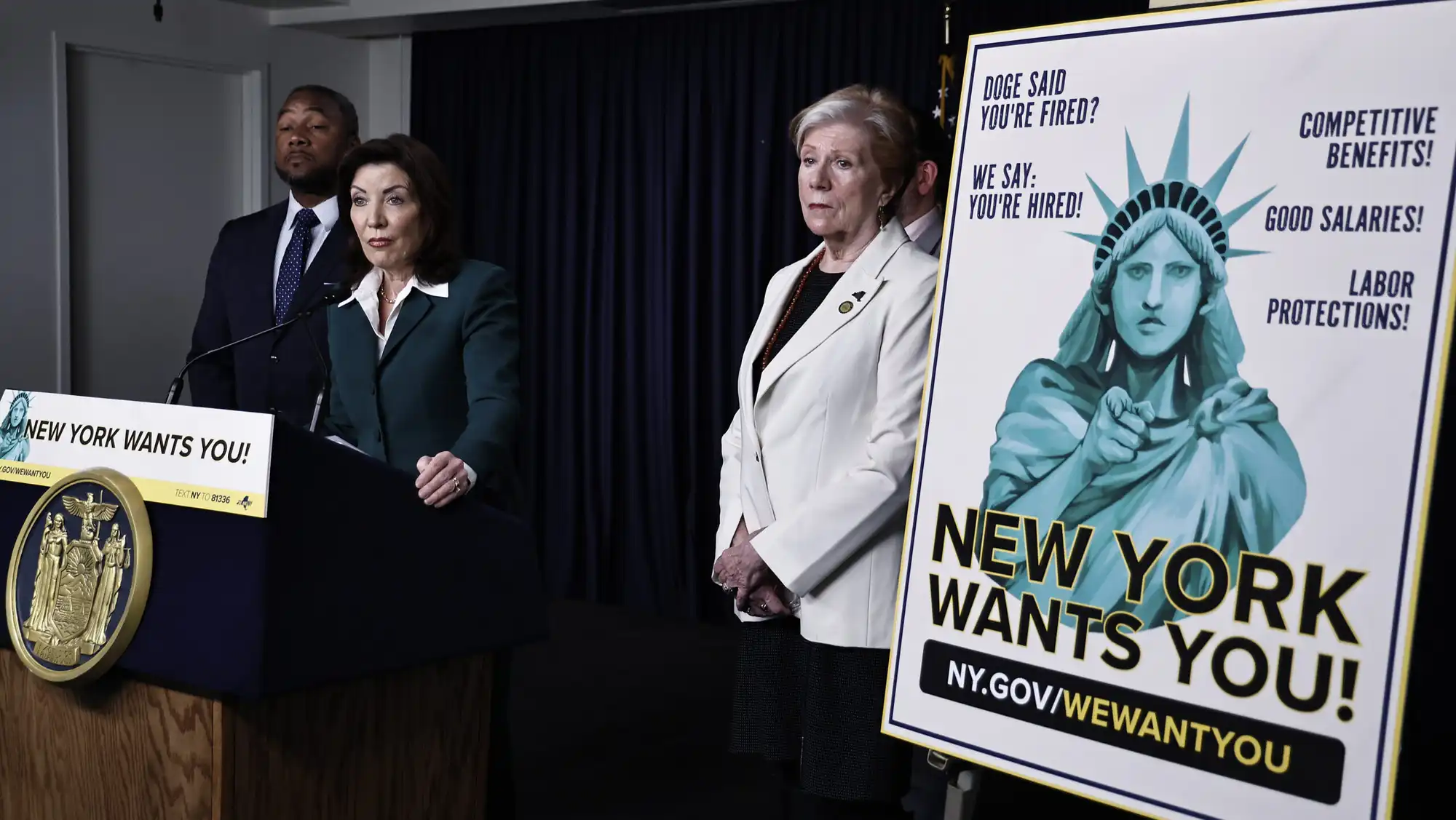
Officials in Maryland, New York, New Mexico and Kansas City are among those launching recruitment campaigns targeting federal workers. But matching those workers’ federal salaries and competing with private sector offers will be tough.
A supermajority at BlueOval SK, a $6 billion joint venture between Ford and South Korea’s SK On, has asked the National Labor Relations Board for a vote on joining the UAW. The union hopes the region is fertile ground for organizing.