Marketplace®
Every story is an economic story
  • 09/01/2017: Harvey and globalization
    Ken Garduno, Illustrator

    We’re handing off the show to Scott Tong and Sarah Gardner for their special coverage of globalization. The idea of more open, global trade has been sold as necessary for economic success. Despite that, we hear calls to “build a wall” and countries like the U.K. make moves to step back from global trading partners. How’d we get here? And can globalization last? We’ll also bring you our initial coverage or Hurricane Harvey with stories of what it’s like to have water creeping up to your door and where your donated dollar really goes.

  • President Donald Trump participates in a tax reform kickoff event at the Loren Cook Company in Springfield, MO, on August 30, 2017.
    JIM WATSON/AFP/Getty Images

    Corporations stand to gain, but what about workers?

  • Sep 1, 2017

    Fox to debut 6-second TV ads

    by Aaron Schrank

    Fox Sports will begin airing some six-second TV commercials during NFL games this season, a format it first tested during this month’s Teen Choice Awards. Ads that short are standard for online video content seen on YouTube or Facebook, but a change of pace for broadcast TV. Could this be more widely adopted in an […]

  • You may have heard today that the August headline jobs number “was below expectations,” or about 24,000 fewer jobs were created than the consensus among leading economists predicted. But how significant is that figure? The first release of the monthly job-creation number is an estimate accurate to plus or minus 119,000, according to the Bureau […]

  • The Department of Health and Human Services announced it would cut Obamacare advertising money by $90 million, a 90 percent overall cut. The money was meant to be used to encourage people to sign up for insurance coverage. To critics, this is just another sign the Trump Administration is trying to sabotage the law that […]

  • A flooded street in Cypress, Texas, northwest of Houston.
    Courtesy of Marcy Matyas

    "Everyone becomes on edge when you hear any type of heavy rainfall," a Louisiana homeowner says.

  • People wait in line to buy water at the Coastal Industrial and Specialty gas welding supplies store yesterday after the water supply to the city of Beaumont, Texas, was shut down from the effects of Hurricane Harvey.
    Joe Raedle/Getty Images

    The free market is cold blooded. Under normal circumstances, prices will balance out for supply and demand. Consumers adjust and the economy goes on its way. But what’s going on in Houston is not normal, and price gouging is rampant. Economists will tell you those prices make sense, but making business sense is another matter. Then: The Department of Health and Human Services is cutting Obamacare advertising by $90 million. Critics say Trump is trying to sabotage his predecessor’s signature legislation, but the administration insists the ads just didn’t work. Speaking of ads: TV is starting to take cues from social media, with six-second ads aimed at short attention spans. Finally: Global trade always has winners and losers, and this country has always struggled with thinking about the latter. That’s the focus of today’s installment of our series Trade Off.

  • People wait in line to buy water at the Coastal Industrial and Specialty gas welding supplies store yesterday after the water supply to the city of Beaumont, Texas, was shut down from the effects of Hurricane Harvey.
    Joe Raedle/Getty Images

    High prices limit hording and increase supply. But that's bad for business, one expert argues.

  • Why do U.S. retraining programs fall short?
    Ken Garduno, Illustrator

    The programs for workers displaced by globalization are a half-hearted attempt to help.

  • A flooded street is seen after the area was inundated with flooding from Hurricane Harvey on August 31, 2017 in Port Arthur, Texas. 
    Joe Raedle/Getty Images

    Local congregations know the neighborhoods and have a built-in system for collecting and distributing donations.

  • The U.S. created 156,000 jobs in August, while the unemployment rate ticked up to 4.4 percent. The verdict? We're doing OK — not that great, not that bad. Chris Low, the CEO of FTN Financial, joins us to help sort through all the numbers. Afterwards, we'll look at a new Texas law that tilts the scales a bit back towards an insurance company if you get in a fight with one.

  • Sep 1, 2017

    Where does your donation dollar really go?

    by Peter Balonon-Rosen
    Where does your donation dollar really go?
    Sarah Menendez/Marketplace

    There's a journey between your pocket and the people in need — and a few pit stops along the way.

  • A job seeker prepares to meet with recruiters during a career fair in San Francisco, California. 
    Justin Sullivan/Getty Images

    Average hourly pay has increased by just 2.5 percent year-over-year.

  • Students at a Chicago elementary school dig into a salad bar in the school's lunchroom.
    Tim Boyle/Getty Images

    This year, districts must have formal policies for handling unpaid bills.

  • 09/01/2017: When your smart speaker misinterprets something
    Ethan Miller/Getty Images

    Sometimes your smart speaker might mishear your command and offer up something decidedly…inappropriate. Which is why Amazon is introducing a layer of parental control on its Echo. On today’s show, we’ll talk with Oren Jacob, the CEO of the computer conversation startup PullString, about what this announcement means for companies like his. Afterwards, host Ben Johnson plays his final Silicon Tally — the game where we try to stump each other with numbers from the week’s news — with Tobin Low, a former Marketplacer and the co-host of the LGBTQ podcast Nancy.

  • Students at a Chicago elementary school dig into a salad bar in the school's lunchroom.
    Tim Boyle/Getty Images

    Tropical storm Harvey has shut down some of the country’s biggest refineries, meaning that the pipelines that they feed can’t flow. One critical for serving the east coast: The Colonial Pipeline, which has also shut down. We’ll take a look at how all this is starting to affect gas prices. Afterwards, we’ll discuss Harvey’s impact on global markets, and then talk about the new policies that school districts are starting to implement to address lunch shaming.

  • Politico's Michael Grunwald discusses a decades-old report about repetitive losses in the Naional Flood Insurance Program.

  • Protesters demand immigration reform in front of the White House yesterday.
    Chip Somodevilla/Getty Images

    700,000 of 800,000 recipients nationwide are legally working, experts say. Repealing the program would exacerbate labor shortages.

  • A flooded street is seen after the area was inundated with flooding from Hurricane Harvey on August 31, 2017 in Port Arthur, Texas. 
    Joe Raedle/Getty Images

    A refrigerated storage container at the Arkema chemical plant in Crosby, Texas, exploded this morning. Well, the sheriff calls it a chemical reaction indirectly caused by flooding, which killed the power and backup power that was keeping the container cool. At any rate, it was bad, and eight more could go off. We’ll start today’s show by looking at the electrical grid: a piece of critical infrastructure that’s very vulnerable to storms like Harvey. Then: We talked yesterday about the White House’s tax plan, which, right now, doesn’t exist. Treasury Secretary Steven Mnuchin talked about it on CNBC today, and we’ll break down his remarks. What you need to know about Obama’s Deferred Action for Childhood Arrivals program, or DACA, before Trump potentially overturns it.

  • Aug 31, 2017

    Why this filmmaker doesn’t want Hollywood’s $100 million

    by Kai Ryssdal and Bridget Bodnar
    Ignacia Allamand as Luciana, Mauricio Ochmann as Raúl and Humberto Busto as Eduardo in "Hazlo Como Hombre."
    Courtesy of Pantelion Films

    Nicolás Lopez used his "Chile-wood" to make "Hazlo Como Hombre" for less than a million dollars.

  • Jared Kushner, son-in-law of the president of the United States and a senior adviser to him, has a problem. It sits on Fifth Avenue smack in the middle of Manhattan, and on it hangs the fortunes of Kushner family business — and some questions about how Kushner is getting the money to pay the mortgage. David […]

  • A Harris County Sheriff vehicle blocks access on the Crosby Dayton Road which leads towards the Arkema Chemical Plant in Crosby, Texas on August 31, 2017.
    MANDEL NGAN / Getty Images

    “I’m just worrying about what we’re gonna be breathing,” one local resident told us.

  • A protester at the "A Day Without A Woman" demonstration on March 8, 2017 in Miami, Florida.
    Joe Raedle/Getty Images

    Majority of women small business owners surveyed believe that the gender wage gap will be closed over the next 20 years.

  • Hurricane Harvey has caused up to $190 billion in damage, according to some estimates. That would make it the costliest natural disaster in the country's history. Diane Swonk, CEO of DS Economics, joins us to talk about Harvey's economic impact and how cleanup could affect the country's GDP. Afterwards, we'll chat with analyst Pavel Molchanov about the state of the United States' fuel infrastructure, and then look at how crowdfunding has changed disaster relief.

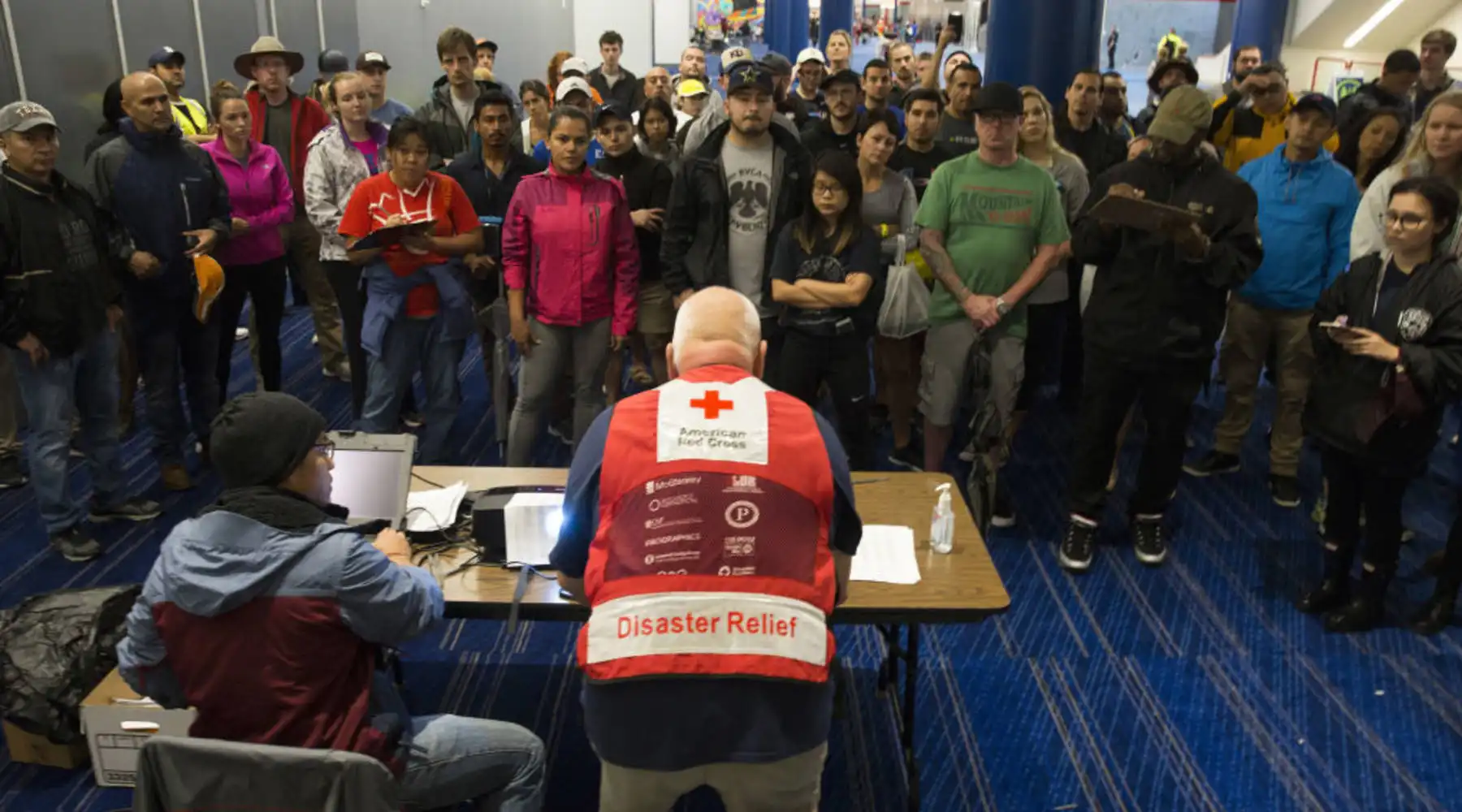
  • Volunteers get a briefing on Monday at the George R. Brown Convention Center in Houston, where the American Red Cross is housing victims of Hurricane Harvey.
    Erich Schlegel/Getty Images

    With more options for giving, donors are urged to do their research.

  • 08/31/2017: A large housing-recovery mission
    Win McNamee/Getty Images

    Explosions at a chemical plant near Houston have hospitalized at least 10 people. On today’s show, we’ll discuss the growing number of industrial and infrastructure problems resulting from this storm. Afterwards, we’ll talk about the process of finding housing for Texas’ flood victims, and then look at New York’s decision to stop cracking down on subway-fare evasion.

  • Dr. Josie Valenzuela, now a fourth year resident at the University of Arizona, uses a microscope for examining the eye. She disagrees with a new rule that allows first year residents to work up to 28 hours in a row.
    Georgia Baumann/University of Arizona

    First-year medical residents can now work up to 28-hour shifts, which some say can lead to fatigue and mistakes. But senior doctors argue that limiting the length of a shift would compromise resident education and patient care.

  • Police officers watch a turnstile in New York City's Times Square subway station in 2005.
    Mario Tama/Getty Images

    "Most offenders aren’t looking to beat the system," a Legal Aid Society defender says.

  • 08/31/2017: Amazon’s Alexa and Microsoft’s Cortana are on speaking terms
    Molly Wood/Marketplace

    Amazon CEO Jeff Bezos reportedly approached Microsoft CEO Satya Nadella about a partnership between their two voice assistants. This could be great for consumers, but what’s in it for the two tech giants? James McQuivey, an analyst with Forrester James, explains how each has what the other wants. Afterwards, we’ll discuss the app Zello — a social radio app that’s being used in evacuation efforts — with CEO Bill Moore.

  • Just over 10 percent of the apartments in Houston are sitting vacant. As the storm clears, survivors can get money to help them move in. Click the audio player above to hear the full story. 

  • 

US President Donald Trump participates in a tax reform kickoff event at the Loren Cook Company in Springfield, MO, on August 30, 2017.
    JIM WATSON/AFP/Getty Images

    President Trump laid out his tax plan during a speech in Springfield, Missouri, today. Except, well, the White House has more of a sheet of bullet points than a plan. There are no details, although the president laid out four principles of tax reform, which we’ll talk through at the top of the show. Then: According to FEMA, 40 percent of businesses that close during a disaster never reopen. And of those that do, nearly a quarter fail within a year. There are any number of reasons for that, but when it comes to floods, there’s a certain structural problem that has to do with the National Flood Insurance Program. Plus: Will electric cars put mechanics out of business?

  • How do you make a book company used to long-term planning thrive in the era of the 24 hour meme?

    Download
  • Introducing the new voice of Marketplace Tech: Molly Wood
    Christopher Michel

    The show has been revamped with a new host and a new mission. Buckle your seat belts!

  • An Obama-era intiative would have required companies to report how much they pay workers of different races and genders. The initiative was an attempt to get a better handle on the pay gap. But the current administration says the data demands would put too much of a burden on employers.  Click the audio player above […]

  • Many of the first responders in Houston have been civilians organized into rescue squads. Their work has the support and approval of government agencies, who have realized that local volunteers can move faster than any bureaucracy. It’s an approach to disaster management that has become codified into policy. Click the audio player above to hear […]

  • Aug 30, 2017

    The robots aren’t coming for your job just yet

    by Kai Ryssdal and Emily Henderson
    The robots aren’t coming for your job just yet
    BERTRAND GUAY/AFP/Getty Images

    James Surowiecki talks about why we don't need to fear the "Robopocalypse."

  • Matthew Moreno works on a vehicle at a Valvoline Instant Oil Change in Los Angeles.
    Jed Kim/Marketplace

    No more changing our oil. Fewer service needs could mean more competition for what's left.

  • Aug 30, 2017

    Why Chronicle Books is watching retail’s slide very closely

    by Kai Ryssdal and Bridget Bodnar
    Tyrrell Mahoney, president of Chronicle Books.
    Natasha Claro, Chronicle Books

    Chronicle Books want you to happen upon their titles in stores like Sur La Table and Urban Outfitters. Which makes declining retail sales a tricky proposition for them.

  • Hurricane Harvey may have an effect on gas pumps that aren't anywhere near Texas. With oil refineries shutting down production, we'll take a look at how much gas prices across the country could rise. Afterwards, we'll discuss whether Trump will still go through with a government shutdown if he doesn't get funding for his U.S.-Mexico wall, and then talk about 21st Century Fox's decision to stop showing Fox News in Britain.

  • Aug 30, 2017

    Barely anyone used text-to-911 during Hurricane Harvey

    by Ben Johnson and Jana Kasperkevic
    A Sheriff's boat rescues people after Hurricane Harvey caused heavy flooding in Houston, Texas on August 28, 2017.
    Mark Ralston/AFP/Getty Images

    Only a handful of texts were sent to 911.

  • More than 120 school districts remain closed Wednesday as a result of Tropical Storm Harvey, according to Texas education officials. In Houston, public schools aren’t expected to open until after Labor Day at the earliest, affecting more than 200,000 kids. Meanwhile, dry schools in nearby towns and cities are opening their doors to evacuees.  Click […]

  • A can of water from the Anheuser-Busch company.
    David McNew/Getty Images

    From distributing supplies to coordinating volunteers, a look at how companies are helping with relief efforts on the ground.

  • Aug 30, 2017

    Thousands of Texans are still in the dark

    by Aaron Schrank

    First, Tropical Storm Harvey knocked down power lines in the Corpus Christi area, then flooding hit the grid in Houston. Thousands of workers are trying to get the lights back on, but it’s complicated. Click the audio player above to hear the full story.

  • 08/30/2017: The effects of Hurricane Harvey on Texas schools
    Scott Olson/Getty Images

    More than 120 school districts remain closed as a result of the flooding caused by Hurricane Harvey. On today’s show, we’ll look at the accommodations some schools are making for students. Afterwards, we’ll check in on how Texas utilities are coping with the hurricane’s aftermath, and then discuss the catastrophic effects of heavy rains in South Asia.

  • 08/30/2017: Texting 911 for help
    Joe Raedle/Getty Images

    In the event of a natural disaster, sometimes a text can be one of the best ways to reach out for help. On today’s show, we’ll chat with Trey Forgety from the National Emergency Number Association about the future of emergency dispatch technology. Afterwards, The Verge’s Adi Robertson joins us to discuss Google’s new ARCore platform, which will allow you to build augmented reality apps and experiences into smartphones without the need to use extra hardware. 

  • People make their way out of a flooded neighborhood after it was inundated with rain water following Hurricane Harvey on August 29, 2017 in Houston, Texas. 
    Scott Olson/Getty Images

    It’s still raining in Houston and all along the Gulf Coast. We don’t quite know what it’s going to look like when the water recedes, so we called Craig Fugate. He ran FEMA under President Obama and talked to us about what happens next and how displaced people can start putting their lives back together. Then: We’ll look how undocumented immigrants are seeking (or even avoiding) help in Harvey’s wake. Plus: Why does it seem like Congress does the same debt ceiling dance every couple years?

  • A fireman walks by a burnt out car that caught fire after Hurricane Harvey hit Corpus Christi, Texas.
    MARK RALSTON/AFP/Getty Images

    We check in with the sixth largest port in the United States.

  • There are some new regulations going into effect for financial institutions licensed by the state of New York this week. That’s for some banks, big insurance companies and all kinds of financial firms. The rules are about cybersecurity, specifically. They require companies to hire a chief information security officer, to report data breaches within 72 […]

  • A person waits to be rescued from his flooded home yesterday after Houston was inundated with rain from Hurricane Harvey.
    Joe Raedle/Getty Images

    Harvey’s damage taxes an already debt-ridden program.

  • People take shelter at the George R. Brown Convention Center in Houston today after flood waters from Hurricane Harvey inundated the city.
    Joe Raedle/Getty Images

    “For flood recovery, that's an important group of people for sure,” a university professor says.

  • Aug 29, 2017

    Full recovery from Harvey could take years

    by Kai Ryssdal and Robert Garrova
    People make their way out of a flooded neighborhood after it was inundated with rain water following Hurricane Harvey on August 29, 2017 in Houston, Texas. 
    Scott Olson/Getty Images

    Former FEMA administrator Craig Fugate talks about what recovery from a flooding event of this size looks like.

  • Aug 29, 2017

    Why do we keep playing the debt limit charade?

    by Nancy Marshall-Genzer
    U.S. Secretary of Treasury Steve Mnuchin discusses 2018 budget proposals for the Department of Treasury and tax reform at a Senate Finance Committee hearing on May 25.
    Drew Angerer/Getty Images

    It has everything to do with politics and very little to do with debt.

  • Bruce Springsteen performs on stage at The Theater at Madison Square Garden on November 1, 2016 in New York City.
    Kevin Mazur/Getty Images for The Bob Woodruff Foundation

    Ticketmaster has made buying seats for the Boss's Broadway run very complicated.

  • People walk through the flooded streets of Galveston, Texas, on Aug. 26.
    BRENDAN SMIALOWSKI / Getty Images

    Along with donations and an outpouring of help come the cons and rumors.

  • 

A truck driver walks past an abandoned truck while checking the depth of an underpass during the aftermath of Hurricane Harvey Aug. 28, 2017 in Houston, Texas.
    BRENDAN SMIALOWSKI/AFP/Getty Images

    Houston doesn't drain well.

    Download
  • Stem cells, like these viewed at the University of Connecticut`s Stem Cell Institute, help repair injured tissues in the body.
    Spencer Platt/Getty Images

    Some clinics claim to use stem cells to treat diseases like Alzheimer's and Parkinson's.

  • Mutual and exchange-traded funds focused on U.S. stocks are seeing billions of dollars flow out. Are investors just happy about the money they've already made, or are they noticing something in the underlying U.S economy? Macropolicy Perspective's Julia Coronado is here to explain what could be going on. Afterwards, we'll chat with energy fellow Ed Hirs from the University of Houston about Texas' refineries, and then talk about the FDA's decision to crack down on companies peddling fraudulent stem cell treatments.

  • As Harvey continues to pummel Houston, the city is using call lists and maps to help community health workers keep in touch with thousands of people. Some are in wheelchairs, others may need oxygen, ventilators or other medical devices that rely on electricity. Click the audio player above to hear the full story.

  • As the devastation continues to mount in Texas, so does the heavy debt owed by the National Flood Insurance Program. The program, which is managed by FEMA, already borrowed nearly $25 billion, most of it to cover claims from Hurricane Katrina and Superstorm Sandy. The program was supposed to effectively manage the cost of flood […]

  • Aug 29, 2017

    Can compassion have economic benefits?

    by Marketplace Contributor
    Louisville, Kentucky declared itself a “compassionate city,” by signing onto an international compassion charter in 2011.  Louisville’s mayor, Greg Fischer, is a former businessman who lists making his city more compassionate as one of his top goals.
    Jeff Gentner / Getty Images

    Louisville, Kentucky, is providing compassion training in public schools and the city’s jail.

  • The streaming service reports third-quarter earnings and subscriptions will be key.
    Ryan Anson/AFP/Getty Images

    It’s Netflix’s 20th birthday today. With about 100 million subscribers around the world, the streaming giant has come a long way from the days of mailing DVDs to customers. Gina Keating, author of “Netflixed: The Epic Battle for America’s Eyeballs,” joined us to talk about the company’s original business model and whether it’ll be able to compete with Disney’s new streaming service. Afterwards, we’ll talk with Greta Byrum — director of the Resilient Communities program at New America — about what happens to our communications networks during natural disasters.    

  • 08/29/2017: How compassion can pay off
    Carl Court/Getty Images

    North Korea filed a missile over Japan today, rattling markets in Asia, Europe and the U.S. The U.S. dollar is often seen as a safe haven during international incidents, but it’s the euro that’s actually up this morning. We’ll talk to the BBC’s Andrew Walker about the rising strength of this currency. Afterwards, we’ll look at how the federal government got involved in the business of flood insurance, and then discuss the economic benefits of compassion. 

  • Flood victims gather for food at a shelter in the George R. Brown Convention Center during the aftermath of Hurricane Harvey today in Houston.
    BRENDAN SMIALOWSKI/AFP/Getty Images

    The Federal Emergency Management Agency and officials in Texas don't want to use massive structures to house people, but sometimes that is the best option.

  • Aug 28, 2017

    Being Uber’s new CEO is like climbing corporate Mt. Everest

    by Kai Ryssdal and Molly Wood

    The name to know today in corporate America is Dara Khosrowshahi. At the moment, he’s the CEO of the travel website Expedia. Khosrowshahi was on the Corner Office podcast in March about what it was like to lead a travel company under the cloud of the president’s travel ban last spring. But now he’s been […]

  • Flood waters rise today by the refinery section of the Houston Ship Channel. The city is battling Harvey, now a tropical storm, and flooding.
    THOMAS B. SHEA/AFP/Getty Images

    Louisiana, another critical area for oil plants, is watching Harvey's path.

  • People view the flooded highways in Houston yesterday as the city battles with Harvey, downgraded to a tropical storm, and resulting floods.
    THOMAS B. SHEA/AFP/Getty Images

    Every expert she's talked to says regulations for building in the city's flood plains are insufficient, says Texas-based reporter Neena Satija.

  • A police officer in riot gear stands guard outside City Hall during a protest in Los Angeles, California on November 2016.
    RINGO CHIU/AFP/Getty Images

    A policy reversal from the government could mean grenade launchers, bayonets and night-vision goggles for law enforcement.

  • The Repeal of the Corn Laws in Manchester is a 170-year old story with ramifications that continue to this day.
    Ken Garduno, Illustrator

    England's repeal of tariffs on grain imports in the 19th century kicked off a free trade explosion.

  • People view the flooded highways in Houston yesterday as the city battles with Harvey, downgraded to a tropical storm, and resulting floods.
    THOMAS B. SHEA/AFP/Getty Images

    The thing about Hurricane Harvey is that other than there’s gonna be more rain in and around Houston, there’s a whole lot we don’t know. We’ll start with oil. Some of the biggest oil refineries in the country, not to mention the Port of Houston, are shut down right now, and it’s not clear when any of that will open back up. Then we’ll talk about the empty posts at key agencies responding to Harvey and the shelter strategy for people whose homes are underwater. Plus, we’ll look at why Houston is especially susceptible to flooding. Believe it or not, there’s other news to talk about today, too, including the Trump administration’s restoration of a program that gives military gear to police and Uber’s new CEO. 

  • With Hurricane Harvey causing many refineries in Texas to temporarily shut down, we'll chat with Energy Intelligence analyst Barbara Shook about the effects this is having on crude oil and gasoline prices. Afterwards, we'll chat with University of South Carolina professor Robert Hartwig about why many people are left without flood insurance, and the difference between how much insured damage the industry has to pay out, and the overall economic cost of a natural disaster.

  • A motorist drives through heavy rain before the approaching Hurricane Harvey hits Corpus Christi, Texas, on Friday.
    MARK RALSTON/AFP/Getty Images

    The president has threatened to let government funding run out if he doesn't get money for a U.S.-Mexico border wall. But that could leave out funds for storm aid.

  • Starting today, more than 30,000 workers in St. Louis could see their paychecks shrink. The city’s minimum wage is dropping from $10 an hour to $7.70. That’s because of a new state law that says cities can’t set a higher minimum wage than the state. Click the audio player above to hear the full story.

  • Study shows racial disparities in infant intensive care
    Mario Tama/Getty Images

    “Our research is not uncovering racial bias,” the lead author at Stanford says.

  • 08/28/2017: Why one internet service provider is not a fan of net neutrality
    Sean Gallup/Getty Images

    This Wednesday marks the end of a public comment period that allows people to tell the Federal Communications Commissions exactly how they feel about net neutrality. On today’s show, we’ll revisit our conversation with former FCC Commissioner Tom Wheeler about the current commissioner, Ajit Pai. (Hint: The relationship was dicey.) Then we’ll chat with Brett Glass, founder of the world’s first wireless internet provider, about how net neutrality could affect his business. 

  • 08/28/2017: St. Louis is shrinking its minimum wage
    KAREN BLEIER/AFP/Getty Images

    Hurricane Harvey has caused many refineries and port facilities in Texas to temporarily shut down. We’ll chat with Energy Intelligence analyst Barbara Shook about the preparations they made prior to the event, and what’s going to happen to the prices of crude oil and gasoline. Afterwards, we’ll discuss news that Uber has chosen the head of Expedia, Dara Khosrowshahi, to be its new CEO, and then look at why St. Louis, Missouri is decreasing the city’s minimum wage from $10 an hour to $7.70.

  • Aug 28, 2017

    Expedia CEO Dara Khosrowshahi to lead Uber

    by Marketplace Contributor
    Dara Khosrowshahi, chief executive officer of Expedia, Inc., attends the annual Allen & Company Sun Valley Conference on July 7, 2016 in Sun Valley, Idaho.
    Drew Angerer/Getty Images

    He comes amid a time when several factions of Uber's board are suing each other.