Marketplace®
Every story is an economic story
  • As more and more debt piles on, many make comparisons between this bubble and the one that burst a few years back: housing. But are they really that similar?

  • A Syrian refugee camp in Jordan is now the second-largest refugee camp in the world.

  • Aug 30, 2013

    Quiz: Unusual scholarships for college

    by Raghu Manavalan

    Scholarships are usually awarded for the best and the brightest, but there are other off-beat scholarships available.

  • Aug 30, 2013

    The numbers for August 30, 2013: Animals

    by Ethan Lindsey

    This is a Marketplace.org Reader

  • Labor Secretary Tom Perez explains how he hopes to push unemployment down and economic growth up.

  • Aug 30, 2013

    GE swears off credit cards

    by Sarah McCammon

    General Electric is making plans to sell off its retail lending business, including store credit cards.

  • Wall Street's had its worst month since May 2012.

  • For the next few weeks, we’re focusing on tThe American Dream. This weekend’s show is about college. It is often seen as the path to financial mobility and security. Better paying job. A chance to save for retirement. Buying a home. But talking about college means talking about student loans. It means talking about affordability and family conversations about choices. How should we think about costs? What can you do to save for college? And what are your options to manage debt? 

  • General Electric plans to spin off its highly profitable credit card business, which made the company $2.2 billion last year. August was a nasty month to be a stock. And, former players and their families will receive a massive payout, but the NFL has admitted no wrongdoing.

  • A surprising ruling on texting while driving.

  • Aug 30, 2013

    August was a nasty month to be a stock

    by David Brancaccio

    Where the money shifted in August…

  • With Netflix reporting first quarter revenue of over $1 billion, others are seeing profit in original storytelling. And major tech companies are setting up production studios all over L.A.

  • A wireless Internet-connected device that can block any TV ads — will it change television?

  • The 200-square-mile Rim Fire peels back the layers of the Sierra Nevadas’ economic ecology.

  • The 200-square-mile Rim Fire peels back the layers of the Sierra Nevadas’ economic ecology as the fire impacts timber sales, a tourist sector that ranges from camps and cottages to backpackers, and federal management of a huge area for the public’s benefit. A company called AdTrap is selling a white box about the size of a computer router, that, connected to your devices via WiFi (computers, tablets, smartphones) can block any ads. And finally, we look back at the week that was on Wall Street with the Weekly Wrap.

  • With education costs moving higher and higher, perhaps it's time to start applying for scholarships. You just might qualify for some of the more unique ones out there.

  • For many families, paying for college is a balancing act. You want to give your child the best options, but you don't know how to talk about what you can afford.

  • Breaking down the pros and cons of college savings plans.

  • Aug 30, 2013

    GE to spin off credit card business

    by Dan Gorenstein

    General Electric plans to spin off its highly profitable credit card business, which made the company $2.2 billion last year.

  • Former players and their families will receive a massive payout, but the NFL has admitted no wrongdoing.

  • Emerging markets that thrived during the recession are seeing the flow of capital dry up.

  • Aug 30, 2013

    Cats on the tracks!

    by David Brancaccio

    New York City's subway experiences the cutest little delay of all time, yes it did.

  • 306,000 tweets per minute, 2 (think gaming), 11,000 requests, and 74 percent: Can you guess what these numbers mean?

  • The cost of college is rising faster than inflation. But when you take financial aid into account, it’s gone up only modestly faster than inflation.

  • With Brazil and India reporting their economic growth figures today, we take a look at how emerging markets are fairing around the world. Cigarette ads have been banned from TV since 1971. But next month, tobacco giant R.J. Reynolds, maker of Camels, plans to start airing commercials in Colorado for its new electronic-cigarette. And, it’s been the summer of surveillance — revelations of pervasive government tracking in the name of national security. One industry that raised early warnings about the potential for abuse of tracking technology is, actually, Hollywood.

  • A famous peace-keeping technology turns 50-years-old today — the so-called “red phone” that connected Moscow and Washington. The phone apparently wasn’t actually red, but it did change the Cold War. And, it’s time again to play our tech news numbers game, Silicon Tally. Today’s contestant is behind some mobile video games you’ve probably seen before: Farmville and Pac-Man for iPhone, the insanely popular Mafia Wars, and more.

  • Aug 30, 2013

    Latest inflation victim: Tooth Fairy

    by Kai Ryssdal

    Kids these days are getting more than $3 a tooth from the Tooth Fairy.

  • Fifteen percent of Americans don't use the internet at all.
    Scott Olson/Getty Images

    Data released this week by the Pew Center shows that 98 percent of Americans now live in an area with access to broadband internet. Despite that, 15 percent still don't use the internet at all.

  • We hear all the time that student loan debt is on the rise, and isn't likely to slow down anytime soon. For all those federal loans, though, does the government really make any money?

  • As the e-cigarette market heats up, R.J. Reynolds plans its first TV ad since 1971, when cigarette commercials were banned.

  • Aug 30, 2013

    Answer the red phone!

    by Molly Wood

    In the height of the Cold War, the U.S. and Soviet governments instituted a secure line of communication.

  • This is a Marketplace.org Reader

  • Obamacare plan shows popularity of prepaid debit cards
    vamapaull / Creative Commons

    The government will require insurers to accept prepaid debit cards as payment for insurance under Obamacare.

  • Aug 29, 2013

    Sign spinners turn heads and profits

    by Caitlan Reeg

    In the past, sign spinners, or “human directionals” in marketing jargon, often pointed their signs toward used car lots or new housing developments. But as the cost of renting a billboard has doubled, sign spinning is attracting more interest from businesses big and small.

  • Aug 29, 2013

    PODCAST: Fast food workers on strike

    by David Brancaccio

    Fast-food workers are extending their one-day strikes to 35 cities nationwide as they try to gain traction for higher wages. One of Europe's most famous businessmen has resigned after the suicide of his company's CFO. August was once a quiet time in the political realm, thanks to the annual Congressional recess, but now activists use the time to push their agenda — and Washington message-makers cash in.

  • How do the clothes you wear and products you use get from the factory to your house?

  • A look at the modestly growing market for sleeping pills in the U.S.

  • The levee board for the New Orleans region sued oil companies over their damage to delta wetlands that are a protective buffer against storm surges.

  • Aug 29, 2013

    Shutting down the internet as a weapon?

    by Ben Johnson

    Should shutting off the internet be used as a weapon against Syria?

  • Aug 29, 2013

    Second quarter GDP revised upward

    by Diane Swonk

    There's news today U.S. economy was surprisingly strong — once upon a time.

  • One of Europe's most famous businessmen has resigned after a suicide his company's CFO.

  • Campbell's is the subject of a class action lawsuit alleging its "Heart Check" soups mislead consumers.

  • Aug 29, 2013

    An onion headline: Global onion shortage

    by Adriene Hill

    A poor onion crop in India has sent onion prices skyrocketing.

  • Fast food workers across the country are walking off the job today. Workers are demanding $15 an hour.

  • Fast food workers across the country are striking and walking off the job today. Workers are demanding $15 an hour, up from $7.25, which is the current federal minimum wage. We look at why the Obama administration is working with debit cards on the roll out of the federal health care overhaul. And the weather in India can impact your pocketbook. A poor onion crop in that country has sent onion prices skyrocketing there — and the ripple effect of the onion shortage is being felt across the globe.

  • Aug 29, 2013

    August is a busy season for interest groups

    by Nancy Marshall-Genzer

    August was once a quiet time in the political realm, thanks to the annual Congressional recess, but now activists use the time to push their agenda — and Washington message-makers cash in.

  • The time may be right for Verizon to purchase back British mobile giant Vodafone's stake in its wireless business.

  • Aug 29, 2013

    Fast food workers of the world, unite!

    by Stacey Vanek Smith
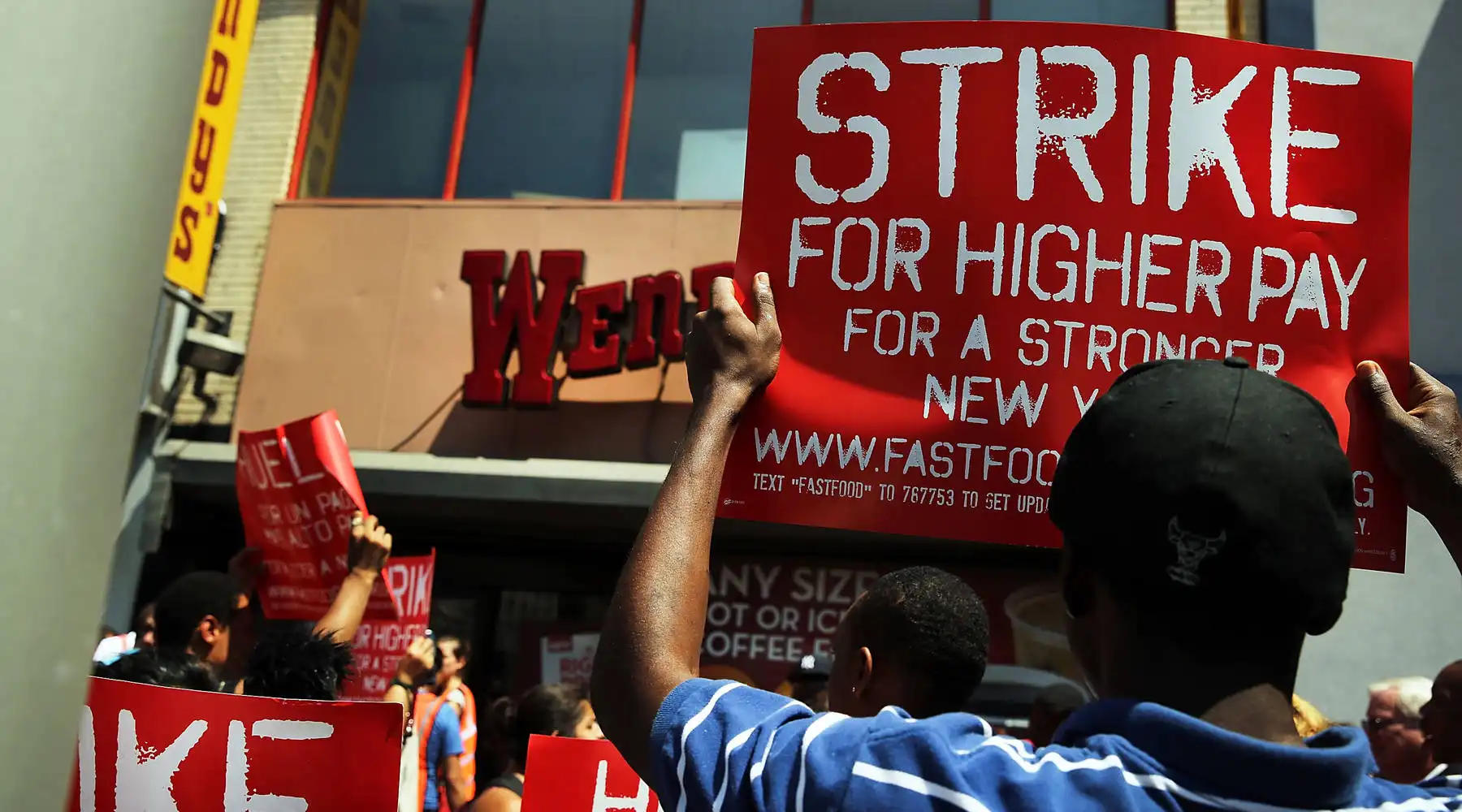
    Employees and supporters demonstrate outside of a Wendy's fast-food restaurant to demand higher pay and the right to form a union on July 29, 2013 in New York City.
    Spencer Platt/Getty Images

    Fast-food workers are extending their one-day strikes to 35 cities nationwide as they try to gain traction for higher wages

  • The National Football League has agreed to pay $765 million to settle a lawsuit with over 4,000 former players over head injuries.

  • Aug 29, 2013

    Should retirement savings be mandatory?

    by Chris Farrell

    Too many Americans aren't saving enough for retirement. Should they be forced to?

  • A researcher at the University of Washington sent a brain signal through the internet to move another man's finger.

  • "I would say that she certainly misrepresented its intent to encourage team support."

  • A Canadian nurse uses Twitter to find people who may be suicidal and help them.

  • By hiring Nathan Hubbard, Twitter seeks to make revenue.

  • There is a simmering deal in the telecom industry that could soon remove a British accent from many U.S. mobile phones. Vodaphone of Britain owns a chunk of Verizon Wireless, and Verizon of New Jersey would like it back — but is going to have to pay big money to get it. “Rich in anti-oxidants.” “Low-fat.” “All-natural.” Today’s shoppers are seeing more and more so-called health-conscious food labels. One brand trying to ride the wave is Campbell Soup Company, which reports its profits and losses today. But a green “Heart Check” label on its soup cans is now the subject of a class action lawsuit. And, when it comes to retirement savings, statistics show too many people won’t have nearly enough and it’s something the slow economic recovery isn’t fixing on its own

  • The idea of controlling objects, even other humans, with only your brain is a holy grail of tech innovation. And what researchers did at the University of Washington this month sounds pretty amazing. Using non-invasive technology to record and stimulate brain function, a researcher at one end of campus controlled the physical actions of someone at the other end of campus. And, Twitter makes another move at revenue.

  • Heading to San Francisco, Orlando or Las Vegas over the Labor Day weekend? Hope you like company.

  • Perks aren't just for the tech world these days.

  • Twitter is tapping former Ticketmaster CEO Nathan Hubbard as its first Head of Commerce. The social network wants to generate more revenue from online retail, but the details have yet to be worked out.

  • A labor dispute in the San Francisco area launched a surprising debate about the future of work in the new economy.

  • Aug 28, 2013

    The numbers for August 28, 2013: 1963

    by Ethan Lindsey

    This is a Marketplace.org Reader

  • Aug 28, 2013

    Getting by as a Syrian refugee

    by Kai Ryssdal

    As the crisis deepens in Syria, more refugees are fleeing the country.

  • Aug 28, 2013

    PODCAST: JPMorgan’s $6bn penalty

    by David Brancaccio

    It's one of those mornings where the brass at JPMorgan might not want to read the papers. It’s the first student-run Apple Store for aspiring marketers, accountants, and entrepreneurs. And, high speed trading is behind this month's errors in financial markets.

  • The nation's largest employer will give healthcare benefits to same-sex partners of full-time employees starting next year.

  • How far have we come in 50 years in terms of economic equality? It depends on how you look at the numbers.

  • Aug 28, 2013

    Who is the Syrian Electronic Army?

    by Adriene Hill

    After they momentarily took down the New York Times web site and Twitter, the Syrian Electronic Army gained a new notoriety.

  • Aug 28, 2013

    Syria, oil, India, and currency

    by Julia Coronado

    With the Syria headlines, the price of oil could become a drag for the U.S. economy and beyond.

  • High speed trading is behind this month's errors in financial markets.

  • After they momentarily took down the New York Times web site and Twitter, the Syrian Electronic Army gained a new notoriety. But who is this group of hackers? Or, how you would figure out who they are? More important, how do they do this kind of hack and how vulnerable are companies like the New York Times and the Internet itself? Next, would you buy something in 140 characters? Twitter is hiring an e-commerce pioneer to explore how to convince users to buy stuff through the service. 

  • Aug 28, 2013

    Who’s watching the students? The watchers

    by Shannon Mullen

    A school district in Southern California has revealed that it is paying a company to track its students online.

  • Aug 28, 2013

    U.S. demands JPMorgan pay $6 billion penalty

    by David Brancaccio

    It's of those mornings where the brass at JPMorgan might not want to read the papers.

  • The alternative culture festival is big among the tech scene.

  • Aug 28, 2013

    A quarter century of ‘Madden NFL’

    by Molly Wood

    What's behind the popularity of one of history's most successful video game franchises?

  • The New York Times and Twitter are its latest targets.

  • Driverless cars are on the horizon. So are new legal challenges to deal with them.

  • With the focus on Syria, also keep an eye on an unfolding economic meltdown in one of the world's most important economies: India.

  • As tensions over a possible U.S.-led military strike against Syria drive up the U.S. dollar, other currencies around the globe are suffering — especially India’s rupee. A perfect storm of economic factors are leading to India’s worst economic crisis in two decades. A new report shows a persistent disconnect between the pay of corporate chiefs and their performance. According to the Institute for Policy Studies, nearly 40 percent of the highest paid CEOs either led firms that received bail-out money, lost their jobs, or had to pay fraud related fines after the financial crisis hit. And, at the start of the school year, many teachers are digging into their own bank accounts to pay for classroom supplies.

  • Although its smartphone business is hurting, BlackBerry may spin off its popular messaging service. All this comes as the company could be getting ready to put the whole firm up for sale. And Nissan says it will offer self-driving cars by the year 2020. Google is also in that space. But driverless cars raise unusual new legal issues we really haven’t had to think about before.

  • The March on Washington, in 1963, wanted the minimum wage moved up to $2.

  • One lesson virtually all teachers have learned: if you want your classroom up to snuff, you're going to have to spend your own money.

  • It’s the first student-run Apple Store for aspiring marketers, accountants, and entrepreneurs.

  • Aug 28, 2013

    How much will Microsoft pay its next CEO?

    by Sally Herships

    As Microsoft starts the search for a new CEO, yet another report highlights the growing gap between CEO pay and that of the average worker.

  • Aug 27, 2013

    My first job: The local grocer

    by Carla Erdmann

    A listener recalls why she was let go from her first job at the neighborhood grocery store.

  • A key shipping index is up dramatically in the past several weeks, thanks largely to demand from China's steel industry. But analysts say it's only a small window into the industry.

  • Since the March on Washington 50 years ago, how much has changed? We asked three generations of black men to talk about their economic opportunities.

  • President Obama has not made a final decision on military intervention in the country, but senior American officials say that missile strikes could be ordered as early as Thursday.

  • Aug 27, 2013

    PODCAST: Unrest in Syria impacts oil markets

    by David Brancaccio

    The headlines about Syria are altering the shape of financial markets today. Airbnb is the latest company to experiment with Vine. And, students at the Greenhill School in Dallas are managing a stock portfolio worth $100,000.

  • The popular football video game turns a quarter-century old; but is the Madden Curse still intact?

  • This is a Marketplace.org Reader

  • Students at the Greenhill School in Dallas are managing a stock portfolio worth $100,000.

  • For the next month, it's open season on wild alligators in the Bayou State, and it's big business for hunters and luxury fashion houses like Hermes and Gucci.

  • Airbnb is the latest company to experiment with Vine.

  • Aug 27, 2013

    Of poverty and sacrifice in Haiti

    by Kai Ryssdal

    Edwidge Danticat's new novel, "Claire of the Sea Light," describes the economic difficulties of life in Haiti, even before the 2010 earthquake.

  • Brace yourself. The debt ceiling showdown is coming back.

  • Consumer confidence increased in August, outpacing economists’ predictions.

  • The Treasury Department says the U.S. will run out of money on some unknown date in October.

  • President Barack Obama is reportedly exploring a range of options to “deter and degrade” Syria’s military capabilities. After a new report of chemical weapons use by the Syrian regime, international pressure has ratcheted up for some show of force in the region. But each and every option on the table has costs. Meanwhile, in Washington, the Treasury Department says the U.S. will hit its debt limit, and run out of money, sometime in October. You know how much is in your wallet and your bank account, how much your paycheck is, how much more you can charge on your card. Why can’t the federal government? And finally, consumer confidence increased in August, outpacing economists’ predictions, as the markets continue to perform well and the housing market improves. 

  • On our laptops, tablets, and smartphones, we're carrying around a lot of information about who we are and what we do.

  • What's behind last week's Nasdaq glitch?

  • Ohio State trustees will vote this week on also renaming its medical school's emergency department after retailer Abercrombie & Fitch.