4

Cruise ships: A luxury for the rest of us


Cruisers just off a ship reflect on why they decided on a cruise and whether it was worth the money.

To view this content, Javascript must be enabled and Adobe Flash Player must be installed.

Get Adobe Flash player

For many well-heeled Americans, the idea of a luxury vacation is a fancy hotel or an expensive flight to an exotic destination. And for the wealthiest among us, taking a break means private jets and pricey beach resorts. But for more than 10 million Americans annually, their luxury vacation means a berth on a cruise ship.

"The United States is still clearly the No. 1... market for cruisers in the world," Royal Caribbean president and CEO Adam Goldstein told Marketplace. "There are about 20 million people a year in the world taking a cruise right now and 11 or 12 [million] come from the United States."

Cruise ships weren't always so mainstream. In 1970, Goldstein said only 500,000 people took a cruise every year. 

"It's definitely become more available, when I got into the business in 1988 we aspired to be a mainstream vacation," Goldstein said. "It's definitely become more accessible but what the last few years of challenges, economically, have posed to us is the need to really get across the value message of what is included in the cruise purchase."

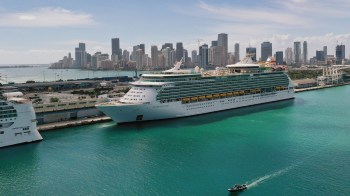
A cruise ship parked at the Port of Miami

According to industry research firm Cruise Market Watch, the ticket price for a typical cruise passenger is $1,311. When you combine onboard expenses and incidentals, the price tag rises to $1,711.

That's not inexpensive, but the the average American family will spend $4,000 on a vacation, including airfare, according to a 2010 American Express survey.

"First of all, we draw pretty broadly, obviously we offer upscale vacations," Goldstein said. "We are looking at household income of probably something like $75,000 and up generally speaking. The vast majority of our cruisers I would say would be middle and upper-middle class."

About the author

Jeremy Hobson is host of Marketplace Morning Report, where he looks at business news from a global perspective to prepare listeners for the day ahead.
andmiles's picture
andmiles - Apr 7, 2013

I have never been on a cruise, and I will not be due to the prices. If one ticket costs around and average of $1,711, i don't think I can afford it.
And to say the truth, I'm not enthusiastic about taking a cruise.
Its much better to travel someplace, meet people or see wonderful landscapes than being locked up in a ship, traveling in sea. It seems too much segregation for me...
Andy,
http://fridgeadvisor.com/how-long-do-refrigerators-last/

alasiri547's picture
alasiri547 - Feb 4, 2013

The cruising industry needs to be more transparent about who actually profits, because it is not the local people of the countries that they visit. Learn to sail, you can chart your own course and will have to rely more on local businesses for provisions, meals, on-shore experiences, etc. http://www.tran33m.com/index.php It is the difference between being a tourist and a traveler. Read "A Small Place" by Jamaica Kincaid (it is a short book) and watch "Life and Debt" by Director Stephanie Black.

nmdjh123's picture
nmdjh123 - Jan 25, 2013

While it's not the only reason, the main reason I've never been on a cruise is the gigantic 'elephant in the room' that most people have probably never thought about re: cruise ships. Yet what they do is not only something I wouldn't do, but one of those things that I can't believe ANYONE thinks is OK, yet all - or at least most - cruise ships do this: they dump their sewage and trash in the ocean! Talk about biting the hand that feeds you. I think anyone with half a brain would've, at the outset, designed cruise ships to have 2 hold areas for those things, which would be disposed of when back in port. Do RVs drive down the highway dumping their sewage and garbage? Of course not. The long-held attitude that the ocean is endless and 'undamageable' is long, long out of date, given giant flotillas of plastic garbage in the Pacific, dying coral reefs, most areas/species being overfished, and more.

Zeine15's picture
Zeine15 - Jan 25, 2013

It is great that the cruise ship industry has made this style of vacation affordable to a broader population. However for many of the countries they visit, especially the Caribbean, the industry is more exploitative then beneficial. For one, on some islands you do not actually enter the Caribbean, but a port area that is a fabrication of what is the Caribbean.

In St. Kitts, there is a lovely pastel-painted port where you could by trinkets made in China and t-shirts with stereotypical Caribbean images (like the smiling yellow "have a good day" face with a Rasta hat) also made outside of the Caribbean. Many of the shops there were not owned by St. Kittian people.

In St. Maartin, the shop owners have to pay what I would call a ransom to have their shops listed as "guaranteed" in the cruise ship guides; this paints an image of other businesses as being unsafe--a way of policing Caribbean businesses?

For those who desire to venture beyond the shopping malls, you may decide to take a river rafting trip or short journey to a historic plantation. You buy the trip on the ship, a trip that is run by local tour operators but who never see the profit. In Jamaica, you could buy the same trip at a lower price from a reputed local operator leaving most of the profit in the country--the same tour operator who is running the one offered from the ship. However if you buy it on the ship, the local operator only sees 10%, if he/she is lucky (but purchasing on the trip is "guaranteed." Guaranteed for what? or being "protected" from what?). Small developing countries have to be able to accept waste from cruise ships when there is barely enough infrastructure on the ground to support waste processing from the people who live there.

Reefs are destroyed to accommodate increasingly larger ships (along with the local fishing industry). More faux "Caribbean" towns are built within ports so you never actually have to enter the countries but rather do your shopping in a way that advances the profits of the cruising industry.

I would be curious to know if the cruise industry buys any produce or supplies from Caribbean suppliers? If so, is it for a fair price? How many times have you seen ackee and saltfish, rice and peas, johnny cakes, roti or even beef patties on a cruise ship?

The cruising industry needs to be more transparent about who actually profits, because it is not the local people of the countries that they visit. Learn to sail, you can chart your own course and will have to rely more on local businesses for provisions, meals, on-shore experiences, etc. It is the difference between being a tourist and a traveler. Read "A Small Place" by Jamaica Kincaid (it is a short book) and watch "Life and Debt" by Director Stephanie Black.