11

A new prescription for marketing drugs


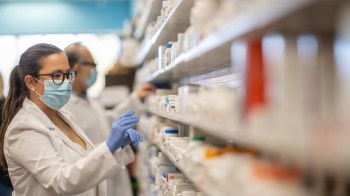
Kristin Nocco, waits to see a doctor as part of her job as an academic detailer for the state of Pennsylvania. Nocco gives doctors information on which drugs and treatments work best for certain conditions.

- Gregory Warner / Marketplace

Kristin Nocco, left, and Dr. Lisa Galante.

- Gregory Warner / Marketplace

To view this content, Javascript must be enabled and Adobe Flash Player must be installed.

Get Adobe Flash player

Kristin Nocco, left, and Dr. Lisa Galante.

TEXT OF STORY

Kai Ryssdal: With an, if you can't beat them, join them story... It's about health care. Face time, as they say in sales, is one of the best ways to push a product. And nobody knows that better than drug companies. They've got almost 80,000 pharmaceutical sales reps out there. That's one for every five doctors. And they are very good at what they do.

Sales of brand name prescription drugs in this country are worth billions of dollars a year. Thing is, states pick up a lot of that tab through programs like Medicare and Medicaid. Obviously, they're looking to hold down costs anyway they can, which brings us to the join them part. States using drug company sales strategies to bring doctors a somewhat different message.

From our health desk at WHYY in Philadelphia, Gregory Warner reports.


GREGORY WARNER: Kristin Nocco works for the state of Pennsylvania as an academic detailer. Her job is to visit doctors and give them a rundown of the latest independent research on which drugs and other treatments work best for different conditions. The idea is to let doctors see how that expensive, brand name drug stacks up against the older, cheaper one. If, that is, Kristin can get through the door.

KRISTIN NOCCO: You're dealing with front office staff who are used to dealing with a drug rep, "Hi, I'm from Lilly. Oh, hi, I'm from this oxygen company." And now I'm this person who doesn't have samples who... am I working for the government? To give the doctor education? It was a hard concept to get around.

The doctor's staff is so used to hearing a sales pitch, the fact that Kristin doesn't have anything to sell makes her suspect. Many times she's been turned away.

And so, Kristin approaches every doctor's office kind of like a fortress that must be scaled.

Eight thirty in the morning. She pulls her minivan into a doctor's parking lot. She jumps out in a blue business suit.

Opening a pack of gum with one hand, she pulls an information booklet from a crate of brochures with the other, and wedges a five-pound bag of peppermints under her arm.

NOCCO: Give me my bag of mints!

WARNER: Mints? Is that crucial?

NOCCO: Every office, everyone wants a little mint, a little candy. I think it's important to give someone something.

Kristin has a lot of practice getting into doctor's offices because for years she worked as a sales rep for the drug company Eli Lilly. She sold Prozac, and Humulin, and something called Ceclor. She was that drug rep you've seen cruising into the doctor's office, kibitzing with office staff, passing out freebies.

NOCCO: Here's some pens for you or here's some sticky pads, or, I got a mug that you'll love.

All that stuff that's illegal today.

NOCCO: Hi, Dr. Galante.

Now Kristin walks into the office armed with nothing but an information packet. And mints. She's a familiar face now. The doctor leads us right in.

LISA GALANTE: It's a little chilly still in here, sorry.

NOCCO: Well, I have my thermals on today!

Lisa Galante is a busy primary-care doctor. Like all the doctors in this education program, she sees a lot of elderly patients, prescribes a lot of drugs. And she tells me something most doctors aren't so eager to admit.

GALANTE: You don't have time as a doctor to verify what everybody's telling you, you just kind of smile and sign for the samples! I mean basically in a rush rush rush rush! And Kristin comes in and gives you data looking at all the kind of summary of the research that's out there.

The summary that Kristin presents is produced by Harvard. But you can tell someone's worked hard to make it seem not so Ivy League. The idea behind academic detailing is to present the most respected research using the snazzy marketing of the drug companies. It's glossy and colorful, with bullet points and simple charts easy to reference for a busy doctor.

GALANTE: So I feel like I'm getting non-biased information. I'm not just picking a drug because a drug rep put it in my head. I'm choosing it for the right reasons.

TOM SNEDDEN: The industry's trying to sell a product. What we're trying to sell is clinically-appropriate prescribing.

That's Kristin's boss, Tom Snedden. He runs a program for the state of Pennsylvania that helps low-income seniors pay for drugs. He's hired 11 academic detailers like Kristin. Compared to Pennsylvania's 8,000 drug reps, he says...

SNEDDEN: It's a very small band of guerrillas.

Small but effective. Since the program began in 2005, the doctors who have met with academic detailers have prescribed fewer brand name drugs and fewer drugs overall. Snedden told me the savings offset the million-and-a-half dollars a year the state spends on the program.

Kristin says she's not there to sway doctors off expensive drugs. She's there to give them the information they need to make the best choice.

NOCCO: So now I've validated what you're doing. You're not doing it bad by choosing the cost-effective option.

It's a strange world we live in when non-biased information needs its own sales rep. And yet, 10 states now have programs like the one in Pennsylvania. A bill making its way through Congress -- separate from health care reform -- would establish these programs around the country.

It's not going to reduce the marketing by drug companies, of course. It just gives a little more face time to the other side.

In Philadelphia, I'm Gregory Warner for Marketplace.

About the author

Gregory Warner is a senior reporter covering the economics and business of healthcare for the entire Marketplace portfolio. Follow Gregory on Twitter @radiogrego

Pages

Sandy Swiss's picture
Sandy Swiss - Jul 23, 2010

With electronic prescribing taking off medical records are becoming easier to obtain in the office. The site http://www.drfirst.com has been helping patients and care providers make a transition into <a href="http://www.drfirst.com">electronic prescription</a>

lilly adams's picture
lilly adams - Apr 30, 2010

Right now, many health systems are taking advantage of recent changes to federal regulations and are connecting physicians and hospitals nationwide through <a href="http://www.DrFirst.com">Medical Prescription Software</a> The federal Stark law, which limits the scope of hospital-physician relationships, has been relaxed to enable hospitals and health systems to assist physicians in adopting healthcare information technologies, including e-prescribing, to enhance patient safety and quality-of-care. Check out http://www.drfirst.com

Scott Nelson M.D.'s picture
Scott Nelson M.D. - Feb 27, 2010

I'm an internist in private practice for the past 31 years. I no longer see sales reps and havn't for at least a decade. I allow them to leave written info that I read but my prescribing guide is The Medical Letter. It's the gold standard for unbiased drug info and actual cost of meds. It's also a good source for the required CME we need. They accept no advertising monies unlike every other medical journal.

Steve Bruski's picture
Steve Bruski - Feb 24, 2010

Which Bill(s) in Congress ? So that I can contact my Senators and Representatives to voice my support for this effort? Which other States are already using this program ? I would dearly love to join this band of Academic Detail Guerillas! As a hospital pharmacist for 28 years, I have been waiting a LONG time join such a group!

Joyce Tipton's picture
Joyce Tipton - Feb 24, 2010

Ricky from NM has an excellent idea with the drug consultants for patients. Fortunately we already have this in communities and hospitals - it is your pharmacist. Ask your pharmacist about your medications. Expert help is available to you.

Maya Griggs's picture
Maya Griggs - Feb 24, 2010

Thanks for the interesting article. My comment relates to this story only indirectly. I'm 38 years old mother of two, 4 and 6. I have frequent chronic migraines or some kind of facial pain. Four years ago I was able to get an appt. with one of the top neurologists who put me on a "cocktail" of about 6 drugs. I stayed on these for three years (+- new drug, +- dosage etc.) It helped a little in the beginning but for the rest of the time (2 1/2 yrs) my condition stayed the same. I felt like a zombie, was extremely tired, etc. I barely could get up in the morning or take care of my kids; every time I drove kids to school I prayed to be alert and safe; being in this condition almost ruined my marriage. Thankfully, I am staying home. There is no way I could work in that condition. I wish doctors realized how taking this many drugs effects patient's personal life without getting much benefit. I independently went off these medications several months ago and my pains are just the same as they were on my "cocktail". I feel like myself again. Not like a zombie who cannot even think straight... It was really sad...

Lori Hawkins's picture
Lori Hawkins - Feb 23, 2010

I was a Pharmaceutical Sales Representative for a top company. I was the only one in my group of 5 with science degrees. I found that most reps were business majors. I spent hours in hospital libraries and online reading clinical studies putting them in simpler terms for everyone. Although, most still did not understand the information. According to this story, I was an academic detailer. I constantly had to prove myself. I believe this is terrific. This is the way information should be presented without bias and all the politics. People need to be hired in this position KNOWING and UNDERSTANDING what they are talking about and not just memorizing lines and looking pretty. I just might look into doing this again! How refreshing.

Ricky VanNess's picture
Ricky VanNess - Feb 23, 2010

This story brings an idea... Maybe we should have drug consultants that work for the patient? With so many doctors (cardiologists, physicians, endrocrinologists, etc.) the ability to have drug-drug interactions or receive a drug that doesn't elicit the correct response for the patient is dramatically increasing.

-20% of emergency room admissions are due to drug-drug interactions

-If you take more that 5 prescriptive drugs, you have an 80% chance of a drug-drug interaction

-People over the age of 55, take an average of 5 drugs a day

Young attractive drug consultants with persuasive money for free food for doctors offices can result in the doctor prescribing drugs that are not 100% suitable for their patient (i.e. Viagra vs. Cialis).

Maybe the need for a drug consultant has arrived. An evaluation of any side effects individuals experience and determine if they are related to a poor prescription. This individual can also investigate all the drugs and foods a patient consumes and identify interactions. Lastly, the evaluation may potentially identify a generic brand resulting in:

a) reduction in emergency room admissions
b) lower the costs for insurance companies/medicare both on drug payouts and emergency room admissions
c) reduce side effects and most likely result in healthier individuals

Tom Shillock's picture
Tom Shillock - Feb 23, 2010

Most docs are insufficiently motivated to read The Medical Letter and Treatment Guidlines.
http://www.medicalletter.org/

Or the unbiased findings of The Cochrane Collaboration.
http://www.cochrane.org/

No doubt the "incentives" to do so would have to exceed those of detailers' free diners, pens, etc. or the money they can make recruiting their patients for clinical trials runs on behalf of big pharma.

"First do no harm." You betcha.

robyn young's picture
robyn young - Feb 23, 2010

I am pleased there is an entity out there that is offering unbiased info to doctors who are equally and maybe critcally more inundated with mass quantities of.information. Having been married to a doctor years ago when the HMOs took over, and medical lawsuits proliferated, I watched a man let go of his dream because the requirement to know the science of medicine, stay abreast of the research, approach your patients with a potential pretense for litigation and just care for them was daunting. How on earth do they do it? Seems the detailers make it a little easier

Pages