19

Eating locally not necessarily better


Commentator Will Wilkinson

To view this content, Javascript must be enabled and Adobe Flash Player must be installed.

Get Adobe Flash player

TEXT OF COMMENTARY

Scott Jagow: The two food stories of the past year have been prices and the environmental impact of food production. One of our commentators, Will Wilkinson, just moved from Washington, D.C. to America's heartland, Iowa. The "eat local" movement he discovered there got him thinking.


Will Wilkinson: The food co-op in my new hometown offers buttons, bags, and newsletters coaxing customers to "eat local." The deli counter helpfully enumerates the "food miles" of the various goods on offer. That's the distance traveled from farm to market. The New Oxford American Dictionary's "Word of the Year" for 2007 was, yes, "locavore."

Local food is often better-tasting and more nutritious. That's a pretty good reason to pay more for it. Maybe you want to support small local farms. Go ahead, if that's your bag. But don't think going local does much to reduce your carbon footprint. And it shouldn't do much to ease your conscience.

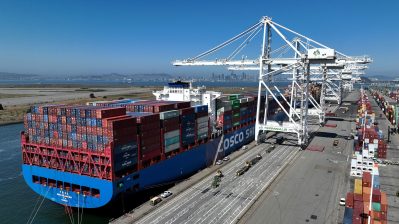
How far your food travels matters a lot less than what kind of food it is, or how it was produced. According to a recent study out of Carnegie Mellon University, the distance traveled by the average American's dinner rose about 25 percent from 1997 to 2004, due to increasing global trade. But carbon emissions from food transport saw only a 5 percent bump, thanks to the efficiencies of vast cargo container ships.

A tomato raised in a heated greenhouse next door can be more carbon-intensive than one shipped halfway across the globe. And cows spew a lot more greenhouse gas than hens, or kumquats, so eating just a bit less beef can do more carbon-wise than going completely local. It's complicated.

But one thing is clear enough: the farmers in Mexico, China, and Brazil, who produce a lot of the imported food Americans eat, are poorer than the farmers here in Iowa. A lot poorer. The corollary of "eat local" is "don't eat Mexican," so to speak. But the way poor people get less poor is to do business with people who have a lot of money, like us. If the local stuff is mouthwatering, you might as well pony up. But if your salad is made with Mexican lettuce, savor your righteousness.

Jagow: Will Wilkinson is a research fellow at the Cato Institute.

Pages

Adam Borut's picture
Adam Borut - Sep 15, 2008

Check out this carbon calculator (includes diet): http://www.ecohatchery.com/calculator. And article on what to prioritize for planning a green meal:
http://www.prweb.com/releases/2008/09/prweb1305454.htm
Am interested in your feedback!

Jordan Stone's picture
Jordan Stone - Sep 1, 2008

I am pleased that the majority of people saw this article as simplistic and very poorly researched. Will seems to be saying that eating local is somehow irrelevant because it matters less ecologically than how the food is produced. Even if the location of production is less important, that doesn't mean it is not still vitally important to the overall ecological health of the globe. A local tomato properly grown has significantly less impact than a foreign tomato properly grown.

Moreover, his argument that buying produce from poor Mexican farmers helps those farmers is horribly shortsighted. Economies of scale are often too focused on the immediate future and unable to see that promoting monocultures dependent on fossil fuels for efficient production is ultimately damaging to all involved. Haiti is a poignant example: the export-oriented agriculture practiced there for many years has, through horrible farming practices, turned the country into a food desert.

I hope that Mr. Wilkinson spends more time researching his journalism before presenting it to the public.

Socratic Gadfly's picture
Socratic Gadfly - Aug 28, 2008

Marketplace apparently doesn't allow HTML tags, so, here's the link to explain HOW Bretton Woods sez you can't tax international food-shipping fuel:

http://socraticgadfly.blogspot.com/2008/04/time-to-tax-international-foo...

Socratic Gadfly's picture
Socratic Gadfly - Aug 28, 2008

Marketplace apparently doesn't allow HTML tags, so, here's the link to explain HOW Bretton Woods sez you can't tax international food-shipping fuel:

http://socraticgadfly.blogspot.com/2008/04/time-to-tax-international-foo...

Socratic Gadfly's picture
Socratic Gadfly - Aug 28, 2008

Uhh, Will?

One BIG monkey wrench in your ideas:

Per Bretton Woods, countries <a href="http://socraticgadfly.blogspot.com/2008/04/time-to-tax-international-foo... TAX</a> fuel used for international food shipments, and I’m sure that would include precluding a carbon tax.

PAUL DANGER KILE's picture
PAUL DANGER KILE - Aug 28, 2008

The folks that pointed out that efficiency does not equal better-for-the-environment (Gary Zenitsky and Dan Rutherford, Ph.D.) are absolutely correct. I stand corrected.

I also appreciate Mark Horn's and Craig Howard's easy-to-understand descriptions.

I am not sure that I understand how the local movement helps downtowns. Money in farmer's hands makes it into downtown businesses, that's for sure. I don't see how it matters where that money ultimately comes from though. Mr. Jorgenson, do you believe that this helps downtowns, because the cost of transport is lower, so profit margins are higher, or am I missing something?

I can't help but think of the Bentonville Arkansas town square. An interesting thing about the Bentonville town square is that it is in between the homes of many of the Wal-Mart Home Office workers, and the Wal-Mart Home Office itself. Wal-Mart executives get to see an example of a town square with successful Mom-and-Pop businesses every time that they drive through. Wal-Mart brings money into the community, and that money gets spent at other local businesses, and hence raises the entire local economy. Bentonville never was a big city during most of its history, it was a true small-town (although that is now changing). So, to paraphrase Mr. Howard, "A dollar in the local economy is still a dollar whether it came from across the street or across the [world]."

Mike Jorgenson's picture
Mike Jorgenson - Aug 28, 2008

Mr. Howard and Mr. Horn-you need to get out of your cities and visit small town America. The re-emergence of small farms, who provide for the local foods movement, have rejuvenated many Main
Streets in the Upper Midwest. The past trend of bigger and more specialized farms growing, in our area, corn and soybeans, profits the likes of Monsanto, Archer and Daniels Midland at the expense of our local economies and the environment. Don't trivialize the effects of the local food movement with your uninformed and opinionated comments.

Daniel Rutherford's picture
Daniel Rutherford - Aug 28, 2008

The argument that food miles don't matter because transport is becoming more efficient is silly. If global emissions from food transport increased by 5% from 1997 to 2004 yet the distance American food is transported increased by 25%, that means that ships became 20% more efficient over that time (round numbers only, here). We missed an opportunity to reduce emissions by 20% just by keeping the 1997 transport distance constant.

A missed opportunity -- to hand off a healthy planet to our grandchildren -- is still an opportunity.

Dan Rutherford, Ph.D.
Staff Scientist
International Council on Clean Transportation

Craig Howard's picture
Craig Howard - Aug 28, 2008

The willful economic ignorance on this thread is astounding. Buying local makes perfect sense when the taste and freshness outweigh any price premium. That's a sensible economic decision. The feel-good blather about keeping money in the local economy, however, is meaningless. A dollar in the local economy is still a dollar whether it came from across the street or across the state. Some of you seem to fear that if you don't buy from the local farmer, no one will. That's true only if he's a very bad one -- in which case I suspect you wouldn't buy from him anyway.

Gary Zenitsky's picture
Gary Zenitsky - Aug 27, 2008

If you want to lie or advance your agenda with statistics, one of the easiest ways is to use percentages. Going from 1 to 2 is a 100% increase, but going from 100 to 101 is only a 1% increase, yet both increased by 1 unit. I haven't seen the study Will cites, but I'm guessing it's rather uninformative to contrast percent increases in miles of food transport with percent increases in tons of carbon emission. A 25% increase in an already big number is huge; likewise with a 5% change in an already tremendous amount. Were we suppose to acknowledge Will's point simply because a 25% change in miles didn't cause a 25% change in emissions? Out-of-season produce purchased in the midwest, even before 1997, came from far away places like California, the Southwest, Florida, and other far away places, traveling hundreds or thousands of miles by big diesel trucks. Compare that to the in season produce found at farmer's markets that may have traveled, say, 30-50 miles and often much less. The massive quantities of food arriving on those super huge cargo ships still have to travel long distances by truck or other freight to reach the midwest. And there's been no mention of the vast resources (land, water, petro-chemicals, energy, etc) gobbled up in far away places that are over-producing for export, trying to feed more and more of the world's growing population that can afford to buy it.

Pages