Cultural training for nurses


TEXT OF STORY
Kai Ryssdal: If you really want to know what’s going on with the economy, you’re going to have to wait ’til Friday. That’s when we’re going to get the May unemployment report. That should give us some sense of what we’re in for.
But slowdown or not, at least one part of the economy is snapping up new employees. The government says 7 out of the 10 fastest-growing jobs are in health care. The need for registered nurses is expected to grow 23 percent over the next 8 years, which is nothing but good news for Youth Radio’s Alyssa Wagner.
Alyssa Wagner: I tell anyone who will listen that I want to be a nurse. When people find out that I’ve been majoring in Chicano/Latino studies, I get some pretty funny looks, but cultural competency is one of the new buzzwords in medicine. Take the University of California at Davis, where I go to school:
Woman: Good afternoon, Chicano and Chicana Studies. This is Leti.
This is the Chicano Studies department. It’s on the other side of campus from the medical school, but Professor Adela de la Torre is bridging the gap by planning a new school of public health that incorporates cultural competency.
Adela de la Torre: It means recognizing that when you enter into a patient encounter that you are not the expert in every domain, that there is an opportunity to learn. If you understand the cultural background, the lifestyle of your patient, you can better treat your patient.
Dorcas Walton is a chief nurse executive at the Kaiser Permanente Hospital in Oakland, California.
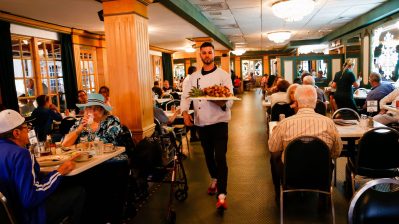
Dorcas Walton: We can have as many as 40-some languages spoken on one of our floors. It brings an international house here to me all the time.
Whether it’s Greek, Arabic or Cantonese, her staff has to be adept at things as complex as medical translation and as simple as knowing when to use eye contact.
Walton: One culture you’re allowed to look the person in the eye and another culture says no, that’s disrespectful. We have to teach our staff how to demonstrate caring for the variety of patients they’re taking care of.
The latest census data shows 39 percent of Californians speak another language besides English at home. It’s part of a larger trend nationwide.
Professor Yvette Flores, who introduced cultural competency to me in her psychology class, describes her “a-ha” moment. It came when she was an undergrad doing mental health work with migrant Mexican families.
Yvette Flores: And it seemed ludicrous to me that I was hired as a Mexican family expert when I was 18 years old and I was not Mexican and I had one course in psychology. That definitely shaped not only the kind of psychologist I became but also the courses that I teach, courses like mental health, psychological perspectives on the family and of course on Chicano psychology. I also teach humanities in medicine.
Humanities in medicine? Sounds strange, but Flores argues that’s where it’s all headed — and I hope she’s right as I get ready to graduate and use my BA in Chicano Studies to transition into a nursing career.
In Davis, California, I’m Alyssa Wagner for Marketplace.
Ryssdal: Alyssa’s story was produced for us by Youth Radio.
Stories You Might Like



There’s a lot happening in the world. Through it all, Marketplace is here for you.
You rely on Marketplace to break down the world’s events and tell you how it affects you in a fact-based, approachable way. We rely on your financial support to keep making that possible.
Your donation today powers the independent journalism that you rely on. For just $5/month, you can help sustain Marketplace so we can keep reporting on the things that matter to you.