27

A fair plan to make college affordable

Robert Reich

To view this content, Javascript must be enabled and Adobe Flash Player must be installed.

Get Adobe Flash player

TEXT OF COMMENTARY

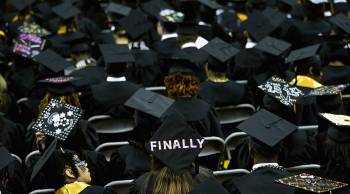
Steve Chiotakis: It's May and for the college crowd, it's graduation time. Cause for celebration, and time for harsh reality. That is, the mountain of debt that's accumulated for those who are finishing up. While repayment can be a big burden, commentator Robert Reich says he has an idea that might make it a little easier.


Robert Reich: The average young person now graduating from college has to repay almost $22,000 of student loans. That's a record, partly because college costs have continued to rise even during the downturn, and because other sources of college funding have taken big hits -- like home equity loans and 529 plans that allowed families to sock money away for college.

But how can a young people repay this much money when the job market is so bad? The law doesn't allow college loans to be discharged in personal bankruptcy.

Even when they do find jobs, college grads have no choice but to take the job that pays the most. They can't afford to do what they might really want to do -- become, say, a social worker or writer or legal services attorney.

Now this problem won't go away when the economy recovers. College debt burdens have been rising for years, and the career choices of many newly-minted graduates are narrowing to those that help repay college loans. We need a new system. So here's my proposal: Any college student can get full funding from the government, with only one string attached. Once they've graduated and are in the work force, they pay 10 percent of their incomes for the first 10 years of full-time work into the same government fund they drew on to finance their college education.

Now maybe that formula will need to be adjusted up or down to cover all the costs. And surely some people will game the system as they do every other one. But the essential idea is that linking the costs of college to subsequent wages makes college affordable to everyone.

And linking repayment to a fixed percent of subsequent wages for a limited number of years enables all graduates to follow their dreams into whatever work they want, without worrying about earning enough to repay a loan. Those who end up in relatively high-paying jobs subsidize those who end up in relatively low-paying ones.

It's fair, it's simple, and good for society as well as the individual. So happy graduation!

Chiotakis: Robert Reich teaches public policy at the University of California, Berkeley.

Pages

Marc S's picture
Marc S - May 26, 2009

Let's focus some effort on encouraging colleges to lower their prices for students, as well as some effort on educating students to choose affordable colleges, rather than take on unaffordable debt.

http://NoSuckerLeftBehind.blogspot.com

Lori Latimer's picture
Lori Latimer - May 26, 2009

That is a great idea, and the only action of the former Administration that made sense. In 2007, there was a change in the Dept of Education regarding those who have chosen public service as a career. 10 years making payments on your student loans without a break; 120 payments while working for the Government, and the balance is forgiven.

This was created for two reasons; 1). many teachers were falling through the cracks when it came to loan forgiveness programs, 2).mainly attorneys who may have a heart for public service, like your article states; had debt that overruled and they left for the public sector. For more information check with Direct Loans - Department of Education.

R Martin's picture
R Martin - May 25, 2009

Robert Reich's proposal is socialistic, pure and simple. It's simply not fair to college graduates who choose to follow more demanding academic paths in order to some day get better paying jobs -- not to mention that those better paying jobs are typically more demanding and require employees to work many more hours per week than the 37.5 to 40 hours required of lesser paid employees in less demanding jobs. Shouldn't the focus of Mr. Reich's article instead be on reducing (or even containing) the cost of college tuition? Of course, that would mean that liberal academia and powerful faculty unions would likely have to make significant financial concessions--something that Mr. Reich would never advocate.

Joe S's picture
Joe S - May 25, 2009

Just a couple of points on this subject:

1. You're increasing the amount of tax that the person has to pay. You just got out of college, you just barely got a job (if you're one of the lucky ones) and now we are going to withhold another 10% of your monthly income on top of what has to be withheld for state and federal income taxes. What a brilliant idea! You'll pay your college loan off but you will barely have enough money for food and a place to live.
2. If Robert's crazy 10% tax idea were to become law, which various religions of the world will trip over themselves trying to say that they came up with the whole "tithing" thing first? Then the liberals will probably denounce Robert's crazy 10% tax idea as a violation of the Establishment Clause of the First Amendment.
2. Don't borrow money, spend that money on something that benefits you and then bitch and moan that you have to pay the money back.
3. Not everyone who wants to be a rock star can be a rock star. Someone has to hang the lights so that people can see you and clean the building after you leave.

Elizabeth Tobias's picture
Elizabeth Tobias - May 22, 2009

I graduated in 1987 with about $5,000 in debt. I went to graduate school, and after a couple years departed without the degree. Whereupon the loan was due. I was unemployed. My B.S. is in Chemistry - this is *not* some "slacker degree". I couldn’t find employment due to my location - and due to being married by then, I couldn’t just up and leave. How is this beneficial to society for me to have been working for minimum wages with a much higher earning potential?

I'm currently in graduate school @ U.Minnesota. Tuition is about $20,000 per year in the School of Public Health. I've got a scholarship covering my tuition - the other people in my department are nervous at the fact they'll graduate with $40k. Why won't I? Because the National Institute of Occupational Health & Safety thinks there should be more people in my profession. They (read: you taxpayers) are paying my tuition. When I go back to the workforce, I expect I'll be making at least what I was 5 years ago when I took a hiatus, which is about $60,000. Not a 'slacker' job, either. Do you think this is a good investment in me?
I will be paying higher taxes and subsidizing your kids’ tuition through government loans made with my tax dollars. I’m perfectly happy with this.

Yes, by all means, head into professions or job which will get you good money. But ... I want someone to teach my children how to write well; how to appreciate music; how to do mathematics. All of which are teachers, and whom are paid pathetic wages.

The argument about “slacker” grades/degrees is fatuous and self-delusional. How is a liberal arts education less valuable to society? It might be less financially lucrative, but it is just as important to have people who can make your movies (Theater), create advertising campaigns for your energy drinks (Marketing), design graphics for your local sports teams (Art), teach your kids math (Education), and write the technical manuals for your iPod (English). [god, I wish someone who wrote English well would write the manual for the last electronic gizmo I bought!]

"Excellent Research University" (as U of Minn claims) - this does *not* equal "excellent teaching institution". Too many people get way too hung up on the name attached to their degree. I will wholeheartedly encourage my kids to attend the local community college for a year or two. It is stupendously less expensive. My experience with Lansing Community College indicates that the quality can be on par with the entry level courses at a big university. Who believes they'll get attention in Chemistry 101 at Mega U? They can at a smaller school. This will also allow the student to shop around for a topic of interest at a much lower price than at Mega U.

Shopping round for a school is a much cheaper way to get educated than simply going where mom/dad went, or going for the brand name. No one is going to care where I got my bachelor’s degree after I get my masters. And, before I went back to grad school, no one cared where I got my bachelor’s degree anyway - I had experience. If kids think they can go straight out of college into a wonder-job with no experience ... then they learned squat for a really high bill.

Keith Willhelm's picture
Keith Willhelm - May 22, 2009

Clearly, an educated populace does benefit society as a whole. That does not mean that we can ignore the fact that vast majority of the benefits derived from a college degree are enjoyed exclusively by the recipient.

There is another issue here as well, and that is the problem with people who feel that they can contribute more to society if only society would underwrite their efforts. We all could do more for others if we had no bills to pay. Who then is left to pay the bills? We do more for society as a whole if each of us, as individuals, make sure we pay our way and then a little more.

On a slightly different tact now, let me say that my daughter is going off to college next fall. She wanted a car. I sat her down and explained to her that her college costs were going to run about $22K/year. "I dont' want a new car," she explained. Buying the $4K "beater" she wanted, however, would have cost her approximately $20K over her college career (and will be essentially worthless when she graduates). With a car, she also would be tempted to incur additional entertainment expenses and perhaps more expensive off campus housing and meal arrangements. I wonder how many people, including the people who compiled Mr. Reich's statistics, would distinguish between my daughter's college expenses and her car expenses. My guess is that the car expenses would be lumped into the category of "college" debt simply because it is debt that will exist upon graduation.

During this same discussion, I also brought up health care. Can we agree that her health care is more important than a car? Yet, she was willing to go into debt to pay for a car without even considering the notion of paying for health insurance.

My daughter is not silly or stupid. On the contrary she is very bright and hard working. She saved almost $13K for college in a year and a half working at minimum wage. She also got some scholarships, so she will not leave college with $80K in debt. Still, she will be in the hole at graduation, so she has to realize that a car and any other life style expenses will drop staight down to the debt column. Call it all "college" debt if you like.

It is our responsibility to teach our young people that life presents choices. You must always consider both sides of the ledger. You can't have a harvest feast if you didn't work the fields all spring and summer.

I don't know yet what she will decide because we all know what a car means to her. But life is not a sprint, it is a marathon, and with or without the car, any investment she makes in her education will give her a better return that a Florida beach house before the bubble burst.

So I tell my daughter what I would tell all you other kids posting comments here today. Thank your lucky stars you are, if not in Texas, in America, get on down that endless highway of opportunity stretching out before you, and stop whining about having to drop quarters along the way.

ed janosko's picture
ed janosko - May 22, 2009

Robert Reich's idea is not new. Yale University proposed this the 60's. It was and still is a flawed idea and not good for society or the individual. Income in society is mostly based on supply and demand. So what society needs (demand) is met by the rewards of that demand. Why should someone strive to work hard and make more money if it will be taken from them to subsidize those jobs (less needed) that pay less? Furthermore these same " producers" will be income taxed more to subsidize the non-producers. Students should do what they like , he says. That would certainly imbalance the work force; We would have an abundance of workers that are not needed and less of those that are if the harder jobs are not rewarded. The problem with Robert Reich is that he thinks that there a few elite people in the government are smarter than the rest of us combined and that governemt subsidy programs will help the econonomy; the entire working population of the US is more intelligent and efficient when left to seek their self good and interest than any policy these "ivory tower professors" can construe.

Scot Celley's picture
Scot Celley - May 22, 2009

I have just graduated from Millersville University of Pennsylvania. I am 49 years old. I am at least $46k in debt, and that will grow as I begin my post-grad work. But considering the alternative - being forever condemned to working for close to minimum wage, zero health benefits, getting no respect from virtually everyone - I urge everyone to not limit yourselves and go back for that new piece of sheepskin.

Dennis Egan's picture
Dennis Egan - May 22, 2009

I think this idea is brilliant, didn't we once think that and educated populace was an asset to us all. I would rather endure a few more potholes in my roads and offer a college education to all children.

Sure it might create more bartenders, waitresses, actors, writers, poets, and artists but it will also make more teachers, social workers, and criminal justice majors. Some of our most important professions are very low payed but the cost of their education is similar to engineers, accountants, and business majors.

Regarding the Federally guaranteed loans, do you have any idea how hard they are to qualify for. I have two kids in college and still don't even qualify for work study much less a guaranteed loan.

Harris Miller's picture
Harris Miller - May 22, 2009

Secretary Reich creative problem solving is usually well ahead of the policy makers. This time, he is behind them. Congress changed the law last year to create an Income Based Repayment plan so students with lower incomes can make lower loan payments on Federally guaranteed loans (though not private loans). In fact, several options already exist to permit students to pay less than the Standard Payment. And forbearances can be granted when graduates are in particularly difficult financial straits. Congress also enacted provisions for full or partial loan forgiveness if graduates choose to pursue various careers that are public service oriented and normally low paying (e.g., some, but not all, teaching positions). More about these options can be found on the US Department of Education website or Finaid.org. Harris Miller, President/CEO, Career College Association.

Pages