
15

Why have we abandoned New Orleans?


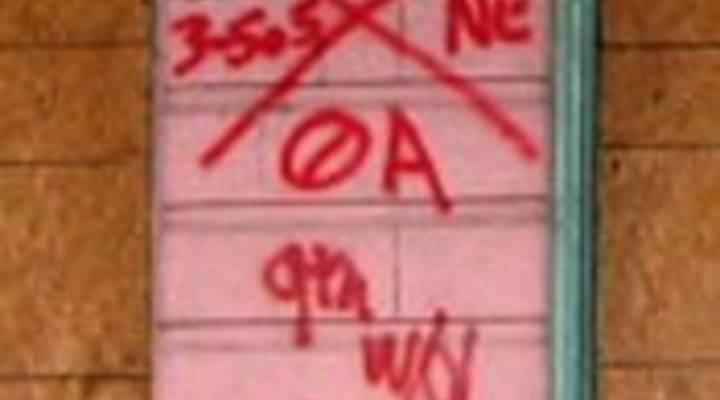
A pink house in New Orleans still displays the X with coded numbers that rescue teams used to indicate when the house was searched and how many bodies were found after Hurricane Katrina. It's a scar that still marks tens of thousands of homes across the city.

To view this content, Javascript must be enabled and Adobe Flash Player must be installed.

Get Adobe Flash player

TEXT OF COMMENTARY

TESS VIGELAND: Some final thoughts on the Big Easy, three years post-Katrina. There are lots of firsts for new visitors to New Orleans like me. The first nighttime ramble down Bourbon Street. The first tastes of gumbo and beignets. The first blast of hot, wet Louisiana air. And today -- if you venture out of the tourist zone -- there's your first heiroglyph. That big X with coded numbers that rescue teams used to indicate when the house was searched and how many bodies were found. It's a scar that still marks tens of thousands of homes across New Orleans.

I saw my first as I was driving north on Elysian Fields Avenue, probably a mile-and-half or so from the French Quarter. It was a bright pink house with turqoise-blue trim. The front doors and windows were boarded up.
A red heiroglyph showed it was inspected on September 11th, 2005 -- 13 days after Katrina.

I kept driving -- past another. And then another. House after house STILL boarded up, STILL marked up. It shocks the conscience to think that it's been three whole years since Katrina, and on this main drag it looks like it's been maybe a month or two.

As I kept driving toward Lake Pontchartrain, I started to cry.

Over the next several days I walked and talked with a dozen New Orleanians trying to re-populate neighborhoods like Gentilly, Mid-City, Lakeview, the Lower 9th Ward. I asked them how they drive through the city day in and day out without crying. "Booze and pills," said K.C. King. He was only half-joking. And then he said: "I guess you get used to it."

I guess the rest of us have gotten used to it, too. We've heard and read so much about how NOLA was back up and running. And the French Quarter? Downtown? Almost like nothing happened. So what I expected -- what I envisioned -- was recovery.

What recovery? Today we're one year shy of the amount of time it took to rebuild Europe after World War II.
And there is nothing resembling a Marshall Plan underway in New Orleans.

I've been tyring to figure out for the last few weeks why I'm so profoundly upset by that. I have no personal stake in New Orleans. I don't have family there. I don't have friends there -- or, I should say, I didn't.
And I remember back three years ago when there were questions about whether to even rebuild the city?
I wasn't sure what the answer should be.

But that's when all I really knew of the disaster was through the hundreds of articles I'd read and the hours and hours of coverage I'd watched on CNN. It's different to walk on that ground that became a lake floor for two weeks. Ground that now boasts cracked sidewalks, potholes and slab foundations engulfed by 4-foot-tall weeds.

Each evening after spending the day out in the neighborhoods struggling to survive, I'd return to the French Quarter to get a taste of the old New Orleans. One night I stopped in for a Sazerac at the famous Carousel Bar, and I struck up a chat with my stool mates. It was a young couple visiting for the weekend from Northern Louisiana. I was sharing some of these same observations with them when the husband looked at me and said, "They chose. They chose not to have the proper insurance," he explained. "They chose to live in a bowl."

It is so vastly more complicated than that. But there's the sentiment -- even from a fellow Louisianan. It goes a long way toward explaining why three years later we have collectively abandoned New Orleans. And, why those who chose to return remain pioneers in their own city.

About the author

Tess Vigeland is the host of Marketplace Money, where she takes a deep dive into why we do what we do with our money. Follow Tess on Twitter @radiotess

Pages

P west's picture
P west - Apr 8, 2009

Hey Robert how much of it is your tax dollars people in louisiana do pay taxes also how about we make it where every state has to get there own gas and oil from there own state you might be suprised how much you would have to pay for that gas

M. Lee's picture
M. Lee - Sep 4, 2008

This is unfortunately one more reason why our hope should not be in the federal government. It was sad to listen to city officials before Gustav, little responsibility was put on the individuals. As someone who was in Louisiana a week after Katrina doing relief work and helping families get help and housing, I see that there are numerous issues involved here but it seems really clear, the first step is that people need to take responsibility for themselves first. Contrary to what Obama says, the government is not your friend. Don't depend on it like you would a friend.

Ed Gaines's picture
Ed Gaines - Sep 1, 2008

Re: Robert Culp's post:
I'm always gratified to hear someone from a farm state, particularly one so heavily dependent upon federal agricultural commodity subsidies for corn and soybeans, call for an end to propping people up with tax dollars. It's particularly gratifying, given that grain and soybean production in the midwest is only viable economically because those products can be shipped down-river via barge to (drum roll, please) New Orleans and other Gulf of Mexico ports, whence they can be exported.

Now if Mr. Culp and his fellow Iowans will also agree to give up the federal relief dollars they're slated to receive for this year's massive floods in that state, and promise to abandon all those towns, farms, and businesses situated in the flood plains, I think we can probably get some sort of monument erected to honor him and his corn state brethren for their lack of hypocrisy.

Sally Southerfield's picture
Sally Southerfield - Aug 29, 2008

Hey Robert (Culp).... do you tell the feds to STOP paying the TRILLIONS that have been doled out in welfare? Do you tell the feds that we shouldn't have spent the hundreds of billions in Iraq? (and I by NO MEANS am some bleeding heart --and I AM a big supporter of our military--I'm just pointing out your incredible HYPORCRISY! The amount of YOUR MONEY being spent here is so piddling as to render you so despicable as to make the old Ebenezer Scrooge a downright teddy bear! Perhaps you should be able to TELL the government EVERYTHING we do NOT want done with "OUR MONEY". You, sir are heartless, inconsiderate, and VERY selfish!

Robert Culp's picture
Robert Culp - Aug 28, 2008

It is not the Governments duty to rebuild that city. New Orleans has Gustov lining up on it right now. Leave that place, it's too low and in the path of huricanes. Use some intellegence and say "I'm outta here". Anyone deciding to stay there should be required to prove they can take another huricane and not have to ask the Government for a dime. Those are my tax dollars they are giving away to irresponsible people and I don't like it. Get over it. The city is no longer a place to live. Stop waisting my money.

Steve Herrington's picture
Steve Herrington - Aug 27, 2008

I am truly sympathetic to the plight of the citizens of New Orleans. But, I don't want to continue to pay with my tax dollars for the maintenance and restoration of a city that should never have been built on its present location, and that will become even more vulnerable as climate change progresses. It's not, in my mind, a question of if it will happen again in New Orleans, but when. And, with the sorry record of the federal government (notwithstanding 'Brownie's heckuva job') and the Corps of Engineers, why should anyone believe anything will be different next time a major storm scores a direct hit? We'll just be paying for it once again...

kAREN kIEFABER's picture
kAREN kIEFABER - Aug 25, 2008

Wonderful story. Just reading it stirs up so much in me. The city is magical with history, culture and the people. New Orleans matters, but more importantly, people matter. Thank you for sharing your journey Tess........

Robert Ali's picture
Robert Ali - Aug 24, 2008

Very good story on New Orleans. Many asked why things were'nt acomplished by now and everything else. Here is my opinion, the entire flood zone, except trees, should be completly cleaned up and turned back into what it was a hundred years ago. Unless your house can withstand 200 mile an hour winds and is 10 feet or more above ground, do not bother to rebuild. It will happen again. What should be done is organized zones with post offices schools hospitals etc should be built in small managable sections. On high ground. Finaly their be one competent individual in charge, does not have to be an engenneer or an architect, simply have common sense, vision and the right personality to get things done. Remember Walt Disney,Howard Hughes or the african american gentleman that designed the dome at Lax? Someone like that. Finaly it is all about the people, Societies can be judged, how they treat their animals. And we really let them down abandoning dogs cats as if they were objects will be forever etched in my mind, no sympathy for those who stood by and did nothing.

Maria Carlos's picture
Maria Carlos - Aug 24, 2008

I want to thank Tess Vigeland for her essay on New Orleans. I visited NOLA for the first time last March, and had the same reaction as she, including crying by the end of my first day of touring. Thank you for articulating my thoughts and feelings. What can we do now?

Kim Stone's picture
Kim Stone - Aug 23, 2008

I, like Tess, just got back from a trip to New Orleans. Actually it was a mission trip with my church to Lafitte, LA which is about 20 miles south of N.O. Since I am a video producer, I interviewed the people we were working with, as well as others 2 hours west. No one seems to mention how, another monster storm, Hurricane Rita came along 3 weeks after Katrina and dumped 6 or more feet of
mud in their houses. 3 years later they are not only waiting for government to raise their houses, but many have been ripped off by dishonest contractors who took their money and ran. I came away feeling the same as Tess... these people have been completely forgotten. The problems do not exist only in the city of New Orleans...they are widespread throughout all of Southern Louisiana... and beyond! The people I met will stay with me the rest of my life.

Pages







