6

GM CEO ousted in 'change of direction'

The General Motors world headquarters building in Detroit, Mich.

To view this content, Javascript must be enabled and Adobe Flash Player must be installed.

Get Adobe Flash player

Austan Goolsbee, senior White House economist and member of the Obama administration's automotive task force.

TEXT OF INTERVIEW

Tess Vigeland: OK, so it's a little more complicated than that and President Obama won't actually be running General Motors. But Chrysler and GM have had months -- some would argue years -- to figure out how to have a future in the world auto business. They've had a mandate -- since accepting billions in taxpayer bailout money in December -- to come up with a plan. Or else. Well today the president announced it was time for the else.

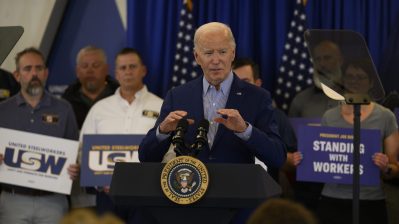
BARACK OBAMA: Now we cannot continue to excuse poor decisions. We cannot make the survival of our auto industry dependent on an unending flow of taxpayer dollars. These companies and this industry must ultimately stand on their own, not as wards of the state.

Rick Wagoner is out as CEO of General Motors. The administration gave Chrysler 30 days to work out a merger with Italy's Fiat. Meanwhile the administration said the government will back all warranties issued by the automakers. Joining us with some more details is Austan Goolsbee, a senior White House economist and also a member of the administration's automotive task force. Welcome back to the program.

AUSTAN GOOLSBEE: Thank you for having me.

Vigeland: Now the White House has said it was dissatisfied with GM and Chrysler's progress in turning themselves around. What are they not doing?

GOOLSBEE: Well, in the plans they presented they embraced some of the restructuring that they are going to need to do. But if you sat down and look at the numbers, what the auto team believed is that they had not presented a plan that was truly viable to make them a profitable enterprise going forward.

Vigeland: What went into the decision to ask for the resignation of GM CEO Rick Wagoner?

GOOLSBEE: Well, the basic view that the president has had is that we need a change of direction. They need a new vision for the company. The government just can't afford, as the president said, we're not going to make these companies wards of the state to just keep them alive no matter what. The government can help them to restructure, but it's not going to be in the business of running an auto company.

Vigeland: Now, I have to ask you because this is a question on lots of people's minds today. Why was Mr. Wagoner forced to leave but the chiefs of Bank of America, Citibank, they're still in charge of their companies.

GOOLSBEE: Well, I would say two things. One this is a situation in which we've had one round in which the auto companies received money to come up with restructuring plans and those restructuring plans did not go far enough. And now the president is outlining that they need to be more aggressive in their restructuring plans, and there needs to be new leadership and a new vision of where these companies are going. In many of the financial institutions, you have seen changes of leadership. At AIG, at Fannie, at Freddie, and at some of the others, so I guess I don't agree that it's really a distinct approach.

Vigeland: There are lots of auto dealers and parts suppliers who are pretty concerned about the changes at GM over the weekend. What can you tell them?

GOOLSBEE: Well, in the last week or two the government has recognized what the issues are facing these companies in restructuring and so it came out with an explicit support program for suppliers that would guarantee their payments in a variety of circumstances, so they would not be nervous about providing supplies to the domestic auto manufacturers, even if they were going through a restructuring. And you saw the president announce we're putting the full weight of the U.S. government behind the warranties, the consumer warranties for these cars, and taking a series of other measures, that people should not view this as the end but instead as the beginning. That the effort is to try to put these companies on a path of viability, as opposed to becoming wards of the state that are just going to have to depend on tax-payer dollars to live.

Vigeland: Austan Goolsbee is a senior White House economist and also a member of the administration's automotive task force. Thank you.

GOOLSBEE: Thank you.

S.J. Phred's picture
S.J. Phred - Apr 1, 2009

It wasn't that long ago, that people didn't want large cars, except for status. You couldn't park a large car in the city, where you went shopping, and you didn't want to make lane changes on the highways, where the speedlimits were not limited to 55mph.

Of course, both factors changed--the speed limit went to 55 to save fuel, and stores moved out to where we had put our houses far away from where we worked. And Chrysler had gone into bankrupcy.

Chrysler came out with a new invention--the minivan. It had easier access than a sedan or station wagon, and could be built on a front wheel drive chassis. When it became a status symbol among those who used to drive Volvo station wagons with "Baby On Board" triangles, competitors made their own minivans--including the Japanese, who had a reputation in the world's biggest consumer market, for better quality products.

How could Detriot pull ahead? One thing it built better than other competitors, were large trucks. SUVs are built from that, so a new advertising campaign convinced the consumer that, bigger was better. It worked for Chrysler's new product, the macho Ram pickups that looked like big rigs. And it sold people that heavy SUV's could survive accidents--well, with other vehicles. High rollover rates were never really discussed until Ford Explorers seemed to keep having this problem. Then, consumer desire started to lag.

Big to small is not a new trend. In 1955, GM built smaller family cars, and the sales result was so hugh, they began to ladel on the chrome and options, until they needed bigger engines, which required bigger cars to handle the engines. By 1958, the cars were big and sales lagged.

By 1964, GM cars were small again, and sold well. By 1968, they were big again. In the 70's, they were hugh, only to shrink down again.

Take a look at the economy cycle during these years. Coincidence?

Richard Cole's picture
Richard Cole - Mar 31, 2009

re: Forces outside of their control 1) Are GM, Ford and Chrysler responsible for hamburger flippers being given $400K loans on McMansions? I.e. the "sub-sub-prime debacle"? 2) Are GM, Ford and Chrysler responsible for the naked credit default swaps? 3) Are GM, Ford and Chrysler responsible for the idiots st NHTSA and EPA that change regulations in the middle of a model run, forcing the copmpanies to spend extra billions on re-tooling? Point is that government blunders put the economy in a tailspin, making it hard for anyone to sell cars. re: B.O. and the other idiots in the current administration telling GM and Chrysler they can only make "the cars B.O. and his ilk want the public to want". Under Jon Smith's plan only Hollywood celebrities and the bankers of Richistan will be able to affors family-sized vehicles, and they'll be forced to buy Honda's, Toyota's and Mercedes' gargantuan SUV offerings.

Jon Smith's picture
Jon Smith - Mar 30, 2009

It won't hurt GM to have a new boss, but the biggest help the government could send would be to raise the gas tax a dollar a gallon - to quit subsidizing cheap gas and to tell GM how big a car they can build. Here's the thing: Joe Sixpack drives the biggest barge-size pickup he can afford, and his wife drives the biggest living room-size SUV she can afford, all of which size is determined by how much they want to spend on gasoline. GM knows just how to build those cars and pickups, and has made a fortune over the years just catering to those customers. At the moment, everybody is wondering if cheap gas is coming back, and waiting to see how big a car they can afford. If we raise the price of gas a buck, we take away the uncertainty and fix the roads and bridges to boot. Joe Sixpack isn't dumb; he'll adjust. He'll never spend $30,000 on an electric; he'll just know how big a car he can buy under the circumstances, and GM will flourish once again!

Tom Shillock's picture
Tom Shillock - Mar 30, 2009

The Detroit car companies are insolvent (like the major banks) but putting the former into bankruptcy would be too messy to be politically tolerable. Obama is playing some kind of game, perhaps trying to distract us from the Geithner / Bernanke / FDIC bailout of bankers and their creditors and the fiction that they not insolvent. Perhaps Obama wants to posture as tough on corporate mendicants? If nothing else, the difference in treatment, Wall Street versus Detroit, shows how the interest of the Democratic Party has diverged from its rhetoric.

Dave Neil's picture
Dave Neil - Mar 30, 2009

I love the idea that the big automakers are suffering from 'forces outside their control'; they've had 35 years to re-jigger as the planet warms, and becomes more crowded. This is also not the first bail-out. Time for a change.

Richard C's picture
Richard C - Mar 30, 2009

Somwhow I doubt that Mr. Obama, Mr. Goolsbee, or any of the other members of the White House Auto Task Force could run a successful shoe shine stand, especially if forces outside of their control were constantly increasing their costs and suddenly caused their business to drop 50%.