3

Banks will likely need cash to make it


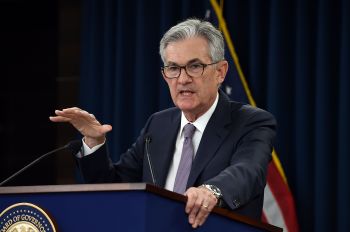
Federal Reserve Chairman Ben Bernanke testifies before the Joint Economic Committee on Capitol Hill -- May 5, 2009

To view this content, Javascript must be enabled and Adobe Flash Player must be installed.

Get Adobe Flash player

TEXT OF STORY

Bill Radke: The chair of the Federal Reserve told Congress this morning he expects the U.S. economy to bottom out and then improve later this year -- here's a big if -- if the financial sector continues to mend. Ben Bernanke said even after recovery begins, unemployment will stay high and economic activity will grow slowly. That's likely to keep inflation in check, and keep interest rates right down with it.

Behind the scenes today, federal regulators are supposed to tell banks how to get on the stress tests. The rumor mill says at least half of them will need more cash to make it through the fallout. Tamara Keith reports.


Tamara Keith: Along with the names we've already heard, like Bank of America and Citigroup, Wells Fargo and Regions Financial of Alabama are also reportedly on the list of banks in need of a better buffer.

Jane D'Arista is a political economist at the University of Massachusetts Amherst, and she has some ideas about how the banks should raise the cash they need:

Jane D'Arista: I think that the government should put the pressure on them to begin selling businesses and parts of their conglomerates in the way that Citibank sold off its Japanese securities operations recently.

She thinks another taxpayer bailout would be a very bad thing.

White House Press Secretary Robert Gibbs said yesterday the administration doesn't plan to go to Congress for more money:

Robert Gibbs: I think everyone involved will be looking for banks to raise this through either private means or the selling of some assets.

The test results are scheduled for public release on Thursday -- after the markets close.

In Washington, I'm Tamara Keith for Marketplace.

Martyn Strong's picture
Martyn Strong - May 5, 2009

Capital markets are unstable. In the past there was no way to make them stable. But today we have computer power that can be used to make them stable.

By using the greater computer power of today we can have a much higher turn over of capital in the capital market. This higher turnover will make the market harder to game or control and the market will no longer have the unstable run ups or declines. Who can change or control the market when say 20% of the capital is trading each day?

So now that we have the compute power to provide for all these transactions that will smooth out the market how do we force people to turn over at a rate of 20% a day? Easy, put a cap gains tax of 0% (zero) on all gains of 7 days or less and put a cap gains tax of 90% of all gains of more than 7 days.

The likes of Yahoo, Micosoft and/or Sun Micro Systems will give us the systems that will provide automated software agents to support turning over one's investments every 7 days (based on the specs you give the agent).

A system like this will make the financial markets work as smoothly as the local fruit market.

Martyn Strong's picture
Martyn Strong - May 5, 2009

Capital markets are unstable. In the past there was no way to make them stable. But today we have computer power that can be used to make them stable.

By using the greater computer power of today we can have a much higher turn over of capital in the capital market. This higher turnover will make the market harder to game or control and the market will no longer have the unstable run ups or declines. Who can change or control the market when say 20% of the capital is trading each day?

So now that we have the compute power to provide for all these transactions that will smooth out the market how do we force people to turn over at a rate of 20% a day? Easy, put a cap gains tax of 0% (zero) on all gains of 7 days or less and put a cap gains tax of 90% of all gains of more than 7 days.

The likes of Yahoo, Micosoft and/or Sun Micro Systems will give us the systems that will provide automated software agents to support turning over one's investments every 7 days (based on the specs you give the agent).

A system like this will make the financial markets work as smoothly as the local fruit market.

Robert Mondavi's picture
Robert Mondavi - May 5, 2009

What happened to the PIPP (I hope I got the acronym right..) So I guess that no longer will be needed..I just can't get my head around the fact that it seems there is already a turnaround in the economy (without any action..may be that stimulus package..but isn't that was not effective up to now..). I just feel like total stupid in spending countless hours going through various economic discussions..what went wrong..how the wall street will change..why the banks should become boring..what are the fundamental issues in US economy etc. etc.