45

Credit card companies are watching you


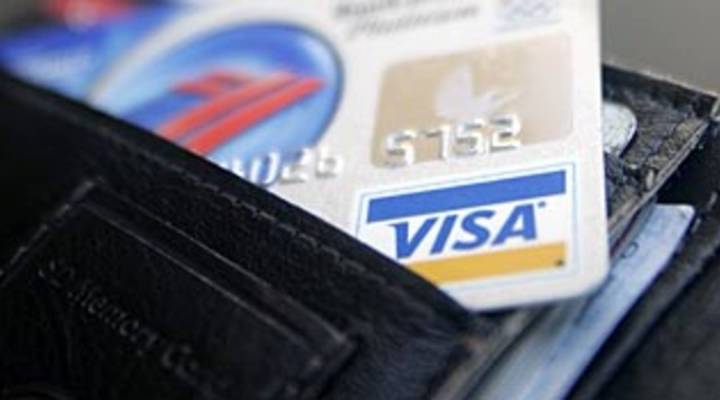
Visa credit card in wallet

To view this content, Javascript must be enabled and Adobe Flash Player must be installed.

Get Adobe Flash player

TEXT OF STORY

Kai Ryssdal: Not all that long ago credit-card companies were looking for reasons to give us credit. As we all know now, it didn't take much to get a shiny new piece of plastic in your wallet. But with credit-card defaults rising, those companies have started looking for reasons to take some of that credit away. To help them figure out how, banks are compiling thousands of bits of data, like what you buy, where you buy it, sometimes even the company you keep. As Marketplace's Stacey Vanek-Smith tell us, your credit card is watching you.


STACEY VANEK-SMITH: So, two guys walk into a bar, have a few drinks and split the bill on their credit cards. One guy's unemployed and in serious debt. The other has a job and pays all his bills on time. The joke is actually on both of them. Those drinks may have just cost them their credit.

Robert Manning is the author of "Credit Card Nation." He says the first problem the card company sees? Booze. Especially if you don't usually put margaritas on your Mastercard.

ROBERT MANNING: Alcohol might be a red flag that you're despondent because you're about ready to get laid off from your job.

And splitting a bill with the unemployed debtor makes the employed guy look bad to his card company. And that's just the beginning. Say Mr. Good Credit rewards himself with a rare trip to the spa?

MANNING: And get a massage, red flag.

His card company might think he's trying to relax because he's stressed about money. And what if he decides to go bargain hunting?

MANNING: Oh my gosh, maybe you're about to lose your job. You're starting to downscale to lower-cost stores.

So, if you start splurging, it looks bad, and if you start scrimping it looks bad. Welcome to the post-credit-crisis world of risk management. Where your card company watches everything you do and then tries to figure out how likely you are to pay your bills.

Analyzing that information is called data-profiling, and it's a $25 billion business. One of the biggest players is Equifax. Tom Madison works in the company's mortgage division. He says business is up 50 percent over last year.

TOM MADISON: The general direction that the financial industry is taking is towards a place where the data they use to render their conclusions about credit worthiness is the heart and soul of everything that they do.

Madison says banks want more data and more kinds of data than ever. Peter Harvey is the CEO of Intellidyn. It uses data profiling to help companies market their products.

PETER HARVEY: Twenty years ago, you could get age, income, home ownership. Today, you can get thousands of variables. Now it sounds ominous but think about the amount of transactions that are online today.

Harvey plugs all those bits of information into intricate models, which examine your past actions, figure out what makes you tick and then predict what you will do. He could look at our upstanding bill payer and figure out where he wants to spend his next vacation.

HARVEY: It's knowing that their next trip was going to be a river cruise in France. What type of boat, what type of amenities.

Harvey says banks are some of the most sophisticated data profilers around and, they're very secretive about it. Regulators have brought some things to light. The Federal Trade Commission recently filed a suit against CompuCredit, which marketed the Visa Aspire card. Reilly Dolan was on the litigation team.

REILLY DOLAN: Compucredit was reviewing how consumers used the credit card, and it would lower the available credit to consumers based on their transactional history.

Things that branded card-users as risky: going to a bar, a marriage counselor, getting tires re-treaded, buying something off of an infomercial. That's right: your 2 a.m. Snuggie breakdown could cost you your card. Which sounds pretty heavy-handed, I mean, sometimes a Snuggie is just a Snuggie, right? NYU economist Lawrence White.

LAWRENCE WHITE: For some individuals, it will not be an adequate representation of their true credit worthiness. That's unfortunately just the nature of the statistical exercise.

White says the banks would rather risk cutting the credit of our upstanding bill payer than having another default on their books.

So the next time two guys walk into a bar, they should probably think about walking to an ATM first.

I'm Stacey Vanek-Smith for Marketplace.

About the author

Stacey Vanek Smith is a senior reporter for Marketplace, where she covers banking, consumer finance, housing and advertising.

Pages

Tyler Massicotte's picture
Tyler Massicotte - Apr 23, 2010

Credit cards get scammed everyday , but they also pay alot of your products in your household.

S Graeme's picture
S Graeme - Apr 10, 2010

All those bills we spend have serial numbers on them. Does anybody really think that cash can't be tied to you with just a little application of technology. 1984 is here.

Peter Mehit's picture
Peter Mehit - Aug 19, 2009

Ross,

Tying two employees together is simple, really.
a. they both work at the same company
b. they had transactions near the same point in time
c. the transactions were at the same place.

Corporations and law enforcement have been doing this for years to figure out who was in and out of drug and crime syndicate stuff.

Cash is the only answer. The government knows almost everything you do. Including posting here. (see PATRIOT Act).

Thomas Jefferson's picture
Thomas Jefferson - Aug 5, 2009

By Paul Zink
From Gloucester, MA, 07/08/2009

"Free enterprise" Republicans don't want socialism in the form of government-supported health care. But corporation-run fascism in the form of dictating our behavior, as above? Well, THAT'S just the American way!
————————————————————

The Goddamn banks are trying to take over the country. They couldn't get every sucker to invest in their worthless derivatives so they TOOK THE TREASURY HOSTAGE and extorted money from the TAXPAYERS.

GOD DAMN THESE FASCIST BASTARDS.

USE CASH

SCREW CREDIT. IF YOU CANNOT AFFORD IT NOW YOU SHOULDN'T BE BUYING IT AT ALL.

"I believe that banking institutions are more dangerous to our
liberties than standing armies. If the American people ever allow
private banks to control the issue of their currency, first by
inflation, then by deflation, the banks and corporations that will
grow up around [the banks] will deprive the people of all property
until their children wake-up homeless on the continent their fathers
conquered. The issuing power should be taken from the banks and
restored to the people, to whom it properly belongs."
- Thomas Jefferson (1743 - 1826), Letter to the Secretary of the Treasury
Albert Gallatin (1802)

Tiff Brotheridge's picture
Tiff Brotheridge - Jul 24, 2009

My instincts tell me this story is a load of @#@%. I am not buying it. Selling paranoia is never a good thing to do. There is enough stress out there, guys.

ImNotaWitch At All's picture
ImNotaWitch At All - Jul 21, 2009

Are you shieting me? Now the credit card companies are big brother? What about debit cards?
Cash is the only answer.

Don Jackson's picture
Don Jackson - Jul 13, 2009

It's laughable. I paid CASH for a 2009 Mercury Grand Marquis two months ago, but charged a new mattress and box spring last week, and will pay the card company in full when they send a bill. Do I care what the credit card company knows or thinks they know? Have I ever bothered to check my credit score? One guess. If they're stupid enough to cancel my card, I can pay by cash til the cows come home. Let them profile THAT!

Mark Taylor's picture
Mark Taylor - Jul 13, 2009

I always pay cash. The cc companies don't like me, and I don't like them. That wasn't always the case. But about 5 years ago they started changing the terms on their end not for payment history issues, but some computer model some genius created to screw consumers. So the nation decided to change the deal on our end and quit paying them. So now they have an even bigger genius with an even more ridiculous computer model to screw more people. And they can't seem to figure out that it doesn't take a genius to know that if you screw people you'll put yourself out of business. America, ditch the plastic and pay cash. Then we'll be back in control. It's that simple.

Michael Covington's picture
Michael Covington - Jul 12, 2009

I think you have swallowed a hoax, or at least a wild speculation. You have certainly not given us any reason to believe it, except "some guy says" -- the "guy" being Mr. Manning, who is now promoting "debt relief," which is some scheme for not paying your bills in full. At least read his web page.

As far as I can determine, merchants do not report the details of purchases to credit cards. Please check your facts. Or is it July Fool's Day?

Tom Wyrick's picture
Tom Wyrick - Jul 11, 2009

Ross,

I think the point was, credit card companies are starting to invest in complex computer databases (either their own, or paying other firms who specialize in this type of data processing and analysis?), so they CAN start cross-referencing purchase information. If you went to a bar with your unemployed buddy and split the bill, they wouldn't KNOW for sure it happened that way. But it wouldn't be hard to see that both cards were run back-to-back, within a very short time between each other, right? If this went on several times (because you are friends, after all, and presumably hang out together somewhat regularly), a data-mining firm could correlate both of your names with sets of charges made at bars within 5 minutes of each other, and flag it as a pattern.

It's this same technology that they're using to pick up on the other stuff (like customers suddenly shopping at discount stores). It's too labor intensive to have humans pore over all the transactions to figure out these changes in buying habits. All of this comes from computer software.

Pages